








India has one of the youngest populations in the world, yet unemployment and underemployment continue to pose serious challenges. With millions of youth entering the workforce each year, the employability gap—caused by limited access to quality education, skill mismatch, and lack of exposure—continues to widen. In rural areas and among women, the challenge is even more severe.
This is where employment-focused CSR in India plays a transformative role.
Mandated by the Government of India and regulated by the Ministry of Corporate Affairs under the Companies Act, 2013, eligible companies are required to spend 2% of their average net profits on CSR activities. This CSR 2% rule, job creation through CSR – allowing companies to build scalable livelihood programs that deliver quantifiable results and create enduring social and economic value—moving CSR from one-time support to lasting transformation.
While CSR spans sectors such as health, education, and environment, employment generation remains one of the most sustainable and scalable priorities. Strong alignment between CSR law India, employment through CSR initiatives enables companies to invest in skill development, vocational training, entrepreneurship support, and livelihood creation.
Employment-focused CSR reduces poverty, strengthens economic resilience, promotes gender inclusion, enhances community stability, and improves ESG performance. It empowers individuals to become economically independent contributors, ensuring that CSR investment fuels long-term inclusive growth rather than short-term relief.
When executed with clear strategy and accountability, employment generation moves beyond being a CSR initiative—it becomes a catalyst for sustainable development, enabling economic independence, strengthening community foundations, and accelerating India’s long-term growth journey.
Why Employment Generation Matters in India.
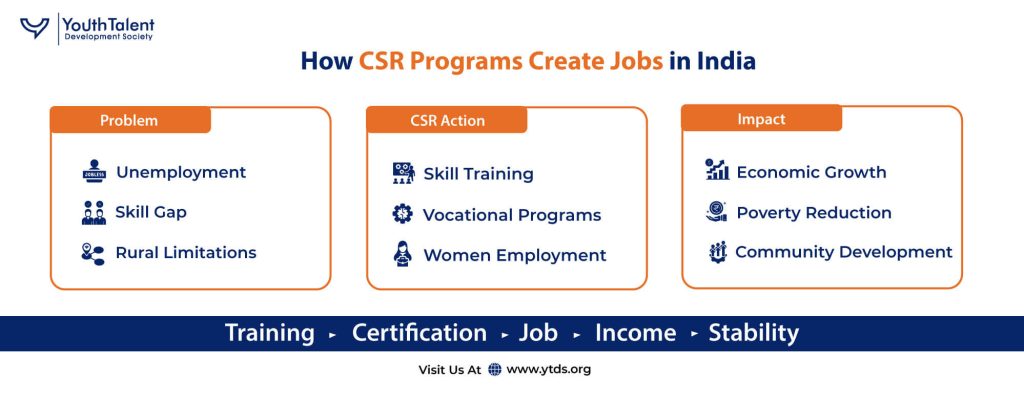
Employment generation plays a vital role in driving inclusive economic development and maintaining social balance. When people secure stable income opportunities, families move out of poverty, consumption increases, and local economies become stronger and more self-reliant. In a developing nation like India, the multiplier effect of job creation extends beyond individuals—it uplifts entire communities. This is why CSR employment generation India has become a strategic priority for inclusive development.
In India, youth unemployment remains a critical issue. Many graduates enter the market without practical job-ready competencies and rural populations often have limited exposure to formal employment pathways. Women, especially in semi-urban and rural areas, face additional barriers such as limited educational access, and mobility restrictions. This makes focused efforts around CSR youth employment and CSR women employment essential for equitable progress.
Strategic corporate interventions can significantly bridge these gaps. Through well-planned rural employment CSR programs and scalable livelihood generation initiatives, companies can:
Providing industry-aligned skill development training
Generate sustainable income opportunities in rural and semi-urban regions.
Promoting women entrepreneurship and self-help groups
Supporting micro-enterprises and local businesses
Such initiatives also align with global development priorities, particularly Sustainable Development Goal 8: Decent Work and Economic Growth. By focusing on job-oriented CSR projects, corporates can simultaneously drive social equity and economic progress.
Unlike short-term awareness drives, employment-focused CSR delivers trackable results —certified trainees, job placements, improved household incomes, and long-term empowerment. For corporates, this translates into stronger ESG performance, credible impact reporting, and deeper stakeholder trust—proving that employment generation is both a social necessity and a strategic investment.
CSR Law & Employment Generation
Under the Companies Act, eligible companies must spend 2% of their average net profits from the preceding three years on CSR activities. As per the Ministry of Corporate Affairs, employment and skill development initiatives fall within approved CSR categories, making CSR employment generation compliance both valid and encouraged under Indian regulations.
CSR funds can be allocated to skill development and vocational training under CSR guidelines India, skill development.
Livelihood enhancement and rural development initiatives are recognized under Schedule VII of the Act.
Rural development initiatives that create sustainable income opportunities qualify.
Women empowerment and entrepreneurship initiatives are permitted.
Companies may implement projects independently or through registered NGOs.
To ensure smooth compliance, companies must:
Maintain proper documentation and financial records.
Clear impact measurement
Compliance with reporting requirements
Partner with credible implementation agencies
Employment-oriented CSR projects are fully compliant when they focus on sustainable livelihood creation rather than commercial profit generation for the company. This makes job-oriented CSR not just impactful—but legally sound and strategically beneficial , By aligning social impact with regulatory requirements, companies can ensure full legal compliance while contributing meaningfully to economic inclusion—making job-oriented CSR both impactful and strategically sound.
Best Practices in CSR Employment Projects.
Corporates aiming to scale CSR employment generation India should focus on well-designed, result-driven implementation models. Employment-led CSR becomes more effective when it balances market demand, grassroots engagement, and strong monitoring mechanisms.
A core strategy is expanding CSR skill development programs that are closely aligned with industry requirements. Corporates can partner with training institutes or implement NGO employment programs to provide certification courses in retail, healthcare, digital marketing, logistics, and manufacturing. For example, companies in the renewable energy sector can sponsor skill academies that train youth in solar panel installation and maintenance, leading to higher placement success.
The most successful initiatives share three key elements: relevance, partnership, and measurable outcomes.
1. Market-Driven Skill Development
Corporates can structure training initiatives around current industry requirements such as retail operations, healthcare assistance, digital services, supply chain management, tailoring, and beauty & wellness. By aligning curriculum with actual employer demand, corporates significantly improve employability outcomes and placement success rates.
2. Women-Focused Livelihood Initiatives
Supporting women through self-help groups, micro-enterprises, and home-based businesses creates dual impact—economic growth and social empowerment.
3. Rural Livelihood & Agro-Based Projects
Skill training in food processing, handicrafts, dairy farming, and agro-entrepreneurship strengthens rural economies.
4. Digital & Gig Workforce Enablement
Teaching digital and platform-based skills enables young individuals to build careers beyond traditional jobs, giving them access to new-age earning opportunities.
5. Strong NGO Partnerships
Companies partner with credible NGOs to manage on ground execution , oversee impact tracking, and streamline community outreach and mobilization of beneficiaries.
Practical actions corporates can implement include:
Linking training programs directly to placement partners to ensure smooth job placements and faster employment opportunities for beneficiaries.
Include soft skills and financial literacy along with technical training. Teach communication, teamwork, and workplace behavior, while also guiding participants on budgeting, savings, and managing income wisely. This builds confident, job-ready, and financially responsible individuals.
Provide job placement assistance or connect beneficiaries with reliable market opportunities.
Monitor sustained income improvement and career progression over time.
Establish guidance and mentorship channels with experienced professionals and sector specialists.
By prioritizing scalable models, partnerships and clear impact tracking, corporates can transform CSR investments into sustainable employment ecosystems that deliver both social value and business credibility.
Case Studies: CSR Projects Creating Jobs in India
Employment- led CSR initiatives across India demonstrate how well-planned interventions can create meaningful livelihood opportunities and drive inclusive growth. These real-world examples illustrate CSR employment generation India in action— where structured training and partnerships translate into sustainable income pathways.
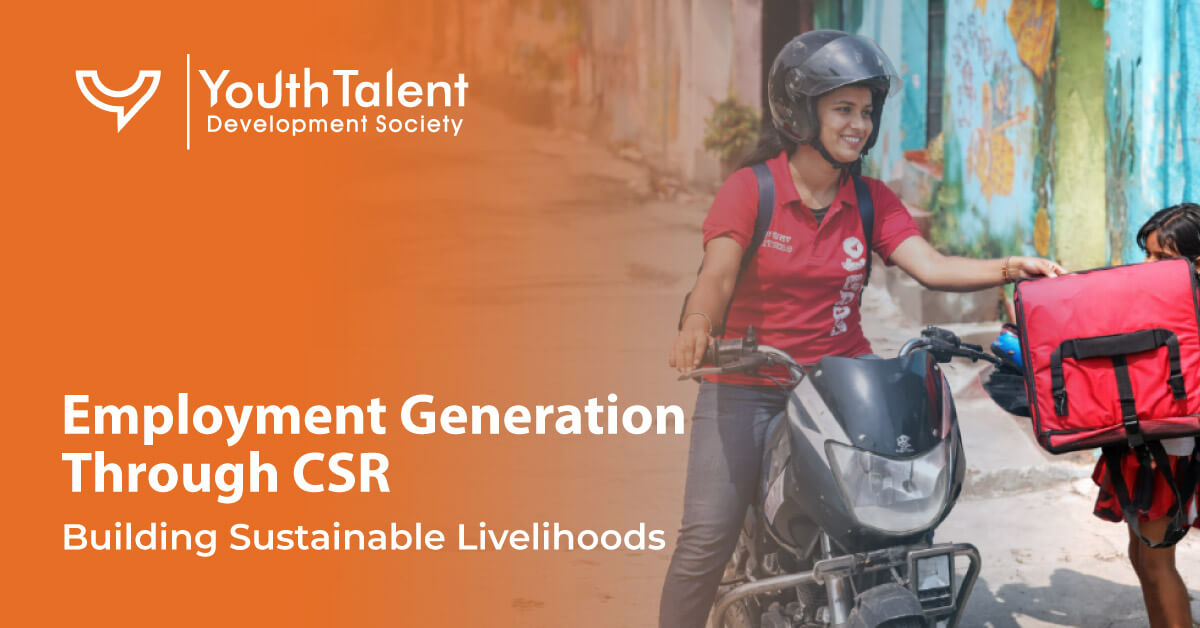
One notable example comes from (YTDS), an NGO committed to empowering youth and women through employment and skills-based programs. In collaboration with partners like Zomato, YTDS launched a drive to onboard women as delivery partners across cities such as Pune, Mumbai, and Bengaluru. Through this initiative, over 150 women have been onboarded, enabling them to become financially self-reliant and actively participate in the workforce—contributing to CSR job creation India by integrating marginalized groups into formal earning pathways.
Beyond urban employment, YTDS has implemented digital literacy and employability enhancement programs targeting underserved communities. This enhances their ability to access online job markets, improves their competitiveness for emerging roles, and contributes NGO success stories that focus on long-term capacity building rather than short-term aid.
Another notable example is the Tata STRIVE initiative by the Tata Group, which provides industry-aligned vocational training across multiple sectors and Similarly, the Infosys Foundation has supported rural skilling and women empowerment initiatives, enabling sustainable women livelihood projects and expanding rural employment opportunities.
Together, these initiatives demonstrate that when companies prioritize employment-driven CSR, the outcomes extend far beyond generating jobs – building confidence, economic resilience, and inclusive growth. Well-structured skilling systems and partnership-based approaches ensure that CSR job creation India initiatives create sustained community impact and drive long-term socio-economic progress.
How NGOs Drive CSR Employment Projects
NGOs play a critical role in strengthening CSR employment NGO India initiatives by bridging the gap between corporates and communities. They bring grassroots understanding, local trust, and implementation expertise—ensuring that CSR investments translate into real employment outcomes rather than short-term activities.
Organizations like (YTDS) actively design and implement structured NGO skill training India programs tailored to market demand. Through targeted skilling, digital literacy, vocational education, and soft skills development, YTDS prepares youth and women for sustainable livelihood opportunities. Their model goes beyond skill-building by incorporating job placement support, career guidance, and sustained mentorship to ensure long-term professional growth.
YTDS CSR employment programs focus on inclusive outreach—engaging marginalized youth, strengthening women’s economic participation, and uplifting rural populations. Through well-designed YTDS youth employment programs, participants develop market-aligned skills, build self-confidence, and gain entry into formal employment opportunities or sustainable entrepreneurial ventures.
Through strong community outreach, clear reporting systems, and outcome-based monitoring, YTDS establishes itself as a dependable and transparent CSR execution partner. For companies aiming to create scalable and lasting employment impact, collaborating with experienced NGOs like YTDS ensures regulatory alignment, trust, and genuine community development.
Conclusion: Empower Communities Through CSR Employment
Employment is more than income—it is dignity, stability, and long-term community transformation. When corporates integrate employment generation into their CSR strategies, they move beyond short-term charity to create measurable, sustainable impact. Investing in youth employment projects strengthens families, boosts local economies, and builds self-reliant communities across India.
At YTDS, we design structured skill development and placement-linked initiatives that align with corporate CSR impact goals while delivering real opportunities to underserved youth. Our model ensures transparency, scalability, and long-term outcomes—making sustainable CSR partnerships truly meaningful.
Now is the time to shift from awareness to action. Partner with YTDS to create impactful CSR employment programs that empower youth, transform communities, and build a stronger, more inclusive future.