








Why Digital Literacy Is the Key to India’s Future.
India’s move towards a technology-driven economy is accelerating, but its benefits are not evenly distributed. While Urban populations have greater access to digital services, many rural communities remains digitally underserved. Due to Inadequate access to technology, lack of skill training, and low computer literacy remains underutilized by large populations.. This gap proves that access alone is not enough—digital literacy is the real enabler of empowerment programs.
For rural populations, Digital literacy enable to access learning, jobs, finance, healthcare, and public services. Without these skills, it pushes individuals further away from modern systems, and these Digital gaps affect students, limit employment prospects, and restrict business growth.
Bridging the gap of digital divide in India requires collaborative and Corporate Social Responsibility (CSR) initiatives are driving digital inclusion. By investing in rural digital literacy programs, CSR-led digital programs strengthen skills and encourage inclusive growth. When technology education reaches the grassroots, it uplifts communities grow, not just individuals.—making digital empowerment to creates community-wide transformation.
Why Digital Literacy Matters for Rural India?
Digital literacy has become a basic requirement for enhancing everyday life in rural regions of India. It is no longer limited to knowing how to use a mobile phone or computer; it focuses on helping people access information, services, and opportunities digitally. For rural communities, digital literacy is closely linked to education, employment, and empowerment, making it a key focus area for digital literacy CSR initiatives.
In education, digital knowledge allows students to use online classrooms, educational platforms, and study tools. In areas where schools lack resources, digital learning can support education if students are digitally trained. However, recent national surveys indicate that less than one-third rural households shows digital literacy remains low, underlining the need for focused action.
Employment growth in rural areas increasingly depends on digital knowledge. Youth with basic digital skills can explore job portals, enroll in online skill courses, and access remote or technology-enabled work opportunities. For small business owners and farmers, technology access in rural communities allows them to check market prices, market goods, and reach customers directly to improve earnings.
From an empowerment perspective, digital skills contribute significantly to financial self-reliance and inclusion .The ability to use digital payments and online services help individuals, particularly women, to manage finances securely and access welfare schemes through (government service portals) without external dependency.
Overall, Digital literacy ultimately builds aware and independent communities. Through CSR – led initiatives in education can use digital skills to create lasting rural impact.
Understanding the Digital Divide in Rural India
India’s digital expansion has surged, yet rural regions continue to struggle with limited technological reach. While internet penetration has expanded rapidly and rural users now form a significant share of India’s online population, yet this growth has not resulted in effective digital engagement. Many villages struggles Frequent network disruptions, slow speeds, and unstable power supply continue to limit consistent internet access.
Affordability remains another digital division. Despite rising smartphone ownership, many families cannot afford reliable devices or ongoing data expenses. As a result, shared devices or outdated phones often limit how people engage with digital platforms, especially for learning and livelihood-related activities.
Beyond infrastructure and affordability, the lack of digital skills remains the biggest hurdle. A large section of rural India lacks basic digital knowledge—such as using online services, digital payments, or e-governance platforms. Women, elderly individuals, and marginalized communities are particularly affected, deepening digital exclusion in India.
These challenges show that digital inclusion depends as much on learning support as it does on connectivity. Strengthening rural digital literacy programs through NGOs working in digital literacy in India is essential. Focused skill training, grassroots learning initiatives, and community based support are essential to ensure digital tools promote inclusion.
How CSR Can Bridge the Digital Divide
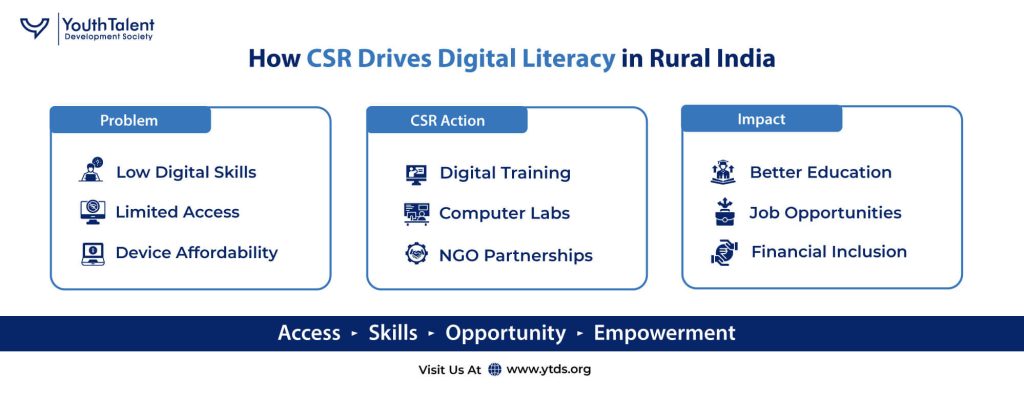
Corporate Social Responsibility has emerged as a powerful driver of digital inclusion, particularly in rural and underserved communities. As technology becomes essential to education, employment, and access to public services, CSR in education in India provides corporates with a meaningful way to support digital literacy while fulfilling statutory CSR compliance under the Companies Act, 2013.
One of the key contributions corporates can create strong impact by investing in digital skill development initiatives. Such programs help students and youth with foundational computer skills and internet usage knowledge. Many companies supports in digital infrastructure by establishing computer labs, smart classrooms, and learning centers in rural schools, where access to technology remains limited. Access to devices, internet connectivity, and curriculum support helps ensure that learning is consistent and relevant to local needs.
Across India, multiple corporate-led digital literacy initiatives have demonstrated strong impact. IT and telecom companies have invested in CSR IT training programs that focuses on digital skills for underprivileged youth, improving employability. Some corporates collaborate with schools to embed digital tools into classroom or create community technology hubs that serve multiple age groups.
Corporate involvement adds value beyond financial support which enhances the effectiveness of digital programs. Employee engagement, digital mentorship and NGO partnerships help adapt programs to on-ground realities. Data shows that while rural internet access has increased significantly, digital skill levels remain inconsistent. CSR for rural schools helps convert digital access into usable skills for communities.
Case Studies: CSR in Action for Digital Literacy
Across India, CSR- backed digital literacy efforts are converting access into sustainable outcomes. Government initiatives like Pradhan Mantri Gramin Digital Saksharta Abhiyan (PMGDISHA) have played a key role in introducing essentials for bringing basic digital skills to rural communities.
These programs primarily support first-time learners by building core digital skills and online awareness for everyday digital practices.
Corporate involvement has further strengthened the investments in learning infrastructure, digital classrooms, and community learning centers. Many CSR-backed programs have shown measurable outcomes, including improved digital confidence among rural youth and increased adoption of online platforms for education and employment. Programs focused on women have increased independent use of digital payments and online services—reducing reliance and increasing autonomy.
Grassroots organizations such as YTDS bridge the gap between CSR intent and community-level outcomes. Through community-led digital literacy programs, it focuses on hands on digital learnings and action oriented learnings are aligned with community needs. The approach emphasizes consistency, mentorship, and real-life usage rather than one-time training, enabling participants to integrate digital skills into their daily routines.
What sets successful models, when policy, funding, and implementation work together. When CSR investments are supported by community trust and engagement programs digital literacy programs move beyond numbers—creating empowered communities equipped to thrive in the digital age.
How YTDS Supports Digital Literacy Through CSR
As a youth-led organization, YTDS plays a vital role in implementing CSR-driven digital literacy programs at the grassroots level. YTDS design and delivers community-centric digital education programs that equip rural youth and women with practical skills—from basic computer literacy to online services and navigating education and employment platforms.
YTDS collaborates closely with corporate partners to ensure every CSR digital projects are impactful, measurable, and aligned with real community needs. Its on-ground presence, local partnerships, and youth engagement model creates lasting digital empowerment in rural India.
Through youth leadership and strong local networks, YTDS helps corporates to convert CSR commitments into measurable digital impowerment, making it a trusted partner for sustainable digital inclusion initiatives in India for long term .
Conclusion: Partner for a Digitally Empowered Rural India
Digital literacy has emerged as a cornerstone of equitable development in modern India. While access to technology has expanded, gaps in skills, awareness, and confidence continue to limit its real impact. Bridging this divide requires focused efforts that place learning and empowerment at the centre of development.
CSR in digital education offers a powerful opportunity for corporates to create social impact while contributing to national growth goals.
Partnering with experienced grassroots organisations like YTDS ensures that CSR investments translate into measurable, on-ground outcomes—empowered communities, skilled youth, and a more equitable digital future. Now is the time to invest in digital literacy and help build a rural India that is connected, confident, and future-ready.
Partner with YTDS to drive digital empowerment through meaningful CSR initiatives.