








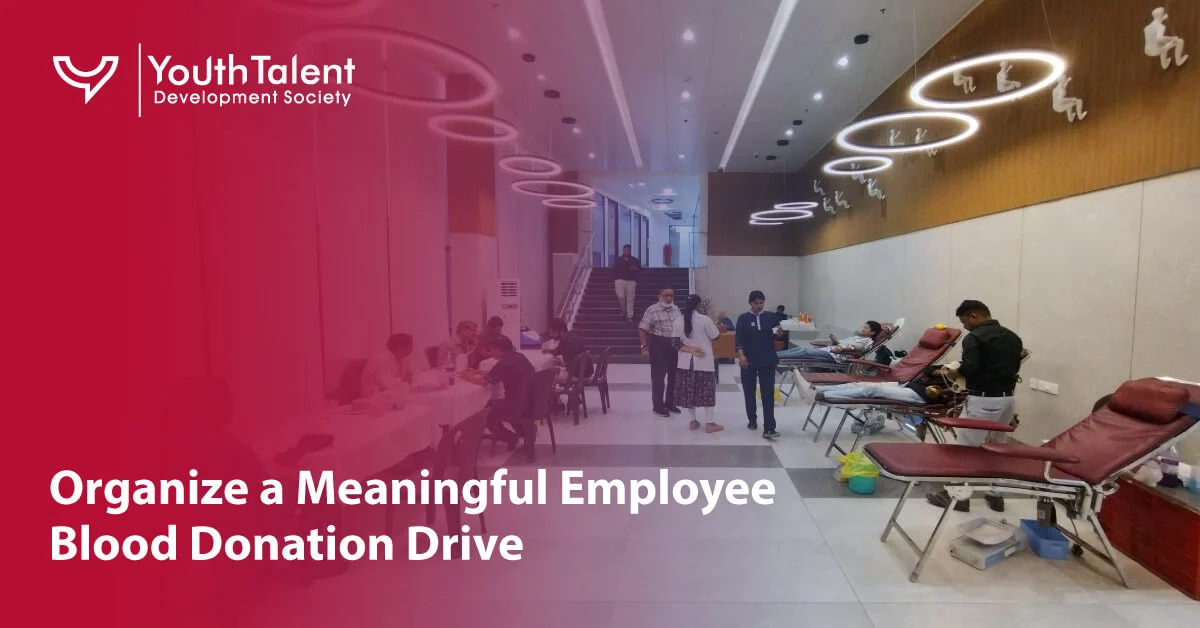
A corporate blood donation drive can be one of the most direct ways for employees to participate in a meaningful community initiative.
Unlike many awareness-only activities, a well-organized blood donation program creates an immediate connection between employee participation and healthcare needs.
For companies, however, organizing a blood donation camp should involve more than selecting a date, setting up a few beds and asking employees to participate.
A safe and effective corporate blood donation drive in India requires coordination with authorised blood collection organisations, proper donor registration and screening, suitable workplace arrangements, employee communication, post-donation care, documentation and follow-up.
When these elements are planned properly, blood donation can become part of a broader corporate health, volunteering and social-impact program.
YTDS supports blood donation initiatives through its #DonateBloodSaveLives campaign, which coordinates structured donation drives with blood banks and encourages voluntary participation.
This guide explains how companies can plan corporate blood donation drives responsibly, increase employee participation and measure the impact of the initiative.
What Is a Corporate Blood Donation Drive?
A corporate blood donation drive is an organised blood collection activity conducted for employees, corporate teams or other eligible volunteers in coordination with an authorised blood bank, hospital or blood centre.
The company may provide:
- Venue and logistical support
- Employee communication
- Volunteer mobilisation
- Internal registrations
- Time for employees to participate
- Coordination with an NGO or implementation partner
- Documentation and participation records
Medical activities such as donor suitability assessment, blood collection, infection screening, handling, storage and processing should remain under the responsibility of qualified and authorised medical professionals and blood services.
The World Health Organization emphasises voluntary, non-remunerated blood donation, appropriate donor selection and quality-assured screening as important components of blood safety.
Why Corporate Blood Donation Drives Matter
Blood and blood components are required for a wide range of medical situations, including surgeries, emergencies and ongoing treatment for certain medical conditions.
According to the World Health Organization’s information on blood products in India, India requires approximately 14.6 million units of blood annually.
Blood also cannot simply be manufactured and stored indefinitely.
A dependable blood supply therefore depends on regular voluntary donation and effective blood-management systems.
Corporate workplaces can contribute by bringing together a large number of potential voluntary donors in an organised environment.
A workplace drive can help:
- Increase voluntary blood donation
- Make donation more convenient for employees
- Create awareness about responsible blood donation
- Encourage first-time donors
- Build repeat donor participation
- Strengthen employee volunteering culture
- Support local healthcare systems
- Create visible employee participation in social impact
For employees, the activity also provides an opportunity to contribute personally rather than participating only through financial donations.
Can Blood Donation Be Part of CSR in India?
Schedule VII of the Companies Act, 2013 includes promoting healthcare, including preventive healthcare, among activities that may be included in corporate social responsibility policies.
However, companies should not automatically assume that every employee blood donation event or every associated expense qualifies as CSR expenditure.
The project’s structure, beneficiaries, expenditure treatment, CSR policy and applicable rules should be reviewed by the company’s CSR, legal or compliance team.
The safer approach is to distinguish between:
- CSR expenditure
- employee volunteering
- employee engagement
- community healthcare support
A blood donation initiative may connect with more than one of these objectives depending on how the program is designed.
How to Organize a Corporate Blood Donation Drive in India
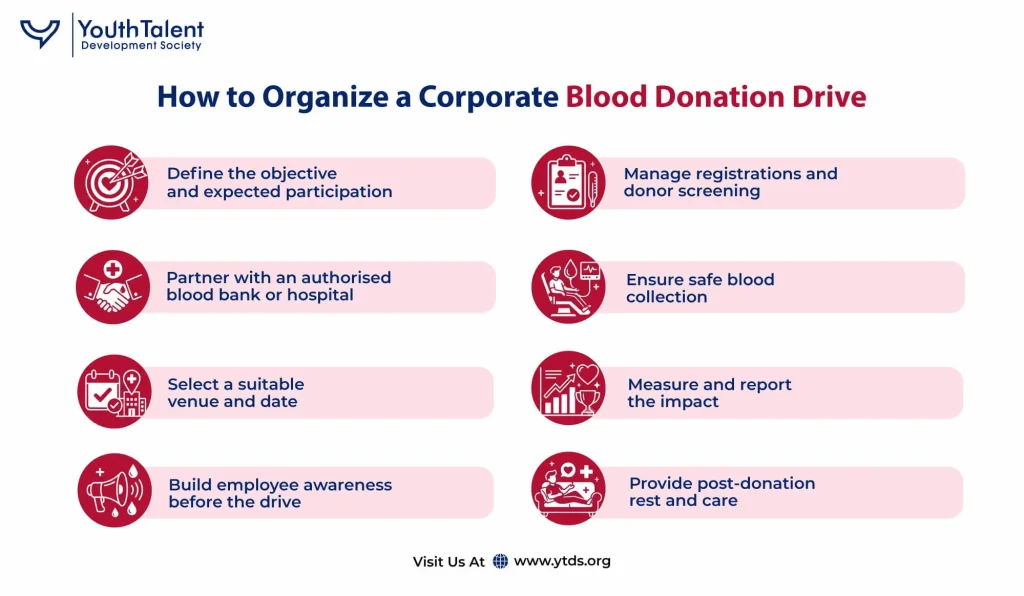
A successful blood donation drive begins well before employees arrive at the donation area.
Here is a practical step-by-step approach.
Step 1: Define the Purpose of the Drive
Start by deciding why the organisation wants to conduct the activity.
Possible objectives include:
- Supporting voluntary blood availability
- Encouraging employee volunteering
- Building healthcare awareness
- Supporting a community initiative
- Creating a recurring corporate volunteering program
- Engaging employees around a social cause
- Supporting an existing CSR or community-health partnership
Having a clear objective helps determine the scale, communication strategy and reporting requirements.
For example, a one-time awareness event requires a different plan from a quarterly employee blood donation program.
Step 2: Estimate Employee Participation
The organising team should estimate the number of employees who may be interested.
This helps the blood bank or medical team plan:
- Staff requirements
- Registration capacity
- Donation stations
- Medical screening arrangements
- Equipment
- Blood collection supplies
- Refreshments
- Time slots
Do not treat initial registrations as guaranteed donations.
Every prospective donor must still be assessed by the medical team before donation.
Step 3: Partner With an Authorised Blood Bank or Medical Institution
This is one of the most important steps.
Blood collection should be conducted through an appropriately authorised blood centre, hospital or blood bank following applicable medical and regulatory requirements.
The medical partner should manage areas such as:
- Donor assessment
- Medical screening
- Blood collection
- Sterile equipment
- Labelling
- Blood handling
- Testing
- Storage
- Transportation
- Post-donation medical guidance
YTDS’s #DonateBloodSaveLives model follows this structured approach by coordinating donation activities with blood banks and medical professionals.
Companies working with an NGO should also evaluate whether the organisation has experience coordinating healthcare-related activities.
Our guide on choosing a CSR implementation partner in India explains broader due-diligence considerations companies can use when selecting implementation organisations.
Step 4: Select a Suitable Venue
The venue should be selected with the medical partner.
Depending on the setup, a workplace blood donation camp may require space for:
- Registration
- Waiting
- Medical screening
- Blood collection
- Rest and recovery
- Refreshments
- Volunteer coordination
The location should be clean, comfortable and easy for employees to access.
Privacy should also be maintained during medical assessment.
Avoid treating the donation area like a promotional event space. Donor safety and medical workflow should come first.
Step 5: Choose the Right Date and Time
Participation can be affected significantly by timing.
Before choosing a date, consider:
- Work schedules
- Shift patterns
- Major company deadlines
- Holidays
- Employee availability
- Venue availability
- Blood-bank availability
Companies with large teams may use scheduled time slots to avoid crowding.
The medical partner can advise on the number of donors that can be handled safely during each period.
Step 6: Start Employee Awareness Before the Drive
Employees should understand what the activity involves before being asked to register.
Internal communication can explain:
- Purpose of the drive
- Date and venue
- Registration process
- What donors can expect
- That medical screening will take place
- Basic pre-donation guidance provided by the medical partner
- What happens after donation
- Who employees can contact for questions
Communication channels may include:
- Internal chat platforms
- Posters
- Digital screens
- HR communication
- Employee town halls
- Volunteer champions
Avoid pressuring employees to participate.
Blood donation should remain voluntary.
Step 7: Use Pre-Registration to Plan the Drive
Pre-registration makes planning easier for the company and blood bank.
A registration system can collect only the information necessary for scheduling and coordination, while medical information should be handled appropriately by qualified personnel.
Companies can organise participants into time slots to reduce waiting periods and operational disruption.
Pre-registration also provides an early estimate of employee interest.
Step 8: Conduct Donor Registration and Medical Screening
Registration at the venue should be followed by the blood service’s donor-assessment process.
The medical team determines whether an individual is suitable to donate on that occasion.
Not every registered employee will necessarily be able to donate.
There may be temporary or other reasons why a person is advised not to donate.
Employees who are deferred should be treated respectfully and should not be asked to disclose private medical reasons to colleagues, managers or company organisers.
The purpose of screening is to protect both the donor and the recipient.
Step 9: Ensure Safe Blood Collection
Blood collection should be handled only by trained medical professionals using appropriate sterile equipment and established procedures.
The organising company or NGO should support logistics without interfering with medical decisions.
During the drive, responsibilities should be clearly separated:
Medical team
- Donor assessment
- Collection
- Clinical supervision
- Blood handling
- Medical response where necessary
Company or NGO team
- Registration coordination
- Queue management
- Volunteer support
- Communication
- Venue logistics
- Documentation
- Refreshment arrangements
Clear responsibilities reduce confusion and help the event run smoothly.
Step 10: Provide Post-Donation Rest and Care
The employee’s experience does not end when blood collection is completed.
Donors should receive the rest, refreshments and post-donation guidance recommended by the medical team.
A designated recovery area can allow donors to sit comfortably before returning to normal activities.
Employees should also know whom to approach if they feel unwell or have questions following donation.
Step 11: Document the Drive Responsibly
Corporate teams often require documentation for internal reporting and employee engagement.
Useful records may include:
- Number of registrations
- Number of successful donations
- Employee participation
- Volunteer participation
- Date and location
- Partner blood bank
- Photographs with appropriate consent
- Activity summary
- Employee feedback
- Follow-up recommendations
Avoid collecting or publishing sensitive medical information.
Impact reporting should focus on program-level outcomes, not individual health data.
Step 12: Thank Employees and Share the Impact
After the event, communicate the results internally.
A simple follow-up can include:
- Number of employees who participated
- Number of donations collected, where confirmed by the medical partner
- Appreciation for employee volunteers
- Partner acknowledgements
- Photographs
- Next planned activity
Recognition can help create a culture in which employees feel that their contribution mattered.
However, communications should avoid exaggerated claims.
If discussing the potential use of donated blood or blood components, use figures and terminology validated by the blood-bank partner rather than making unsupported assumptions.
How to Increase Employee Participation in a Blood Donation Drive
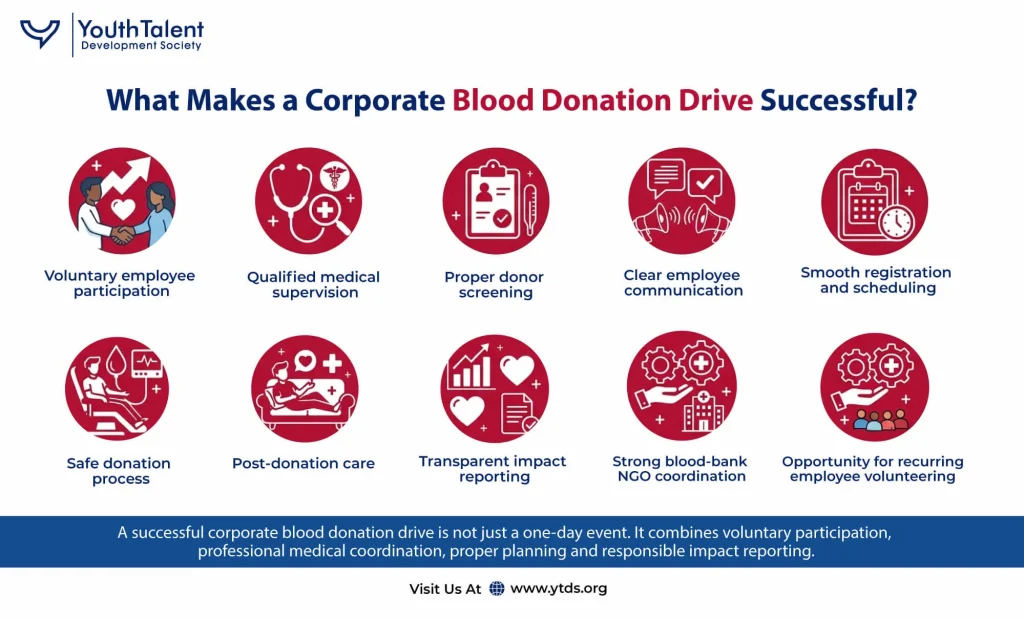
Low participation does not always mean employees are uninterested.
Sometimes employees simply lack information or confidence.
Companies can improve participation through better communication.
Explain the Process Clearly
First-time donors may feel uncertain because they do not know what will happen.
A short FAQ or awareness session led by qualified medical professionals can answer common questions.
Use Employee Champions
Employees who support the initiative can encourage awareness within teams.
Participation should still remain voluntary.
Make Registration Simple
Long forms and unclear processes can reduce participation.
Keep non-medical registration simple.
Offer Flexible Time Slots
Employees may be willing to participate but unable to leave their work at the same time.
Scheduled slots make participation easier.
Build Trust Through Medical Partnerships
Employees are more likely to feel comfortable when they know the drive is being conducted with an established blood bank or hospital.
Communicate the Outcome
Sharing what happened after the drive helps employees understand the collective value of participation.
One-Time Blood Donation Camp vs Recurring Program
A single corporate blood donation camp can create useful participation.
But recurring programs can build a stronger culture of voluntary donation.
One-Time Drive
Suitable for:
- Initial employee engagement
- Awareness days
- Office events
- First partnership with an NGO
- Testing employee interest
Recurring Program
Suitable for companies that want to:
- Build a long-term donor community
- Conduct periodic voluntary drives
- Maintain employee awareness
- Increase repeat participation
- Create structured employee volunteering opportunities
A recurring program should still be scheduled in consultation with qualified blood services, particularly because donor eligibility and safe intervals between donations must be determined according to applicable medical guidance.
Blood Donation and Employee Volunteering
Blood donation can also sit within a broader employee volunteering strategy.
Employees who cannot or do not wish to donate can sometimes participate in non-medical roles such as:
- Awareness support
- Registration assistance
- Employee communication
- Venue coordination
- Volunteer management
- Logistics
- Post-event documentation
This allows the company to involve a broader group without putting pressure on anyone to donate.
Companies exploring other activities can also review our guide to corporate employee volunteering programs in India.
A strong volunteering strategy offers different ways for employees to contribute according to their interests and abilities.
What Should Companies Look for in a Blood Donation Partner?
Blood donation is a healthcare-related activity, so partner selection deserves particular attention.
Companies should look at:
Medical Coordination
Does the organisation work with appropriate hospitals, blood banks or blood centres?
Experience
Has the organisation coordinated similar drives before?
Safety Process
Is there a clearly defined medical and operational process?
Volunteer Management
Can the partner manage employee registrations, communication and on-ground coordination?
Documentation
Can the partner provide appropriate activity and participation reporting?
Data Privacy
Are medical details handled only through appropriate channels?
Post-Event Reporting
Will the company receive a clear summary of the activity?
Follow-Up Capability
Can the partner help create a recurring program rather than only a one-day event?
Companies should verify these factors before confirming a partnership.
How to Measure Corporate Blood Donation Drive Impact
Impact measurement should be simple and credible.
Useful metrics can include:
The goal is not to produce the largest possible number for a report.
The goal is to understand whether the initiative was safe, well-managed, participative and capable of being repeated.
Common Mistakes Companies Should Avoid
Treating the Drive Like a One-Day Photo Opportunity
Blood donation is a healthcare activity. Safety and responsible coordination should take priority over visibility.
Choosing a Partner Without Proper Verification
Always verify the organisations involved in medical collection and program coordination.
Pressuring Employees to Donate
Participation must remain voluntary.
Publishing Medical Information
Employee health information should remain confidential.
Ignoring First-Time Donor Questions
Education and medical guidance can reduce unnecessary anxiety.
Measuring Only Registrations
Registrations alone do not show actual participation or program quality.
Making Unsupported Impact Claims
Use verified information from the medical partner when reporting outcomes.
How YTDS Supports Corporate Blood Donation Drives
Youth Talent Development Society works across Environment, Education, Employment and Empowerment through community-focused initiatives.
Under its Empowerment work, YTDS runs the #DonateBloodSaveLives campaign, which coordinates structured blood donation activities and encourages voluntary participation.
The campaign’s process includes:
- Coordination with blood banks
- Donor registration and screening
- Safe blood donation under trained medical supervision
- Post-donation care
YTDS reports more than 10,000 blood donations and 30,000 blood components through the initiative.
For companies, YTDS can support areas such as:
- Corporate drive planning
- Blood-bank coordination
- Employee mobilisation
- Registration coordination
- Volunteer management
- Venue planning
- Awareness support
- On-ground coordination
- Documentation
- Participation reporting
- Follow-up planning
Companies can also explore YTDS’s broader Empowerment initiatives.
Planning a Corporate Blood Donation Drive With YTDS
A well-managed blood donation drive should make participation easy for employees while keeping medical safety at the centre of the program.
Before planning the activity, companies should determine:
- Intended location
- Approximate employee strength
- Expected participation
- Preferred dates
- Office or venue availability
- Internal approval process
- Reporting requirements
- Whether the initiative will be one-time or recurring
YTDS can then work with the organisation and relevant medical partners to structure the activity appropriately.
Companies interested in organising a corporate blood donation drive can contact YTDS to discuss campaign collaboration and employee participation.
Conclusion
A corporate blood donation drive in India can become a meaningful employee and community initiative when it is organised responsibly.
The strongest programs combine voluntary participation with qualified medical coordination, clear employee communication, proper screening, safe collection, post-donation care and credible reporting.
Companies should avoid treating blood donation as simply another corporate event.
It is a healthcare-related activity that requires proper planning and professional oversight.
When organised through the right blood-bank and implementation partnerships, workplace blood donation programs can encourage voluntary donation, increase employee participation in social initiatives and create a foundation for recurring community-health engagement.
Through #DonateBloodSaveLives, YTDS works with organisations and volunteers to coordinate structured blood donation initiatives.
Planning a blood donation drive for your employees? Connect with YTDS to explore a structured corporate blood donation initiative.
Frequently Asked Questions
1. What is a corporate blood donation drive?
A corporate blood donation drive is an organised blood collection activity conducted for eligible employees or volunteers in coordination with an authorised blood bank, hospital or blood centre.
2. How can a company organize a blood donation camp in India?
Companies should begin by defining the objective, estimating participation and partnering with an appropriate blood bank or medical institution. They should then plan the venue, employee communication, registration, medical screening, donation workflow, post-donation care and reporting.
3. Can blood donation activities be included under CSR?
Schedule VII of the Companies Act includes promoting healthcare, including preventive healthcare. However, companies should evaluate the specific structure and expenditure of their program against applicable CSR rules and seek professional guidance rather than assuming that every blood donation event automatically qualifies as CSR expenditure.
4. Who decides whether an employee can donate blood?
The qualified medical or blood-bank team should assess each prospective donor according to applicable donor-selection criteria. Company managers or volunteers should not make medical eligibility decisions.
5. Should employees be required to participate?
No. Blood donation should be voluntary. Employees should receive appropriate information and be allowed to decide whether they wish to participate.
6. What should a company provide at a workplace blood donation camp?
The exact requirements should be determined with the medical partner. They may include registration space, medical screening areas, blood collection space, rest and refreshment areas, employee scheduling and logistical support.
7. How can companies increase participation in blood donation drives?
Companies can improve participation through early communication, awareness sessions, simple registration, flexible time slots, trusted medical partnerships and clear explanation of the donation process.
8. Can employees who do not donate still volunteer?
Yes. Depending on the program, employees may help with awareness, registrations, logistics, communication, volunteer coordination and other non-medical tasks.
9. How should companies measure the impact of a blood donation drive?
Companies can track registrations, completed donations, employee volunteers, locations covered, events conducted, partner institutions, employee feedback and repeat participation.
10. Can a company conduct blood donation drives regularly?
Yes, a company can build a recurring voluntary donation program in coordination with appropriate medical partners. Individual donor eligibility and donation intervals should always be determined by the authorised blood service.
11. How can an NGO support a corporate blood donation drive?
An NGO may help with campaign planning, employee mobilisation, blood-bank coordination, logistics, volunteer management, documentation and reporting, while medical activities remain with qualified blood-service professionals.
12. How can companies partner with YTDS for blood donation drives?
Companies can work with YTDS through its #DonateBloodSaveLives initiative for campaign planning, employee engagement, blood-bank coordination, on-ground support, documentation and follow-up. Companies can contact YTDS here to discuss a drive.