+91-9881904974
 info@ytds.org
.webp)
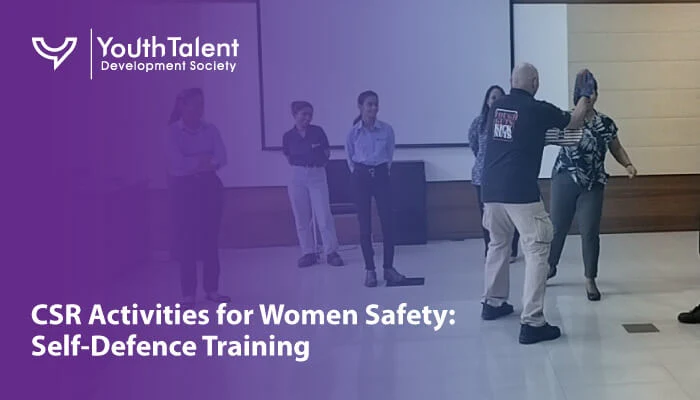
Women safety is not only a social issue. It is directly connected to education, employment, mobility, confidence, and equal participation in society. When women and girls feel unsafe while travelling, studying, working, or participating in community life, their opportunities become limited.
This is why companies should consider women safety as an important area under corporate social responsibility.
CSR activities for women safety can include self-defence training, safety awareness, commute safety programs, digital safety sessions, legal rights awareness, confidence-building workshops, and community-level empowerment initiatives.
Under Schedule VII of the Companies Act, 2013, CSR activities may include promoting gender equality, empowering women, and setting up homes and hostels for women and orphans. This makes women safety and empowerment a relevant CSR focus area for companies in India.
For companies, supporting women safety through CSR is not about one workshop or one event. It is about helping women and girls build awareness, confidence, preparedness, and access to safer participation in education, work, and public spaces.
Why Women Safety Should Be a CSR Priority
Women safety affects many areas of life. A girl may avoid higher education if the commute feels unsafe. A woman may avoid a job opportunity if travel timing, workplace surroundings, or public transport routes feel risky. Students, working women, and community members may also face safety concerns in crowded places, isolated routes, public transport, digital spaces, and unfamiliar environments.
When companies invest in women safety CSR programs, they support:
- Confidence and self-awareness
- Safer mobility for women and girls
- Better participation in education and employment
- Community-level awareness
- Women empowerment programs
- Workplace and commute readiness
- Practical response skills
- Long-term social inclusion
Self-defence and safety programs are especially useful because they help participants understand risk, respond calmly, set boundaries, and use practical techniques in difficult situations.
The goal is not to place the responsibility of safety only on women. The larger goal is to create awareness, preparedness, stronger support systems, and safer communities.
What Are CSR Activities for Women Safety?
CSR activities for women safety are company-supported programs designed to improve safety awareness, confidence, mobility, and preparedness among women and girls.
These activities can be conducted in schools, colleges, workplaces, communities, factories, offices, residential areas, or public institutions.
Examples of CSR activities for women safety include:
- Self-defence training workshops
- Personal safety awareness sessions
- Commute safety programs
- Digital safety awareness for women
- Legal rights and helpline awareness
- Confidence-building sessions
- College and workplace safety workshops
- Community safety campaigns
- Women empowerment and mentorship programs
- Safety reporting and support awareness
The best CSR programs are practical, inclusive, and easy to understand. They should focus on real-life situations that women and girls may face in daily life.
Why Self-Defence Training Is a Practical CSR Activity
Self-defence training is one of the most practical CSR activities for women safety because it combines physical readiness with mental confidence.
A good self-defence workshop is not only about fighting techniques. It includes awareness, prevention, boundary-setting, voice response, escape methods, confidence-building, and emergency decision-making.
Self-defence training can help women and girls learn:
- How to identify unsafe situations early
- How to stay aware in public spaces
- How to use voice and body language confidently
- How to create distance from a threat
- How to respond to sudden grabs or close-contact situations
- How to stay calm under pressure
- How to seek help quickly
- How to use available surroundings for safety
Recent examples from different regions show that women often turn to self-defence training not only for physical protection, but also for confidence, resilience, and community support.
For CSR teams, this makes self-defence training a high-impact activity because it is practical, visible, measurable, and strongly connected to women empowerment.
Practical CSR Activities for Women Safety
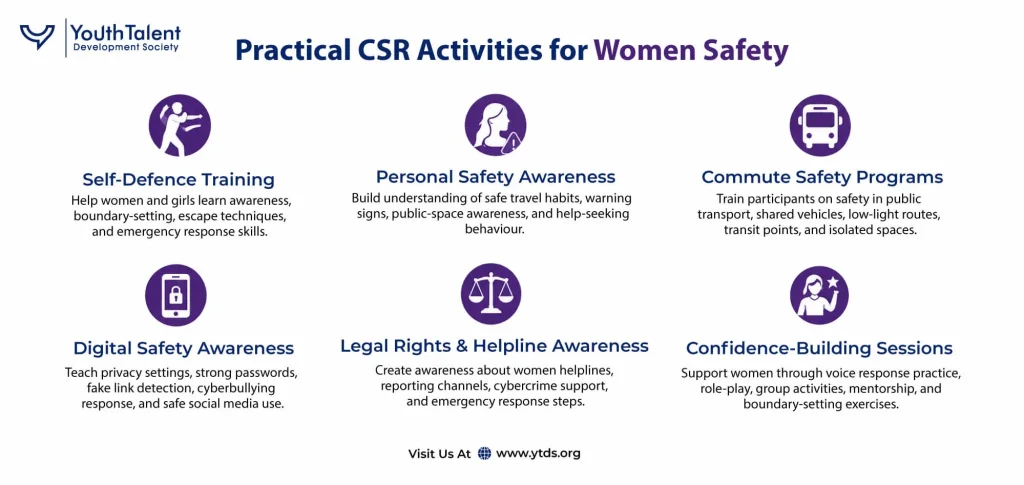
Companies can support women safety through multiple activities. The right program depends on the target group, location, risk context, age group, and community need.
1. Self-Defence Training Workshops
Self-defence training workshops can be conducted for school girls, college students, working women, factory staff, community women, and frontline workers.
These workshops can include:
- Basic safety awareness
- Defensive stance and movement
- Escape techniques
- Boundary-setting
- Voice response
- Close-contact defence basics
- Situational awareness
- Confidence-building drills
For companies, this is one of the most direct ways to support women safety through CSR.
2. Personal Safety Awareness Sessions
Personal safety awareness helps participants understand how to identify and avoid risky situations. This training can be useful even for those who may not be comfortable with physical self-defence training.
Topics can include:
- Awareness in public spaces
- Safe travel habits
- Recognising warning signs
- Emergency contacts
- Safe use of transport
- Behaviour in crowded places
- Responding to harassment
- Seeking help safely
This type of session can be conducted in schools, colleges, offices, and community centres.
3. Commute Safety Programs
Many women and girls face safety concerns while commuting to school, college, work, or training centres. CSR commute safety programs can help participants plan safer travel and respond better during difficult situations.
A commute safety program can cover:
- Public transport safety
- Safety in shared vehicles
- Awareness at bus stops and transit points
- Low-light travel precautions
- Route planning
- Emergency contact planning
- Safety in elevators, parking areas, and isolated spaces
This is especially useful for college students, working women, and employees who travel during early morning, evening, or monsoon conditions.
4. Digital Safety Awareness for Women
Women safety is not limited to physical spaces. Digital safety is also important because women and girls may face cyberbullying, fake profiles, online harassment, stalking, privacy risks, phishing, and digital fraud.
CSR-supported digital safety sessions can teach:
- Privacy settings
- Strong passwords
- Safe social media use
- Avoiding fake links
- Reporting online harassment
- Identifying fake profiles
- Protecting personal photos and information
- Safe use of messaging apps
- Cybercrime reporting awareness
Research on online safety has highlighted differences in how women access security and privacy advice, showing why structured training and trusted guidance can be important for improving online safety behaviour.
5. Legal Rights and Helpline Awareness
Many women are unaware of available legal rights, support channels, and emergency helplines. CSR programs can include simple awareness sessions that explain where and how to seek help.
These sessions can cover:
- Women helplines
- Police complaint basics
- Cybercrime reporting
- Workplace harassment reporting
- Internal complaint mechanisms
- Local support systems
- Emergency response steps
The aim is not to give complex legal training. The aim is to make women aware of the support systems available to them.
6. Confidence-Building Sessions
Confidence is a major part of women safety and empowerment. Many women hesitate to speak up, set boundaries, ask for help, or respond assertively because of fear, social pressure, or lack of training.
CSR programs can support confidence-building through:
- Group activities
- Role-play exercises
- Public speaking
- Boundary-setting practice
- Voice training
- Peer discussion circles
- Mentorship
- Leadership activities
These sessions help women feel more prepared and supported.
7. College and Workplace Safety Workshops
Colleges and workplaces are important spaces for women safety programs. Students and employees often face safety concerns during commute, late working hours, public transport, events, field visits, or crowded areas.
Companies can support safety workshops covering:
- Campus safety
- Workplace safety awareness
- Commute preparedness
- Reporting channels
- Bystander awareness
- Emergency response
- Personal safety planning
Such programs are useful for corporate CSR, HR teams, colleges, factories, and institutions.
8. Community Safety Campaigns
Women safety improves when the community is involved. CSR programs can support awareness campaigns in communities, schools, residential areas, and public spaces.
Community safety campaigns can include:
- Street plays
- Awareness drives
- Safety pledge programs
- Local volunteer participation
- Parent awareness sessions
- Youth sensitisation programs
- Community support network awareness
These campaigns create wider awareness beyond the direct participants.
How Companies Can Measure Women Safety CSR Impact
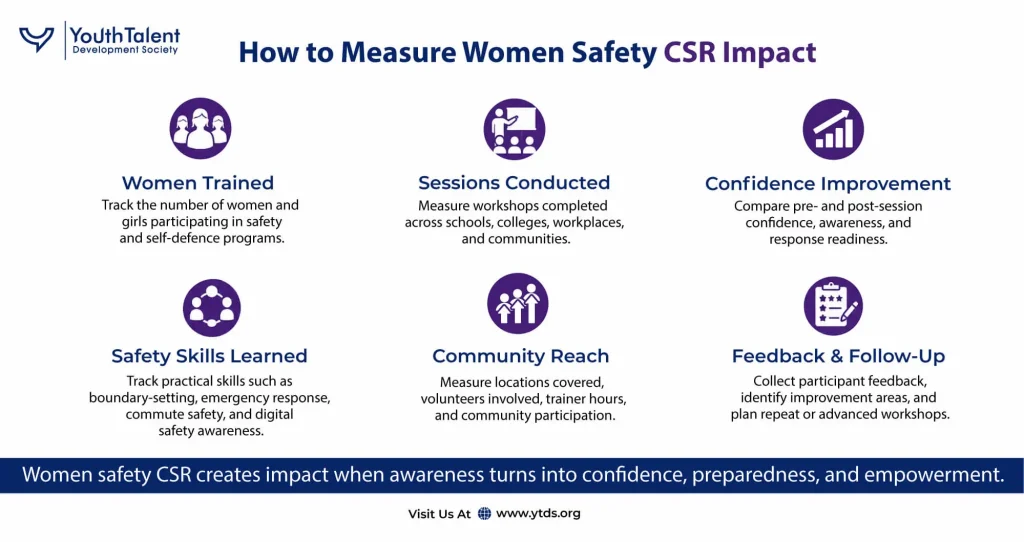
Women safety CSR programs should be measured with both activity and outcome indicators. Companies should not only count how many sessions were conducted. They should also understand whether participants gained confidence, awareness, and practical safety knowledge.
Useful impact metrics include:
- Number of women and girls trained
- Number of sessions conducted
- Attendance rate
- Colleges, schools, workplaces, or communities covered
- Trainer hours delivered
- Pre- and post-session confidence score
- Safety awareness improvement
- Number of participants learning emergency response steps
- Number of participants aware of helplines and reporting channels
- Feedback collected
- Repeat workshops planned
- Follow-up sessions conducted
These metrics help CSR teams show that the program created practical and measurable impact.
Why NGOs Are Important for Women Safety CSR Programs
NGOs can help companies make women safety CSR programs more effective because they understand community needs, local challenges, participant mobilisation, and on-ground execution.
An NGO partner can support companies with:
- Community mobilisation
- School and college coordination
- Trainer coordination
- Program planning
- Volunteer support
- Safety workshop execution
- Participant feedback
- Documentation
- Impact reporting
- Follow-up planning
A good NGO partner helps companies move beyond one-time activity and create structured safety and empowerment programs.
How YTDS Can Support Women Safety CSR Programs
Youth Talent Development Society works across Environment, Empowerment, Education, and Employment. Under the Empowerment pillar, YTDS supports initiatives that help women, students, and communities build confidence, awareness, and practical life skills.
For women safety CSR programs, YTDS can support companies with:
- Self-defence training workshops
- Women safety awareness sessions
- Commute safety workshops
- Digital safety awareness
- Confidence-building activities
- Community mobilisation
- Trainer coordination
- Volunteer engagement
- Documentation and reporting
- Impact tracking
Through women safety and self-defence programs, YTDS helps CSR partners create initiatives that are practical, community-connected, and measurable.
Conclusion
CSR activities for women safety can create meaningful impact when they are planned with the right mix of awareness, confidence-building, practical training, and community support.
Self-defence training is a strong CSR activity because it helps women and girls build awareness, confidence, preparedness, and response skills. But women safety CSR should not stop at physical training. It should also include commute safety, digital safety, legal awareness, confidence-building, and community-level support.
Companies that invest in women safety help create stronger, safer, and more inclusive communities.
Partner with YTDS to design and execute women safety CSR programs that support confidence, awareness, empowerment, and measurable community impact.
FAQs
1. What are CSR activities for women safety?
CSR activities for women safety are company-supported programs that improve safety awareness, confidence, mobility, and preparedness among women and girls. Examples include self-defence training, personal safety sessions, digital safety awareness, commute safety workshops, and legal rights awareness.
2. Why should companies support women safety through CSR?
Companies should support women safety through CSR because safety directly affects women’s education, employment, mobility, confidence, and social participation. These programs support women empowerment and community development.
3. Is self-defence training a good CSR activity?
Yes. Self-defence training is a practical CSR activity because it helps women and girls build awareness, confidence, boundary-setting, emergency response, and basic protection skills.
4. What should a women safety CSR program include?
A women safety CSR program can include self-defence training, personal safety awareness, commute safety, digital safety, legal rights awareness, confidence-building, and community safety campaigns.
5. How can companies measure women safety CSR impact?
Companies can measure impact through number of women trained, sessions conducted, attendance, confidence improvement, safety awareness improvement, feedback, trainer hours, locations covered, and follow-up sessions.
6. Can NGOs help companies run women safety CSR programs?
Yes. NGOs can help companies plan programs, mobilise participants, coordinate trainers, conduct workshops, collect feedback, document activities, and prepare impact reports.