








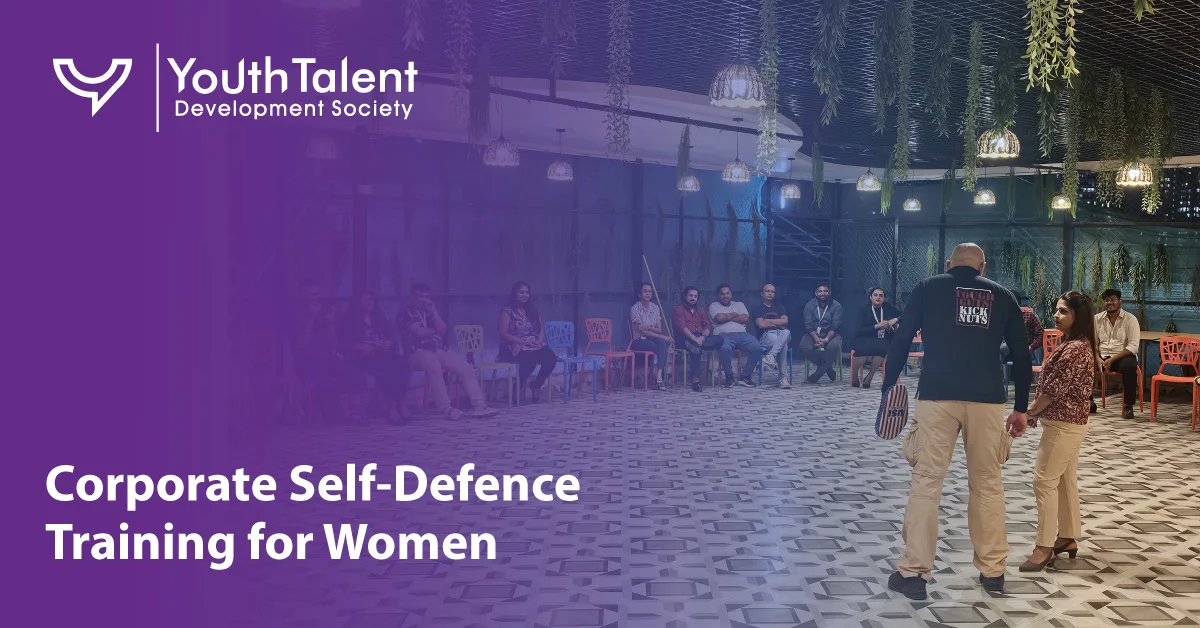
Women safety is an important part of empowerment, workplace wellbeing, community development, and responsible corporate social impact. Many companies today want to support women-focused initiatives, but they often need structured programs that go beyond one-time awareness activities.
This is where corporate self-defence training for women can become a practical CSR and employee engagement initiative.
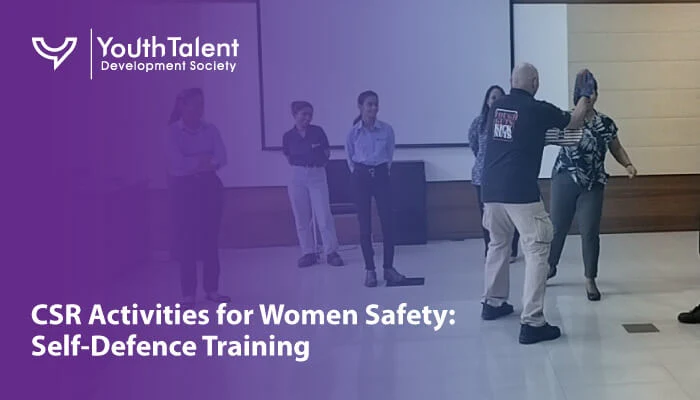
A well-planned program does not only teach basic physical response techniques. It can also include personal safety awareness, confidence-building, commute safety, emergency response, digital safety basics, helpline awareness, and NGO-led execution support.
For companies, this type of program can support both internal and external objectives. Internally, it can help women employees feel more confident and supported. Externally, it can help companies support college girls, community women, frontline workers, and women from underserved groups through CSR-led empowerment programs.
Women empowerment and gender equality are also listed among the areas that companies may include in their CSR policies under Schedule VII of the Companies Act, 2013.
What Is Corporate Self-Defence Training for Women?
Corporate self-defence training for women is a structured safety and confidence-building program planned by companies, CSR teams, HR teams, or NGO partners.
The program may be conducted for:
- Women employees
- College girls
- School students
- Community women
- Factory workers
- Frontline staff
- Young women from underserved communities
The objective is not to create fear. The real objective is to build awareness, confidence, preparedness, and practical response ability.
A strong program can combine basic self-defence techniques with broader safety education. This makes the initiative more useful because women safety is not limited to physical response alone. It also includes awareness, communication, digital safety, commute safety, and knowing where to seek help when needed.
For a broader understanding of why this matters, companies can also refer to YTDS’s article on self-defence training for women.
Why Companies Should Invest in Women Safety Training
Companies can support women safety training because it contributes to both empowerment and social responsibility.
For employees, such programs can support confidence, wellbeing, and workplace inclusion. For communities, they can create practical awareness around safety, emergency response, and personal preparedness.
Corporate self-defence and women safety programs can help companies support:
- Women empowerment
- Employee wellbeing
- Community safety awareness
- Confidence-building
- CSR-led social impact
- Employee engagement
- Responsible corporate citizenship
- Safer learning and working environments
This type of initiative is especially useful when companies want to move beyond donation-based CSR and support practical, skill-based empowerment.
It can also connect with broader CSR activities for women safety, where self-defence is one part of a larger women safety and awareness strategy.
Self-Defence Training vs Women Safety Workshop: What Is the Difference?
Self-defence training and women safety workshops are closely connected, but they are not exactly the same.
Self-defence training usually focuses on basic physical techniques, safe response methods, body awareness, and immediate reaction in unsafe situations.
A women safety workshop is broader. It may include:
- Personal safety awareness
- Situational awareness
- Commute safety
- Emergency contact planning
- Digital safety basics
- Confidence-building
- Legal and helpline awareness
- Reporting guidance
- Communication and boundary-setting
For companies, the best approach is to combine both.
A workshop that only focuses on physical techniques may feel incomplete. A session that only discusses awareness may not feel practical enough. A balanced program should include self-defence basics along with personal safety, confidence-building, commute safety, and emergency response guidance.
What a Corporate Self-Defence Program Can Include
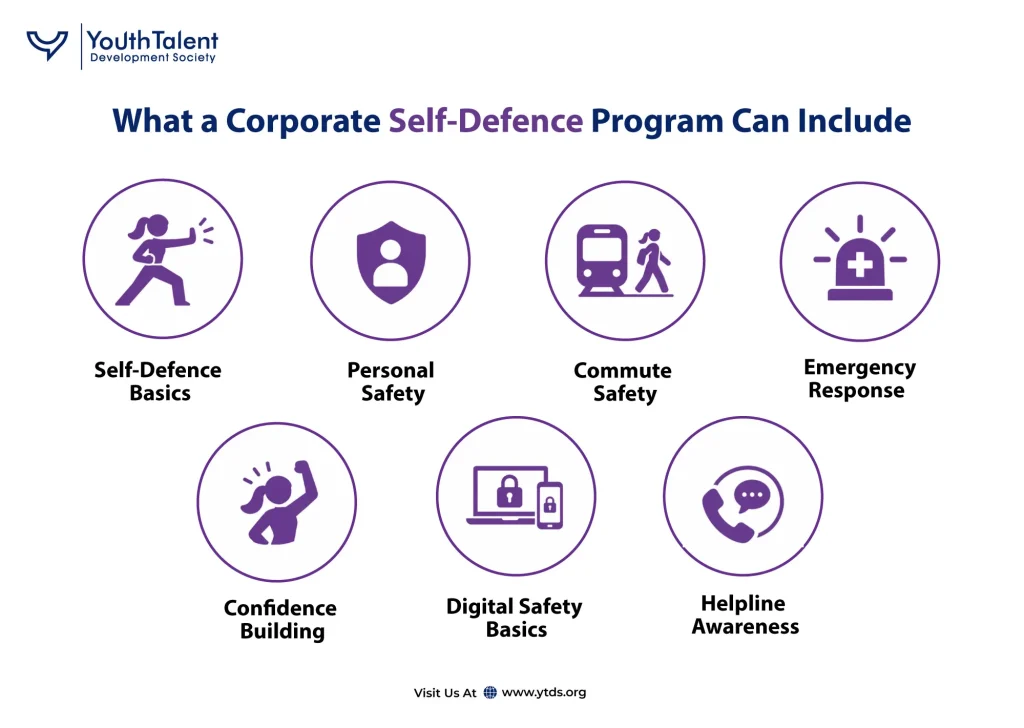
A strong corporate self-defence training program for women should be practical, safe, respectful, and easy to understand. The program should be led by trained instructors or qualified partners, especially when physical techniques are involved.
Below are the key elements companies can include.
1. Basic Self-Defence Techniques
The program can introduce simple and practical self-defence basics. These should be easy to understand and suitable for the participant group.
This may include:
- Defensive posture
- Safe distance awareness
- Simple escape techniques
- Voice response and assertive communication
- Basic reaction techniques
- Safety-first response methods
The purpose is not to make participants overconfident or aggressive. The goal is to help them understand how to respond, create distance, seek help, and protect themselves in difficult situations.
Physical self-defence training should always be conducted by trained professionals. Companies should avoid casual or unqualified instruction because safety and sensitivity are important.
2. Personal Safety Awareness
Personal safety awareness helps participants understand how to identify and avoid risky situations.
This section can cover:
- Understanding surroundings
- Identifying unsafe situations
- Avoiding risky isolation
- Being alert in public spaces
- Safe communication habits
- Trusting warning signs
- Knowing when to leave a situation
This part of the workshop helps women build practical awareness without creating fear.
The tone should be empowering. The message should be that awareness supports confidence and preparedness.
3. Commute and Public Space Safety
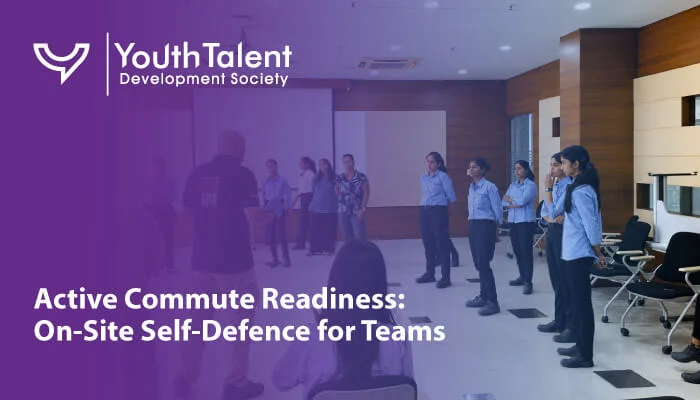
Commute safety is important for women employees, college students, frontline staff, and community women.
A corporate women safety program can include practical guidance on:
- Safe travel planning
- Public transport awareness
- Cab and auto safety basics
- Sharing location with trusted contacts
- Emergency contact readiness
- Safe return planning for late hours
- Staying aware in isolated areas
- Responding calmly in uncomfortable situations
For companies, commute safety can also connect with employee wellbeing and workplace support.
For CSR programs, this can be useful for college girls and women from communities who travel for education, work, training, or daily responsibilities.
4. Emergency Response Readiness
A self-defence program should also teach participants what to do during and after an unsafe situation.
This can include:
- Whom to contact in an emergency
- How to seek help in public spaces
- How to stay calm under pressure
- How to report an incident
- How to use emergency contacts
- How to document important details
- How to access local support systems
This section should remain general and practical. It should not be presented as legal advice. Instead, it should help participants understand the importance of being prepared and knowing available support options.
5. Confidence-Building and Communication
Women safety training should not only focus on risk. It should also support confidence, communication, and personal boundaries.
A good session can include:
- Assertive communication
- Saying no clearly
- Boundary-setting
- Speaking up in uncomfortable situations
- Reducing hesitation
- Building self-confidence
- Understanding personal space
- Responding with clarity
This makes the program more aligned with empowerment.
Confidence-building is especially useful for young women, college students, and participants who may not have access to such training before.
This can also connect with YTDS’s work around women empowerment mentorship programs, where guidance, confidence, and personal development are important themes.
6. Digital Safety Basics
Women safety today also includes online safety. Many risks now happen through smartphones, social media, messaging platforms, and digital payments.
A corporate self-defence or women safety workshop can briefly include digital safety basics such as:
- Social media privacy
- Strong password habits
- Avoiding unknown links
- Handling online harassment
- Blocking and reporting unsafe users
- Avoiding oversharing personal details
- Digital payment caution
- Recognising suspicious messages
This does not need to become a full cyber safety session, but basic digital safety awareness can make the workshop more relevant.
YTDS already covers student-focused cyber awareness, and this article can internally connect with that topic.
You can also link the classroom smartphone safety post where relevant.
7. Legal and Helpline Awareness
Women safety programs should also include awareness of where participants can seek help.
This section can cover:
- Emergency helpline awareness
- Local support systems
- Internal workplace complaint channels if applicable
- Reporting process awareness
- Importance of documentation
- Knowing whom to contact when unsafe
- Support from institutions, communities, or NGOs
This should be handled carefully and generally. The article or workshop should not provide legal advice, but it can encourage participants to know the correct reporting channels and seek help from appropriate authorities or trusted support systems.
How Companies Can Run Self-Defence Training Through CSR
Companies can support women safety and self-defence training as part of broader women empowerment, community development, and employee engagement goals.
However, companies should evaluate CSR budgeting, reporting, and expenditure treatment as per applicable CSR rules and professional guidance.
A company can run self-defence training through different formats:
- Workplace safety session for women employees
- College workshop for girls
- Community women safety workshop
- Factory or frontline worker safety program
- NGO-led women empowerment program
- Employee volunteering-supported awareness activity
- Multi-session confidence and safety training series
For CSR teams, the most useful approach is to identify a clear beneficiary group and work with an NGO partner that understands the local context.
For HR teams, the same program can be adapted for internal employee wellbeing and engagement.
For companies planning structured CSR execution, choosing the right NGO partner is important.
How Employee Volunteering Can Support Women Safety Programs
Employee volunteering can make women safety programs more engaging and organised.
Employees can support the program through:
- Registration and attendance coordination
- Awareness material distribution
- Communication support
- Mentorship sessions
- Confidence-building activities
- Follow-up coordination
- Documentation and reporting
- Event management support
- Feedback collection
However, employee volunteers should not conduct physical self-defence training unless they are professionally trained. Physical techniques should be taught only by qualified instructors.
This distinction is important because safety, sensitivity, and participant confidence are involved.
Companies can use employee volunteering to support the non-technical parts of the program, while NGOs and trained instructors manage the core training.
This connects naturally with broader corporate employee volunteering programs, where employees support social impact activities in education, environment, employment, and empowerment.
Why NGO Partners Are Important for Corporate Women Safety Programs
Companies may have the intent, funds, and employee volunteers, but successful execution requires local understanding and careful planning.
This is where NGO partners play an important role.
An NGO partner can help companies with:
- Identifying beneficiary groups
- Coordinating with colleges, communities, or institutions
- Understanding local safety needs
- Planning workshop format
- Bringing trained instructors
- Managing volunteer participation
- Conducting awareness sessions
- Collecting feedback
- Preparing reports
- Supporting follow-up programs
The National CSR Exchange Portal is positioned as a platform where implementing agencies can put up projects and companies can select social welfare projects for CSR spending, which shows the importance of company-implementation partner collaboration in CSR execution.
For women safety programs, NGO involvement is especially useful because the sessions should be handled with sensitivity, relevance, and participant comfort.
How to Plan a Corporate Self-Defence Training Program Step by Step
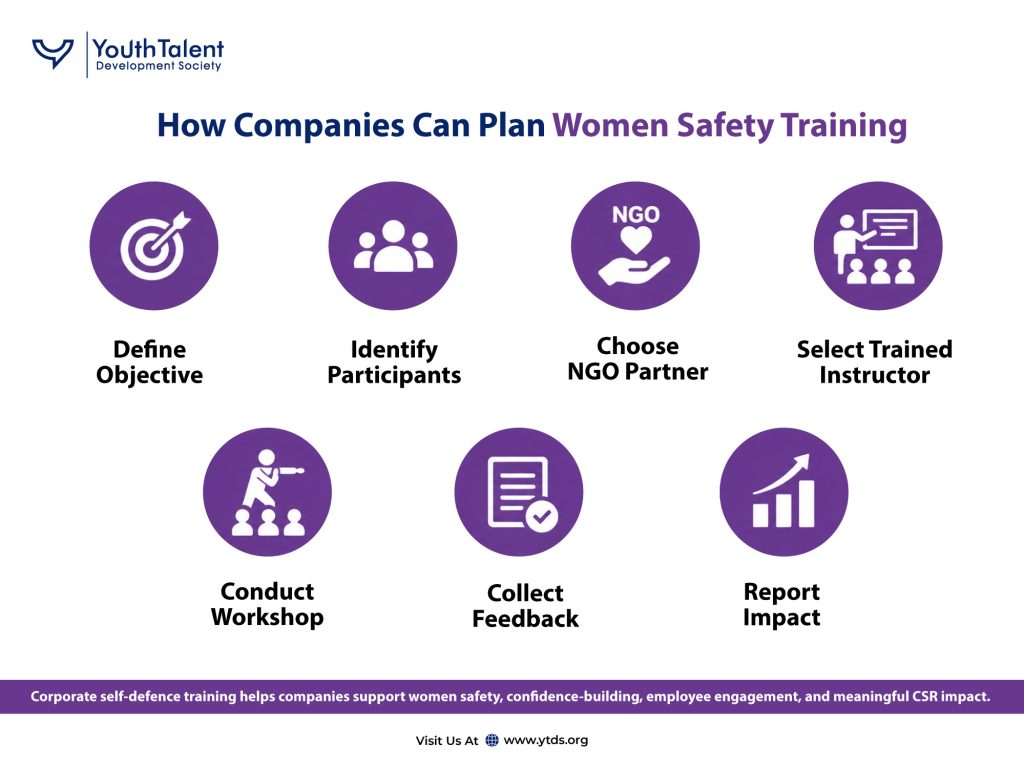
A corporate self-defence training program should not be planned casually. It needs a clear objective, safe execution, relevant trainers, and proper documentation.
Here is a simple step-by-step process.
Step 1: Define the Objective
The company should first define why it wants to conduct the program.
The objective may be:
- Employee wellbeing
- Women empowerment CSR
- College girls’ safety awareness
- Community women safety
- Confidence-building
- Safer commute awareness
- Employee volunteering engagement
A clear objective helps the company and NGO design the right format.
Step 2: Identify the Participant Group
The program should be customised for the audience.
Possible participant groups include:
- Women employees
- College girls
- School students
- Young women from communities
- Factory staff
- Frontline workers
- Women from underserved groups
A session for women employees may focus on workplace wellbeing and commute safety. A session for college girls may focus on personal safety, confidence-building, digital safety, and emergency response.
Step 3: Select the Right Format
Companies can choose from different formats depending on time, budget, and purpose.
Options include:
- One-day workshop
- Half-day awareness session
- Multi-session training
- Monthly safety series
- Employee volunteering-supported program
- College or community awareness program
A one-day session is useful for awareness. A multi-session program is better for confidence-building and deeper learning.
Step 4: Choose Trainers and NGO Partner
This is a very important step.
Companies should ensure that trainers are qualified, respectful, and experienced in working with the chosen participant group.
The NGO partner should help with:
- Program planning
- Beneficiary coordination
- Venue coordination
- Instructor arrangement
- Volunteer support
- Documentation
- Feedback collection
- Reporting
A good partner will make the program safer, more organised, and more impactful.
Step 5: Prepare Workshop Content
The workshop should be practical and balanced.
It can include:
- Self-defence basics
- Personal safety
- Commute safety
- Emergency response
- Confidence-building
- Digital safety basics
- Helpline and reporting awareness
The content should match the age, background, comfort level, and context of the participants.
Step 6: Execute With Safety and Documentation
During execution, the company and NGO should ensure a respectful, safe, and supportive environment.
Documentation can include:
- Attendance
- Photos
- Activity summary
- Volunteer participation
- Trainer notes
- Participant feedback
- Key learnings
- Follow-up suggestions
This helps the company report outcomes and plan future activities.
Step 7: Measure Impact and Plan Follow-Up
After the workshop, companies should not stop at photos and attendance.
They should also review:
- What participants learned
- Whether participants felt more confident
- What feedback was received
- Whether follow-up sessions are needed
- Whether the program can be repeated in another location
- Whether employee volunteers can support future sessions
This makes the program more meaningful and measurable.
How to Measure the Impact of Women Self-Defence CSR Programs
Impact measurement is important for CSR reporting and future planning.
Companies can track:
- Number of participants trained
- Number of workshops conducted
- Number of locations covered
- Number of employee volunteers involved
- Training hours completed
- Feedback score
- Confidence improvement feedback
- Awareness improvement feedback
- Repeat session demand
- Photos and documentation
- Follow-up actions completed
Qualitative indicators can also be useful.
For example:
- Participants felt more confident
- Participants understood basic safety awareness
- Participants learned emergency response steps
- Participants became aware of reporting channels
- Participants requested follow-up sessions
This type of reporting makes the CSR program stronger than a one-time activity.
Common Mistakes Companies Should Avoid
To make the program meaningful, companies should avoid some common mistakes.
1. Treating It as a One-Time Photo Activity
A self-defence workshop should not be done only for photos or CSR visibility. It should provide practical value to participants.
2. Not Using Trained Instructors
Physical self-defence should be taught only by qualified trainers. Untrained instruction can be unsafe and ineffective.
3. Making the Session Fear-Based
The tone should be confidence-building, not fear-based. The goal is empowerment, not anxiety.
4. Ignoring Digital and Commute Safety
Modern women safety programs should include at least basic awareness around online safety and commute safety.
5. Not Collecting Feedback
Feedback helps companies improve future sessions and understand what participants actually need.
6. Not Planning Follow-Up
One workshop can create awareness, but repeated sessions can build stronger confidence and recall.
7. Using the Same Format for Every Audience
College students, women employees, community women, and frontline workers may need different workshop formats.
How YTDS Can Support Corporate Self-Defence Training for Women
YTDS can support companies in planning and executing corporate self-defence training for women through structured workshops, NGO-led coordination, employee volunteering support, and impact reporting.
These programs can also be delivered through YTDS’s SafeHerIndia initiative, which focuses on practical self-defence, confidence-building, safety awareness, and real-world response readiness for women.
YTDS can help companies with:
- Women safety program planning
- Community or college coordination
- Self-defence workshop execution support
- Trained instructor coordination
- Awareness session planning
- Employee volunteering coordination
- Participant mobilisation
- Documentation and reporting
- Feedback collection
- Follow-up program planning
This connects strongly with YTDS’s 4E model.
Environment: School/community-based environmental awareness, plantation participation, clean-up drives, and responsible citizenship.
Empowerment: Women safety, confidence-building, self-defence, awareness, and personal preparedness.
Education: Digital safety, helpline awareness, safety education, and practical awareness sessions.
Employment: Workplace readiness, communication confidence, professional preparedness, and confidence for participation in learning or work environments.
Together, these four areas help create safer, more confident, and more aware participants across schools, colleges, workplaces, and communities.
For companies looking to create meaningful women empowerment impact, YTDS can act as a structured implementation partner.
Why Corporate Self-Defence Programs Should Be Long-Term
One workshop can be useful, but long-term programs create deeper impact.
A single session can create awareness. Repeated sessions can build confidence. A one-day workshop can teach basic concepts. Follow-up sessions can improve recall and preparedness.
Long-term programs also help companies improve reporting because they can track participation, feedback, confidence improvement, and repeat engagement over time.
Instead of treating women safety as a one-day CSR activity, companies can build it as a structured empowerment initiative.
This creates better value for participants, stronger impact documentation for companies, and more meaningful community engagement.
Conclusion
Corporate self-defence training for women can become a meaningful CSR and employee volunteering initiative when it is planned responsibly.
A strong program should combine self-defence basics with personal safety, commute safety, confidence-building, digital safety, helpline awareness, and NGO-led execution. Companies should also use trained instructors, collect feedback, measure impact, and plan follow-up sessions.
For companies, this type of initiative supports women empowerment, employee wellbeing, community safety awareness, and measurable CSR impact.
YTDS can help companies plan and execute corporate self-defence training for women through structured workshops, NGO coordination, employee engagement, documentation, and impact reporting.
Partner with YTDS to plan corporate self-defence training for women through structured workshops, NGO-led execution, employee engagement, and measurable social impact.
FAQs
1. What is corporate self-defence training for women?
Corporate self-defence training for women is a structured safety and confidence-building program planned by companies, CSR teams, HR teams, or NGOs for women employees, students, or community participants.
2. Why should companies conduct self-defence training for women?
Companies can conduct self-defence training to support women empowerment, employee wellbeing, community safety awareness, confidence-building, and CSR-led social impact.
3. Can self-defence training be part of CSR?
Women safety and empowerment programs can support broader CSR and community development goals. Companies should evaluate CSR treatment and reporting as per applicable CSR rules and professional guidance.
4. What should a women self-defence workshop include?
A workshop can include basic self-defence techniques, personal safety awareness, commute safety, emergency response, confidence-building, digital safety basics, and helpline or reporting awareness.
5. How can employee volunteering support women safety programs?
Employee volunteers can support coordination, communication, registration, awareness material distribution, mentorship, documentation, and follow-up activities. Physical self-defence training should be led by qualified instructors.
6. Why should companies work with NGOs for women safety programs?
NGOs help companies identify beneficiaries, coordinate with communities or institutions, plan workshops, arrange trained instructors, execute programs, collect feedback, document impact, and support follow-up.
7. How can YTDS support corporate self-defence training for women?
YTDS can support companies with women safety program planning, workshop coordination, trained instructor support, employee volunteering, participant mobilisation, documentation, reporting, and follow-up planning.