





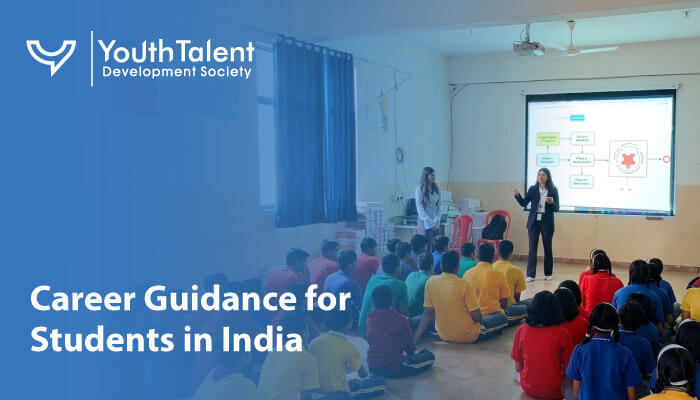
For many students, choosing a career is one of the first major decisions they are expected to make.
Yet that decision is often made with limited information.
Students may know about a handful of familiar careers but have little exposure to emerging industries, vocational pathways, scholarships, skill requirements, entrance examinations, or the realities of different occupations.
The challenge can be greater for students from underserved communities, where access to professional counsellors, industry exposure, mentors, and reliable career information may be limited.
This is why career guidance for students should go beyond asking them what they want to become.
A well-designed career guidance program helps students understand themselves, explore realistic options, learn what different careers require, and create a practical pathway from education to future opportunities.
India’s National Curriculum Framework for School Education recognizes guidance and counselling as an important part of supporting students with learning, well-being, career choices, and higher-education decisions. UNICEF has also worked with government and education partners in India to expand career-guidance access for secondary-school students.
For companies investing in education and youth development, career guidance creates an opportunity to connect CSR support with longer-term student outcomes.
Through initiatives such as Each One Teach One, YTDS supports students through education assistance, mentoring, digital access, and career-oriented guidance.
This guide explains what an effective career guidance program should include, how companies can support such programs through CSR, and how career awareness can connect education with employability.
Why Career Guidance for Students Matters
Students today have access to more education and career options than previous generations, but more choice does not necessarily make decision-making easier.
A student may need to understand:
- Which academic stream fits their interests
- Whether a vocational pathway may be appropriate
- What courses are available after school
- What skills different careers require
- Which entrance examinations apply
- What scholarships or financial support may be available
- Whether a career requires a degree, certification, apprenticeship, or practical training
- What employment opportunities exist in different sectors
- How changing technology is affecting career paths
Without structured guidance, students may rely heavily on family expectations, peer choices, social media, or incomplete information.
Career guidance gives them a more informed starting point.
The goal is not to choose a career on behalf of the student.
The goal is to help the student make a better-informed decision.
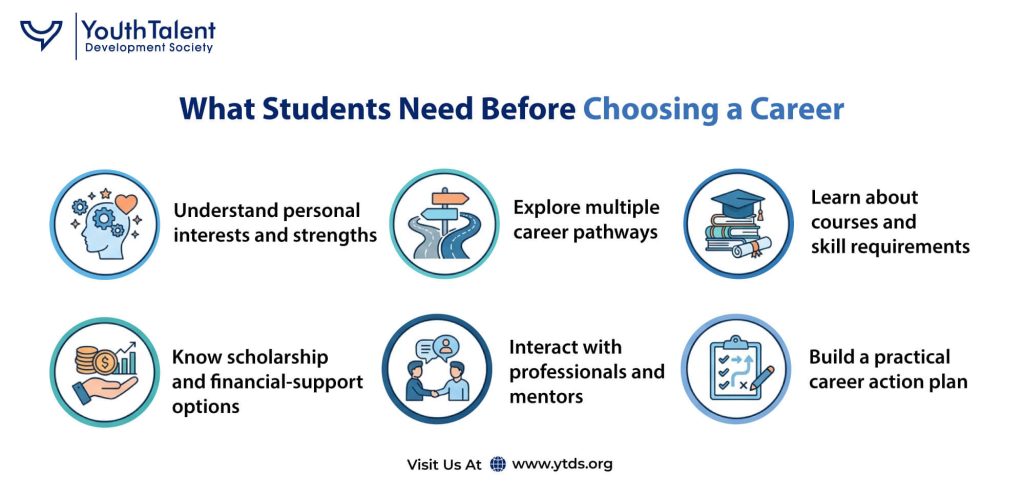
Career Guidance vs Career Counselling vs Career Mentoring
These terms are often used interchangeably, but they can serve different purposes.
| Approach | Primary Purpose | Typical Activities |
|---|---|---|
| Career Guidance | Helps students understand options and pathways | Career awareness, course information, education pathways, career exploration |
| Career Counselling | Provides more individualised support for decisions | One-to-one discussions, assessments, decision support, personalised planning |
| Career Mentoring | Connects students with experienced individuals | Industry conversations, professional insights, workplace exposure, ongoing guidance |
| Career Readiness | Prepares students for transition into further education or work | Communication, resume basics, interviews, workplace behaviour, digital skills |
A strong student-development program may combine several of these elements rather than treating them as separate activities.
When Should Career Guidance Begin?
Career guidance should not begin only when a student is about to leave school.
Different age groups need different kinds of guidance.
Middle-School Students
The emphasis can be on:
- Understanding interests
- Exploring different occupations
- Challenging stereotypes about careers
- Building curiosity about work and society
- Connecting subjects with real-world applications
Secondary-School Students
Programs can become more structured around:
- Stream selection
- Career clusters
- Course options
- Vocational education
- Scholarships
- Entrance examinations
- Skill pathways
Higher-Secondary Students
Students may need more detailed guidance on:
- College and course selection
- Vocational and technical education
- Professional certifications
- Apprenticeships
- Employment pathways
- Entrepreneurship
- Financial planning for education
The earlier students begin exploring options, the less pressure they may face when an immediate decision becomes necessary.
What Should a Career Guidance Program for Students Include?
An effective program should provide more than a motivational speech or a list of popular careers.
1. Self-Awareness
Students should begin by reflecting on:
- Interests
- Strengths
- Learning preferences
- Values
- Skills
- Aspirations
Self-awareness does not mean that a student must identify one lifelong career at an early age.
Instead, it helps them understand what kinds of learning and work environments may suit them.
2. Career Awareness
Students need exposure to a wider range of careers.
This can include:
- Science and technology
- Healthcare
- Finance and accounting
- Design
- Manufacturing
- Skilled trades
- Digital careers
- Public services
- Agriculture
- Sustainability
- Logistics
- Entrepreneurship
- Social sector careers
Career awareness should also explain what professionals actually do rather than focusing only on job titles.
3. Education Pathways
Students should understand how education connects with different careers.
Programs can explain:
- Academic streams
- Diploma programs
- Industrial Training Institutes
- Degree courses
- Vocational education
- Professional certifications
- Apprenticeships
- Skill-development programs
This is particularly important because not every successful career follows the same academic pathway.
4. Course and Institution Research
Students should learn how to compare education options rather than choosing only based on familiarity or popularity.
They can be taught to examine:
- Eligibility requirements
- Curriculum
- Duration
- Recognition
- Costs
- Location
- Practical training
- Placement support
- Future education pathways
The objective is to teach students how to evaluate options, not simply hand them a list.
5. Scholarships and Financial Support
Cost can significantly influence education decisions.
Career guidance programs should therefore help students understand where they can look for:
- Scholarships
- Government schemes
- Institutional financial aid
- Education support programs
- CSR-supported opportunities
Students should also be encouraged to verify eligibility and application requirements from official sources.
6. Career Conversations With Professionals
One of the most valuable forms of exposure is hearing directly from people working in different fields.
Employees and industry professionals can explain:
- What their job actually involves
- What skills they use
- How they entered the field
- Challenges they encountered
- What students should learn
- How their sector is changing
These conversations can make unfamiliar careers feel more understandable.
7. Workplace and Industry Exposure
Where appropriate, programs can include:
- Workplace visits
- Virtual industry sessions
- Job-shadowing opportunities
- Professional demonstrations
- Career fairs
- Industry panels
This helps students connect classroom learning with the world of work.
8. Career Planning
Students should leave the program with practical next steps.
A simple career plan might include:
Career area of interest
↓
Education or skill requirements
↓
Courses/institutions to research
↓
Entrance or eligibility requirements
↓
Skills to develop
↓
Short-term actions
The plan does not need to be permanent.
Its purpose is to give students direction while leaving room for learning and change.
Why Career Guidance Is Especially Important for Underserved Students
Students do not all begin with the same access to information and networks.
Some students can easily speak with family members working across different professions.
Others may have little exposure beyond the occupations visible in their immediate community.
Students from underserved communities may face additional barriers such as:
- Limited access to career counsellors
- Lack of reliable information
- Financial constraints
- Limited digital access
- Fewer professional networks
- Language barriers
- Lack of industry exposure
- Social or gender expectations
- Uncertainty about higher education
This is where structured programs can create value.
Career guidance cannot remove every economic or social barrier, but it can help students see a wider range of possibilities and understand the steps required to pursue them.
How Companies Can Support Career Guidance Through CSR
Companies can contribute more than funding.
They can bring together resources, professional knowledge, employee volunteers, and implementation partnerships.
1. Sponsor School-Based Career Guidance Programs
Companies can support structured programs across schools or communities.
A program may include:
- Career-awareness workshops
- Individual or group guidance
- Career-resource materials
- Mentoring
- Industry sessions
- Career planning
- Digital resources
- Follow-up sessions
Companies already investing in school development can integrate career guidance into a broader education strategy.
Our guide to CSR education partnerships in India explains how companies can work with NGOs to build longer-term education programs.
2. Engage Employees as Career Mentors
Employee volunteering can be particularly valuable in career guidance.
Employees can speak with students about:
- Their profession
- Education choices
- Career transitions
- Workplace expectations
- Communication skills
- Technology
- Problem-solving
- Professional behaviour
The employee’s role should be to expose students to real experiences, not pressure them toward a particular career.
Companies planning broader volunteering initiatives can also explore our guide to corporate employee volunteering programs in India.
3. Support Career Exposure for Rural and Underserved Students
Companies can help bring career information to students who may otherwise have limited access.
Programs may use:
- School workshops
- Community sessions
- Digital learning
- Mobile career resources
- Regional-language content
- Virtual mentoring
- Career fairs
The delivery model should match local infrastructure and student needs.
4. Connect Career Guidance With Digital Literacy
Many career decisions now require students to navigate digital platforms.
They may need to research:
- Colleges
- Scholarships
- Entrance examinations
- Courses
- Skills programs
- Apprenticeships
- Employment portals
Career guidance should therefore include basic digital research skills and online safety.
YTDS’s work around digital literacy in rural India shows how digital access and practical digital skills can support broader education and opportunity.
5. Connect Guidance With Skill Development
Career awareness becomes more useful when students also understand what skills they need.
For example:
A student interested in accounting may need to understand bookkeeping, spreadsheets, taxation, and accounting software.
A student considering digital marketing may need communication, content, analytics, and digital-platform skills.
A student interested in technical trades may need vocational training or certification.
This creates a natural connection between:
Career Awareness → Skill Development → Employability
From Career Guidance to Career Readiness
Career guidance should ultimately help students move toward action.
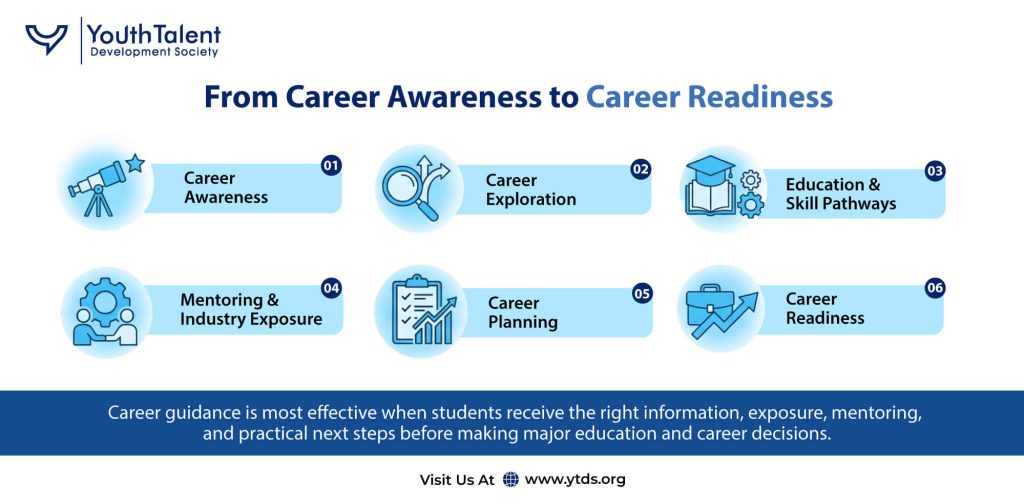
Career readiness may include:
- Communication
- Digital literacy
- Workplace behaviour
- Problem-solving
- Resume basics
- Interview preparation
- Professional confidence
- Financial awareness
Companies can therefore treat career guidance as one stage within a broader youth-development pathway.
This is especially relevant for CSR programs that aim to connect education with employability rather than measuring success only through workshop attendance.
What Role Can Employee Volunteers Play?
Employee mentors can add practical exposure that schools may find difficult to provide on their own.
Possible activities include:
Career Talks
Employees explain their profession and answer student questions.
Small-Group Mentoring
Volunteers work with small groups around career exploration, skills, and professional development.
Industry Panels
Professionals from different departments or industries discuss different career pathways.
Resume and Interview Sessions
Older students learn the basics of presenting themselves professionally.
Workplace Exposure
Where practical and appropriate, students can visit workplaces or attend virtual sessions.
Skill Demonstrations
Professionals demonstrate how real workplace skills are used.
Employee participation should complement trained educators, counsellors, and implementation teams rather than replace professional counselling where it is needed.
How to Design a Career Guidance CSR Program
Companies should begin with the student population rather than starting with a pre-designed workshop.
Step 1: Understand Student Needs
Assess:
- Age
- Grade
- Location
- Language
- Existing career awareness
- Digital access
- Education aspirations
- Major information gaps
Step 2: Define Program Outcomes
Decide what students should gain.
Possible outcomes include:
- Greater awareness of career options
- Better understanding of education pathways
- Improved knowledge of scholarships
- Increased confidence in career research
- Exposure to professionals
- Individual career action plans
Step 3: Build the Program Structure
The program may combine:
- Classroom sessions
- Counselling
- Digital resources
- Mentoring
- Industry exposure
- Career planning
- Follow-up
Step 4: Select the Right Implementation Partner
Career guidance programs require more than event coordination.
Companies should look for an implementation partner that can support:
- School/community mobilisation
- Student engagement
- Career content
- Mentor coordination
- Program delivery
- Documentation
- Follow-up
- Impact measurement
Companies evaluating NGOs can use our guide to choosing a CSR implementation partner in India.
Step 5: Train Employee Volunteers
Employees should receive a clear briefing before interacting with students.
They need to understand:
- Program objectives
- Student age group
- Volunteer boundaries
- Session format
- Appropriate communication
- How to avoid imposing personal career preferences
Step 6: Deliver Guidance in Stages
Instead of covering everything in one session, the program can progress through:
Awareness
↓
Exploration
↓
Pathway Research
↓
Mentoring
↓
Career Planning
↓
Follow-Up
This creates a more meaningful learning journey than a single motivational event.
Step 7: Measure Outcomes
The program should measure more than attendance.
Useful indicators can include:
Pre- and post-program assessments can help companies understand whether awareness actually improved.
| Metric | What to Track |
|---|---|
| Students Reached | Number of students participating in the program |
| Schools Covered | Number of schools or educational institutions supported |
| Career Awareness | Improvement in students’ knowledge of career options |
| Pathway Awareness | Understanding of courses, skills, qualifications, and education routes |
| Mentor Participation | Number of employee or professional mentors involved |
| Career Plans | Students completing an individual career action plan |
| Scholarship Awareness | Students introduced to relevant scholarships and financial-support resources |
| Follow-Up Participation | Students attending later mentoring or guidance sessions |
| Student Feedback | Changes in confidence, perceived usefulness, and remaining questions |
What Companies Should Avoid
One-Time Motivational Sessions Without Follow-Up
Inspiration can be useful, but it is not the same as structured career guidance.
Promoting Only a Few Popular Careers
Students should be exposed to academic, vocational, technical, professional, entrepreneurial, and emerging pathways.
Treating Assessments as Final Answers
Assessments may support exploration, but students should not be reduced to a score that supposedly determines their future.
Ignoring Financial Constraints
Career planning should include realistic information about course costs, scholarships, and alternative pathways.
Ignoring Parents and Teachers
In many communities, education and career decisions involve families and schools.
Including them appropriately can improve program effectiveness.
Measuring Only Student Attendance
A room full of students does not automatically indicate improved career understanding.
Career Guidance and India’s Education Priorities
Career guidance is increasingly recognised as part of broader student development.
India’s National Education Policy 2020 specifically refers to community and alumni involvement in career guidance and mentoring for students.
The National Curriculum Framework for School Education also treats guidance and counselling as part of supporting students with learning, well-being, higher-education choices, and careers.
UNICEF India has supported career-guidance initiatives that help secondary students access information on educational and occupational pathways.
These developments reinforce an important point:
Career guidance should not sit outside education.
It should help students understand where education can take them.
How YTDS Supports Student Career Guidance and Mentoring
Youth Talent Development Society works across Education, Employment, Empowerment, and Environment, with education programs designed to help students access learning opportunities and build practical pathways toward the future.
Through Each One Teach One, YTDS supports students through areas such as:
- Educational support
- Digital access
- Academic mentoring
- Career planning
- Volunteer mentoring
- Learning resources
- CSR partnerships
The initiative also enables professionals to participate as trainers and mentors, helping students understand academic challenges and career planning.
YTDS can work with companies to structure student-focused programs around school needs, employee volunteering, mentoring, digital support, and longer-term educational development.
Companies interested in building a career-guidance or student-mentoring initiative can contact YTDS to discuss CSR partnership opportunities.
Conclusion
Career decisions can influence a student’s education, skill development, and future employment opportunities.
Yet many students are expected to make those decisions without enough exposure to careers, education pathways, professional networks, or reliable guidance.
Effective career guidance for students in India should therefore go beyond career lists and motivational sessions.
It should help students understand themselves, explore multiple pathways, access reliable information, interact with professionals, and create practical next steps.
For companies, career guidance can become an important part of education CSR by combining school partnerships, professional mentoring, digital resources, career awareness, and measurable student outcomes.
When these elements are connected, CSR programs can help students move from:
“What should I become?”
to:
“What options do I have, what do they require, and what can I do next?”
Through Each One Teach One, YTDS works with students, volunteers, and corporate partners to strengthen education support and help young people build more informed pathways toward their future.
Planning a career guidance or student mentoring program through CSR? Connect with YTDS to explore a structured education partnership.
Frequently Asked Questions
1. What is career guidance for students?
Career guidance helps students understand career options, education pathways, skill requirements, and future opportunities so they can make more informed education and career decisions.
2. Why is career guidance important for school students?
Students often need to make decisions about academic streams, courses, vocational options, and higher education before they have much exposure to the world of work. Career guidance provides structured information and exploration before these decisions are made.
3. What should a school career guidance program include?
A strong program can include self-awareness, career exploration, education pathways, scholarships, mentoring, professional interactions, career planning, and follow-up support.
4. What is the difference between career guidance and career counselling?
Career guidance usually focuses on providing information and helping students explore options. Career counselling may involve more personalised support, assessments, and individual decision-making assistance.
5. Can companies support career guidance through CSR?
Yes. Companies can support school-based career programs, mentoring, career-awareness workshops, digital resources, industry exposure, and longer-term student-development initiatives through appropriate CSR partnerships.
6. How can employees participate in career guidance programs?
Employees can volunteer as mentors, conduct career talks, participate in industry panels, explain workplace skills, help students understand professions, and support career-readiness sessions.
7. Is career guidance only for students planning to attend college?
No. Career guidance should cover multiple pathways, including higher education, vocational education, technical training, apprenticeships, professional certifications, entrepreneurship, and skill-development programs.
8. How should companies measure the impact of career guidance programs?
Companies can track students reached, career-awareness improvement, pathway knowledge, mentor participation, career action plans, scholarship awareness, follow-up participation, and student feedback.
9. How can career guidance help rural students?
It can expand students’ exposure to careers, education pathways, scholarships, vocational opportunities, and professional networks that may not be readily available in their immediate communities.
10. How can companies partner with YTDS for career guidance programs?
Companies can work with YTDS through its education initiatives to support student mentoring, career-awareness programs, employee volunteering, digital access, school partnerships, and structured CSR implementation. Companies can contact YTDS to discuss a program.