







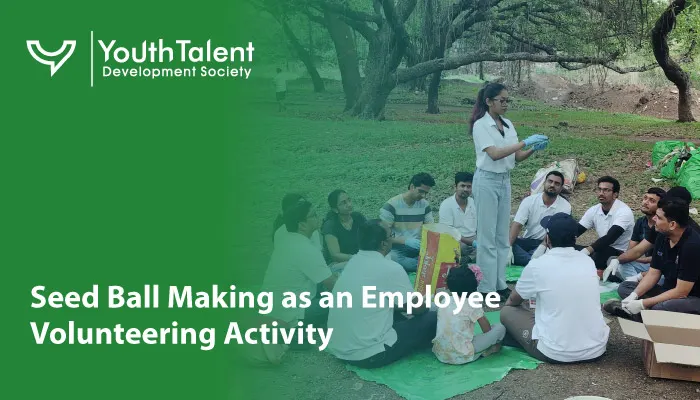
Employee volunteering works best when people can participate in a meaningful activity, understand its purpose, and see how their contribution connects to a larger environmental goal.
One such activity is seed ball making.
A well-planned seed ball activity can bring employees together around environmental restoration while also helping companies introduce biodiversity, native species, ecological awareness, and community participation into their volunteering programs.
But seed ball making should not be treated as a simple craft activity.
The real impact depends on what seeds are used, where the seed balls are deployed, when they are dispersed, how suitable the site is, and whether the activity is connected to a broader restoration plan.
Through its Seed The Future initiative, YTDS uses seed ball preparation and deployment as part of a wider environmental restoration and volunteering approach.
This guide explains how companies can organize a seed ball activity under CSR or employee volunteering, what the activity should include, and how to make it more meaningful than a one-day engagement exercise.
What Is a Seed Ball Activity?
A seed ball is typically made by combining seeds with a protective mixture such as clay, soil, and organic material.
The mixture helps hold the seed together and provides some protection until suitable moisture and environmental conditions support germination.
Seed ball activities may involve:
- Selecting appropriate native seeds
- Preparing the soil or clay mixture
- Forming the seed balls
- Drying them
- Deploying them at suitable restoration sites
- Tracking the activity and site outcomes
Seed balls can support restoration in suitable areas, especially where conventional plantation may be difficult.
However, seed balls are not a substitute for every type of plantation activity.
They should be used only where the species, site conditions, timing, and ecological objectives make sense.
Why Seed Ball Making Works Well for Employee Volunteering
Seed ball making is particularly suitable for employee engagement because it is:
Easy to Participate In
Employees do not need specialised environmental knowledge to take part in the preparation activity when they are properly guided.
Collaborative
Teams can work together in groups, making it suitable for employee volunteering days, sustainability weeks, and environmental campaigns.
Educational
The activity creates an opportunity to explain:
- Native species
- Biodiversity
- Soil health
- Ecosystem restoration
- Seasonal planting
- Long-term environmental responsibility
Scalable
A company can organise a small activity with a single team or a larger volunteering event across multiple locations.
Seed Ball Making vs Traditional Tree Plantation
Both activities can support environmental programs, but they serve different purposes.
Companies should not choose between these activities based only on what is easiest to organise.
The right activity depends on the site and the intended environmental outcome.
For companies planning conventional plantation volunteering, our guide to employee tree plantation drives explains how to structure the activity around employee participation and long-term environmental impact.
How to Organize a Seed Ball Employee Volunteering Activity
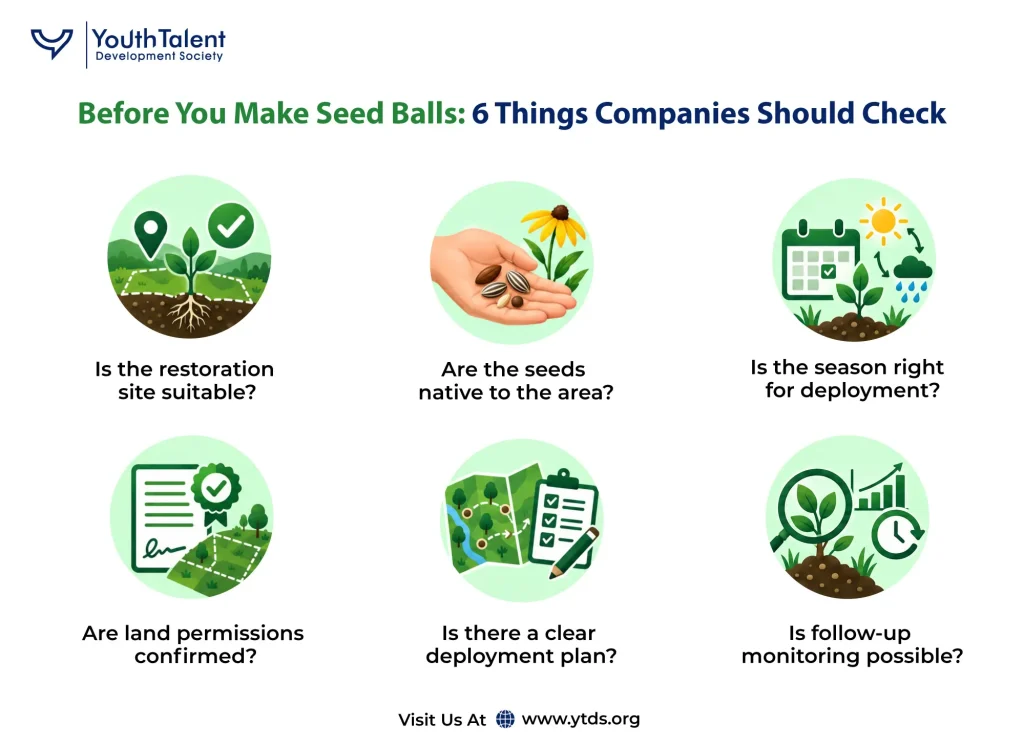
A successful activity begins before employees start making the seed balls.
Step 1: Define the Environmental Objective
Start by deciding what the activity is intended to support.
Possible objectives include:
- Ecological restoration
- Native vegetation recovery
- Biodiversity awareness
- Employee environmental volunteering
- Restoration of degraded land
- Community participation
- Environmental education
Avoid setting a target based only on the number of seed balls created.
A large number of poorly planned seed balls does not automatically translate into ecological impact.
Step 2: Identify an Appropriate Restoration Site
Seed balls should be connected to a real site and restoration purpose.
Before the event, the implementation team should assess:
- Existing vegetation
- Soil conditions
- Rainfall
- Site accessibility
- Local ecology
- Competing or invasive species
- Land ownership or permissions
- Suitability for the proposed plant species
The goal should be ecological fit rather than simply finding an open area where seed balls can be thrown.
YTDS’s environmental work includes hill restoration, seedball deployment, plantation, cleanup, and other ecological interventions depending on site conditions.
Companies interested in broader restoration approaches can also review our guide to hill ecosystem restoration.
Step 3: Choose Native and Site-Appropriate Seeds
Seed selection is one of the most important parts of the activity.
Companies should avoid choosing seeds simply because they germinate quickly or are easy to purchase.
The implementation partner should consider:
- Native suitability
- Local biodiversity
- Climate
- Soil type
- Rainfall pattern
- Ecological role
- Invasive-species risk
- Restoration objective
Step 4: Prepare the Seed Ball Mixture
A typical seed ball mixture may include:
- Clay
- Soil
- Organic matter
- Seeds
- Water
The exact composition should be determined based on seed type and environmental conditions.
The purpose of the mixture is to keep the seed protected and intact until appropriate moisture conditions occur.
Employees should be shown the correct size, consistency, and handling process before the activity begins.
Step 5: Brief Employees Before the Activity
Do not begin with only a demonstration of how to roll a seed ball.
A short orientation should explain:
- Why seed balls are being used
- Which species are included
- Where they will be deployed
- What ecological problem the project is addressing
- Why native species matter
- What happens after the volunteering activity
This helps employees understand that they are participating in a restoration program, not just completing an office engagement activity.
Companies looking for broader employee engagement ideas can also explore our guide to corporate employee volunteering programs in India.
Step 6: Organize the Seed Ball Making Activity
The actual volunteering session can be structured into teams.
A simple workflow may include:
- Employee registration
- Environmental orientation
- Seed and species briefing
- Mixture preparation
- Seed ball formation
- Drying and storage
- Counting and documentation
- Deployment briefing
Depending on the scale of the event, employees may also participate in packaging, site preparation, awareness activities, or deployment.
Step 7: Dry and Store the Seed Balls Properly
Seed balls usually need to dry before transportation or deployment.
Poor storage can damage the balls or affect seed viability.
The implementation team should manage:
- Drying conditions
- Labelling
- Seed/species records
- Packaging
- Storage
- Transportation
This is particularly important when seed ball preparation and deployment happen on different dates.
Step 8: Deploy Them at the Right Time
Timing matters.
Seed ball deployment is often aligned with rainfall or site-specific moisture conditions so seeds have a better chance of germinating.
The right deployment period depends on:
- Region
- Rainfall
- Species
- Site conditions
- Restoration plan
Companies should avoid deploying seed balls only because the volunteering event happens on a particular date.
The ecological calendar should guide the activity calendar, not the other way around.
Step 9: Document the Activity
Useful documentation may include:
- Number of employees involved
- Number of seed balls prepared
- Species used
- Date and location
- Restoration site
- Deployment quantity
- Photographs
- Geo-tagged records
- Partner organisation
- Volunteer hours
Step 10: Monitor What Happens After Deployment
The activity should not end when the seed balls are dispersed.
Where practical, companies and implementation partners should track:
- Germination
- Vegetation establishment
- Site changes
- Seasonal conditions
- Survival
- Community participation
- Need for complementary restoration work
Not every seed ball will germinate, and germination itself does not guarantee long-term ecological restoration.
This is why reporting should distinguish clearly between:
seed balls prepared,
seed balls deployed,
germination observed, and
vegetation established.
What Makes a Seed Ball Activity Meaningful?
A meaningful corporate activity has five important characteristics.
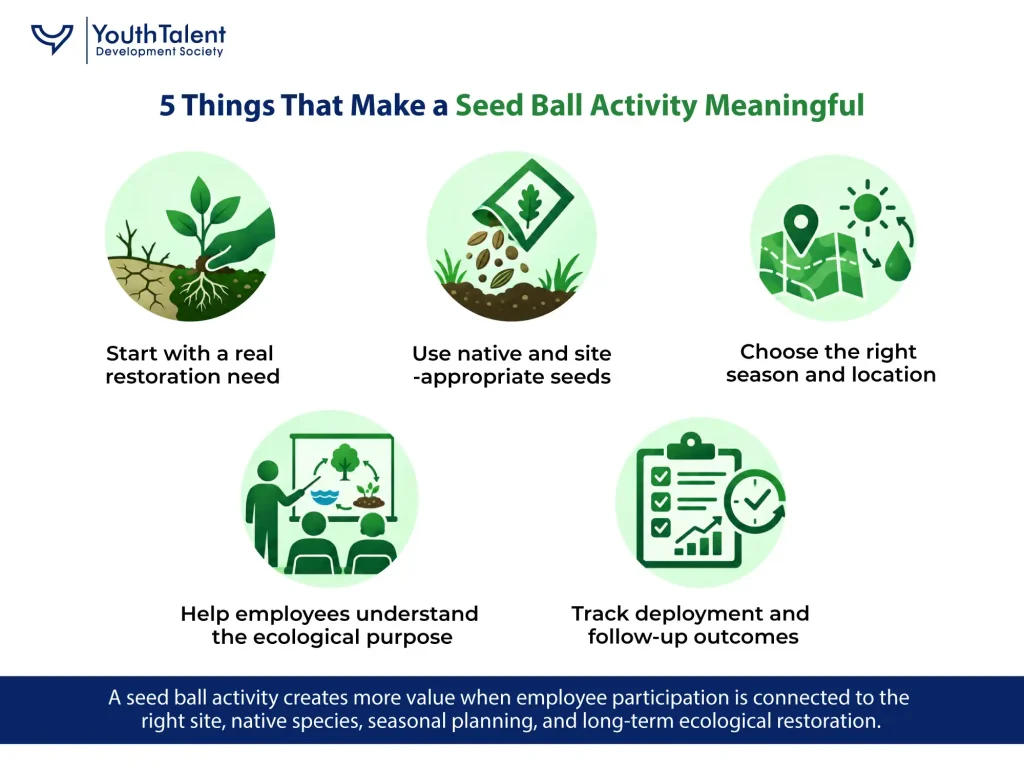
1. It Is Site-Led
The environmental need comes first.
2. It Uses Appropriate Seeds
Species selection is based on local ecology rather than convenience.
3. Employees Understand the Purpose
Volunteers know how their activity connects to the larger restoration goal.
4. Deployment Is Planned Properly
Timing and site selection are not left to chance.
5. Impact Is Reported Credibly
Companies report what was actually completed rather than making unsupported claims about future forest cover or carbon impact.
Common Mistakes Companies Should Avoid
Treating Seed Ball Making as Only a Team-Building Activity
Employee engagement is valuable, but the environmental purpose should remain central.
Using Random or Non-Native Seeds
Poor species selection may reduce ecological value and can potentially create problems at the restoration site.
Deploying Seed Balls Anywhere
Open land does not automatically mean suitable restoration land.
Focusing Only on Quantity
“10,000 seed balls made” is an activity metric, not an ecological outcome.
Ignoring the Season
Deployment should match environmental conditions and species requirements.
Claiming Every Seed Ball Will Become a Tree
Germination and establishment depend on many environmental factors.
Impact communication should remain realistic.
How Companies Can Use Seed Ball Activities in Employee Volunteering Programs
Seed ball activities can be included within:
- Environment Day programs
- Sustainability Month
- ESG engagement initiatives
- Employee volunteering calendars
- Biodiversity campaigns
- CSR environment programs
- Community volunteering
- School or college awareness activities
- Restoration initiatives
They can also work well as part of a larger environmental program alongside:
- Tree plantation
- Native forest development
- Cleanup activities
- Biodiversity awareness
- Water conservation
- Habitat restoration
For companies that want a broader environmental CSR mix, YTDS also supports Plant A Million Trees and other environmental initiatives.
How to Measure a Corporate Seed Ball Activity
The company should track both engagement and environmental indicators.
The reporting framework should avoid converting activity metrics into environmental claims without supporting evidence.
Seed Ball Activity vs One-Day Plantation Events
Companies sometimes look for environmental activities that can engage many employees within a limited time.
Seed ball making can help, but the objective should not be to replace one one-day activity with another.
The better approach is to connect employee participation to a longer environmental program.
For example:
Employee Activity Day
↓
Seed Ball Preparation
↓
Site-Based Deployment
↓
Seasonal Monitoring
↓
Restoration Reporting
This creates a stronger CSR story than simply reporting the number of employees who attended the event.
How YTDS Supports Corporate Seed Ball Activities
YTDS works across environmental restoration, employee volunteering, tree plantation, hill restoration, and community participation.
Through Seed The Future, YTDS supports seed ball preparation and deployment with a focus on ecological restoration and volunteer engagement.
The campaign includes support for:
- Seed ball preparation
- Drive execution
- Volunteer mobilisation
- Logistics and transport
- Awareness and engagement
- Field documentation
- Geo-tag verification
- Progress tracking
Companies evaluating broader implementation support can also review our guide on choosing a CSR implementation partner in India.
Planning a Seed Ball Employee Volunteering Activity With YTDS
Before organising the activity, companies should consider:
- Number of participating employees
- Preferred location
- Environmental objective
- Suitable restoration sites
- Season
- Native seed availability
- Employee volunteering format
- Reporting requirements
- Whether the activity is part of a larger CSR initiative
YTDS can help companies structure the activity around both employee engagement and ecological relevance.
Companies interested in organising a seed ball activity can contact YTDS to discuss volunteering, restoration, and CSR partnership opportunities.
Conclusion
Seed ball making can be a practical and engaging employee volunteering activity when it is connected to a real ecological purpose.
The strongest programs do more than bring employees together to make seed balls.
They begin with the right restoration site, use suitable native species, follow seasonal conditions, involve employees through environmental education, document deployment, and monitor outcomes wherever feasible.
For companies, this creates an opportunity to combine employee participation with biodiversity awareness and environmental restoration.
Through Seed The Future, YTDS helps organisations connect seed ball preparation, volunteer mobilisation, site-based deployment, and environmental reporting within a structured restoration initiative.
Planning a seed ball employee volunteering activity? Connect with YTDS to explore a structured Seed The Future collaboration.
Frequently Asked Questions
1. What is a seed ball activity?
A seed ball activity involves preparing seeds inside a protective mixture of soil, clay, and other suitable materials before deploying them at appropriate restoration sites.
2. Can seed ball making be used for employee volunteering?
Yes. Seed ball preparation can work well as an employee volunteering activity when it is properly guided and linked to an actual ecological restoration program.
3. What seeds should companies use in seed balls?
Seed selection should be based on local ecology, climate, soil, restoration objectives, and native-species suitability. Companies should avoid selecting species only because they are easy to obtain.
4. When should seed balls be deployed?
Deployment timing depends on rainfall, location, species, and site conditions. The implementation partner should determine the appropriate period rather than scheduling deployment only around a corporate event date.
5. Are seed balls better than tree plantation?
Neither activity is automatically better. Seed balls and conventional plantation serve different environmental purposes and should be chosen based on site conditions and restoration objectives.
6. How can companies measure seed ball activity impact?
Companies can track employees engaged, volunteer hours, seed balls prepared, seed balls deployed, native species used, sites covered, monitoring visits, and observed germination or vegetation establishment where feasible.
7. Can seed balls be deployed on any unused land?
No. The restoration site should be assessed for land permissions, ecological suitability, existing vegetation, soil conditions, and species compatibility.
8. Why are native seeds important?
Native species are generally better aligned with local ecosystems and biodiversity objectives. Species selection should still be based on the specific site and restoration plan.
9. How can seed ball activities support CSR goals?
They can support environmental awareness, employee volunteering, biodiversity initiatives, ecological restoration, and community engagement when designed within a structured program.
10. How can companies partner with YTDS for a seed ball activity?
Companies can work with YTDS through the Seed The Future initiative for activity planning, volunteer mobilisation, seed ball preparation, restoration-site coordination, deployment, documentation, and follow-up. Companies can contact YTDS to discuss a program.