







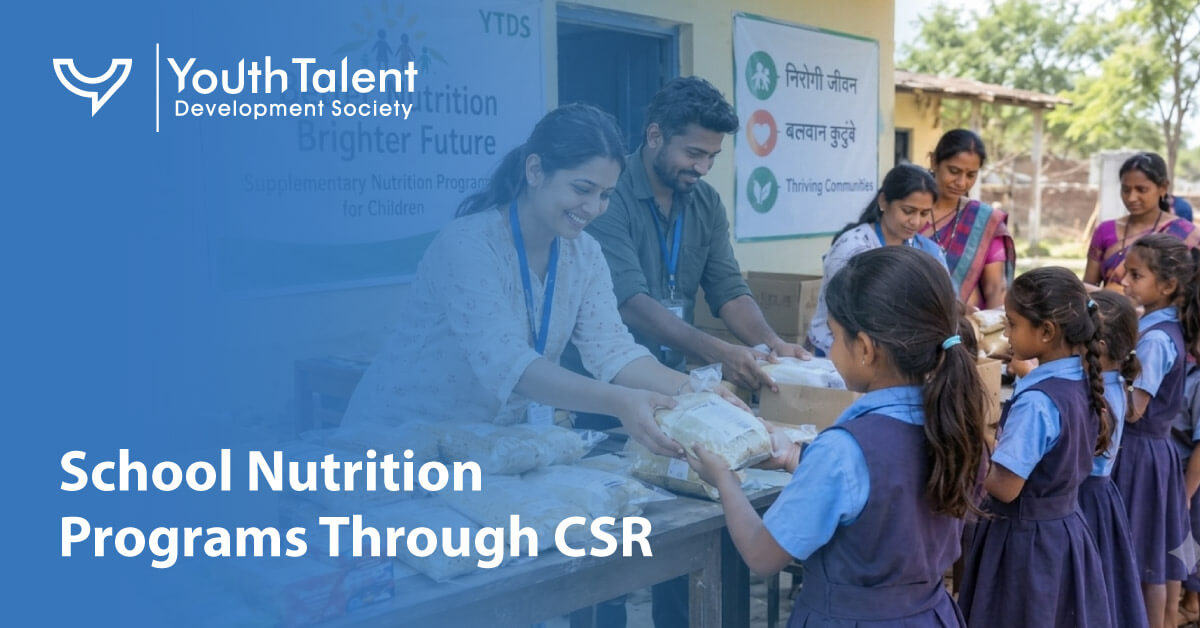
A child cannot learn effectively when hunger, poor nutrition, dehydration, or preventable health issues interfere with the school day.
This is why school nutrition should not be viewed only as a health issue.
It is closely connected with:
- attendance
- concentration
- classroom participation
- physical development
- energy levels
- school retention
- overall learning readiness
India’s PM POSHAN programme reflects this connection between nutrition and education. The scheme aims to improve children’s nutritional status while also encouraging regular school attendance and helping students concentrate on classroom activities.
For companies investing in education, health, or community development, school nutrition programs through CSR can therefore create value across multiple outcomes.
But an effective program should go beyond distributing food occasionally.
Companies need to understand what children actually need, how schools currently manage nutrition, where gaps exist, and how food, health, hygiene, awareness, and monitoring can work together.
This guide explains how companies can approach school nutrition CSR in a structured, practical, and measurable way.
Why School Nutrition Matters for Learning
Nutrition directly influences a student’s ability to participate in school.
When children regularly miss meals or consume diets that lack essential nutrients, they may experience:
- low energy
- difficulty concentrating
- frequent illness
- reduced classroom participation
- poor physical development
- irregular attendance
For schools serving children from vulnerable communities, nutrition support can therefore become part of the learning environment itself.
PM POSHAN specifically connects school meals with improving nutritional status, attendance, retention, and classroom concentration.
This makes nutrition particularly relevant for companies already investing in:
- school development
- education CSR
- child welfare
- health programs
- rural development
- women and community empowerment
What Is a School Nutrition Program Through CSR?
A school nutrition CSR program is a corporate-supported initiative designed to improve children’s access to nutritious food, nutrition awareness, healthy habits, or related school-health support.
Depending on local needs, the program may include:
- supplementary meals
- breakfast support
- nutritious snacks
- micronutrient support through appropriate health systems
- nutrition awareness
- school nutrition gardens
- clean drinking water
- hygiene education
- health screening
- anaemia awareness
- parent education
- kitchen or food-service improvements
- monitoring and follow-up
The right approach depends on the school, age group, geography, existing government schemes, and identified nutrition gaps.
Companies should avoid assuming that every school needs the same intervention.
School Nutrition Is More Than a Meal
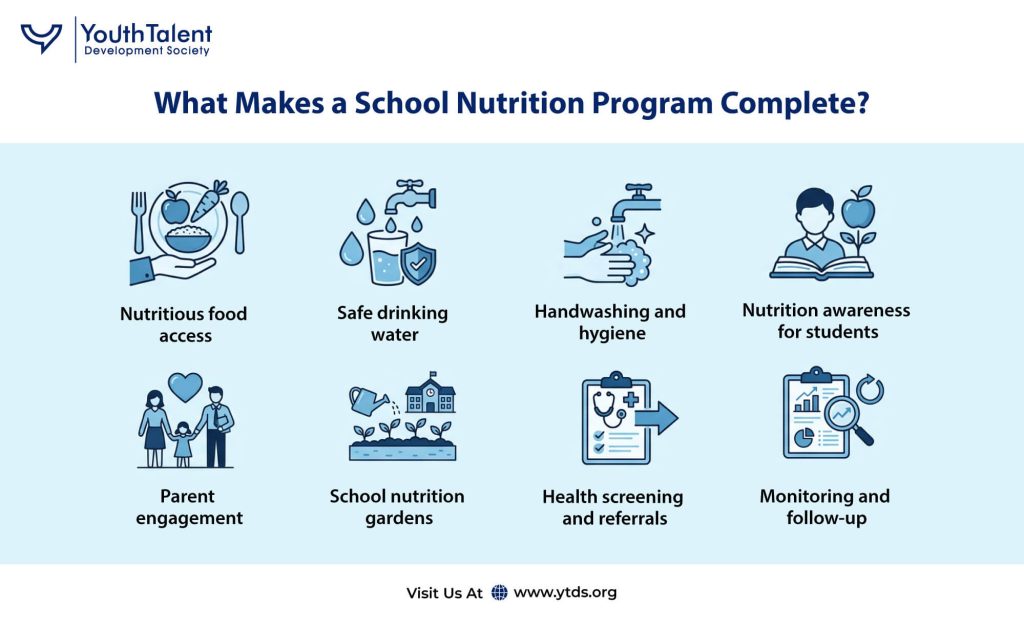
A meal may be an important part of a nutrition program, but good school nutrition requires a broader system.
A strong program should consider four areas:
1. Food Access
Are children receiving adequate and regular meals or supplementary nutrition?
2. Nutrition Quality
Does the food provide appropriate variety and nutritional value?
3. Health and Hygiene
Are safe water, handwashing, food hygiene, and health awareness part of the program?
4. Nutrition Education
Do children and parents understand balanced diets, healthy habits, and the importance of nutrition?
Government nutrition initiatives have also emphasized awareness among students and parents around balanced diets, hygiene, healthy food choices, and nutrition-related behaviours.
What Can Companies Support Through School Nutrition CSR?
Companies have several options depending on the needs of the schools they support.
1. Supplementary Nutrition Support
In some communities, schools may identify gaps where additional nutritional support is useful.
Depending on professional guidance and local requirements, companies may support:
- nutritious snacks
- seasonal fruit
- milk or appropriate alternatives
- protein-rich food
- locally available nutritious foods
The program should be designed with qualified nutrition or health professionals where appropriate.
It should also complement, rather than unnecessarily duplicate, existing government entitlements or school meal systems.
2. Breakfast Support
Children arriving at school without breakfast may struggle with energy and concentration during morning classes.
Where a documented need exists, companies can explore structured breakfast-support models.
The program should define:
- target students
- menu or food standards
- delivery responsibility
- food safety
- frequency
- monitoring
- cost per child
- parent and school involvement
The focus should remain on consistent support rather than occasional distribution.
3. School Nutrition Gardens
School nutrition gardens can serve both nutrition and education objectives.
PM POSHAN encourages School Nutrition Gardens, with produce potentially contributing additional micronutrients while also giving children hands-on exposure to gardening and food systems.
Companies can support:
- garden development
- seeds and planting material
- simple irrigation
- composting
- student participation
- teacher orientation
- seasonal crop planning
Nutrition gardens can also connect naturally with environmental education.
For YTDS, this creates potential alignment between the Education and Environment pillars.
4. Nutrition Awareness for Students
Students should understand why food choices matter.
Sessions can cover:
- balanced diets
- importance of breakfast
- fruits and vegetables
- protein sources
- hydration
- healthy snacks
- limiting excessive junk food
- food hygiene
- handwashing
The goal is not to shame children about their diets.
It is to help them understand practical, affordable, and age-appropriate healthy habits.
5. Parent Nutrition Awareness
Children’s eating habits are also influenced by what happens at home.
Companies can therefore support sessions for parents or caregivers covering topics such as:
- affordable balanced meals
- local nutritious foods
- healthy lunchbox ideas
- hygiene
- breakfast
- adolescent nutrition
- reducing excessive salt, sugar, and highly processed foods
Government nutrition-awareness initiatives have similarly emphasized taking nutrition messages from schools into households and parent interactions.
6. Anaemia and Micronutrient Awareness
Anaemia can affect energy, physical development, and overall well-being, particularly among adolescents.
Companies can support awareness and health-related initiatives in partnership with appropriate medical or public-health professionals.
Programs may include:
- awareness sessions
- screening support where professionally appropriate
- referral pathways
- nutrition education
- adolescent health education
PM POSHAN also provides for coordination with health programs around micronutrients and school health support.
Health interventions should always follow applicable medical, government, and professional guidelines.
7. Clean Drinking Water
Nutrition programs should not ignore hydration and water quality.
Companies can support:
- safe drinking-water access
- filtration systems where appropriate
- water-quality testing
- storage improvements
- hydration awareness
- maintenance systems
This can also link with broader school-infrastructure projects.
Companies planning wider school improvements can refer to YTDS’s guide on school infrastructure CSR projects in India.
8. Handwashing and Food Hygiene
Food support without hygiene can create additional risks.
School nutrition programs should consider:
- handwashing before meals
- soap availability
- safe food handling
- clean utensils
- kitchen cleanliness
- food storage
- waste management
Students should understand simple hygiene behaviours that reduce avoidable health risks.
School Meals vs Supplementary Nutrition vs Nutrition Education
These approaches serve different purposes.
| Approach | Primary Purpose | Typical CSR Role |
|---|---|---|
| School Meals | Provide regular food support during the school day | Support gaps where legally and operationally appropriate |
| Supplementary Nutrition | Address additional nutritional needs | Fruit, nutritious snacks, or professionally designed supplements |
| Nutrition Education | Improve nutrition knowledge and healthy behaviours | Student and parent awareness sessions |
| School Nutrition Gardens | Connect food, learning, and local nutrition | Garden setup, materials, training, and student activities |
| Health Support | Identify or address health-related gaps | Screening, awareness, and referral partnerships |
| Water & Hygiene | Support safe nutrition and healthier school environments | Drinking water, handwashing, and hygiene systems |
Companies should first understand which gap they are trying to solve before selecting an intervention.
How Companies Can Design a School Nutrition CSR Program
A strong program should begin with assessment rather than procurement.
Step 1: Assess the Existing Situation
Before designing the program, understand:
- student age groups
- school enrolment
- current meal arrangements
- government-scheme coverage
- attendance patterns
- drinking-water access
- kitchen facilities
- hygiene conditions
- local food practices
- major nutrition concerns
- teacher and parent observations
The goal is to identify a genuine gap.
Step 2: Define the Objective
Companies should define what the program is supposed to achieve.
Examples:
- improve access to nutritious food
- reduce breakfast skipping
- strengthen nutrition awareness
- improve hydration
- support adolescent health awareness
- improve food hygiene
- strengthen parent knowledge
- support school nutrition gardens
A clear objective makes measurement easier.
Step 3: Select the Right Intervention
Not every school needs meal sponsorship.
For one school, the priority may be drinking water.
Another may need nutrition-awareness sessions.
Another may benefit from a school nutrition garden.
Another may need structured supplementary support.
The program should fit the problem.
Step 4: Involve Schools and Parents
Nutrition programs work better when schools and parents understand the purpose.
Stakeholders may include:
- school leadership
- teachers
- parents
- students
- local health workers
- nutrition professionals
- implementation partners
- CSR teams
Early involvement can improve participation and reduce misunderstandings.
Step 5: Establish Safety and Quality Standards
If food is distributed, companies need clear processes around:
- food sourcing
- preparation
- storage
- transportation
- hygiene
- allergies where relevant
- contamination prevention
- responsible vendors
- documentation
Food-related programs should never be treated as simple event logistics.
Step 6: Build Awareness Into the Program
Nutrition education increases the value of food-based interventions.
For example:
A company supporting fruit distribution might also run sessions on balanced diets.
A company supporting school gardens can teach students about vegetables, soil, seasons, and nutrition.
A company improving drinking-water access can add hydration and hygiene education.
Step 7: Create a Monitoring System
Companies should know whether the program is actually reaching students.
Track:
- frequency
- participation
- delivery consistency
- utilisation
- awareness
- school feedback
- parent feedback
- health referrals where relevant
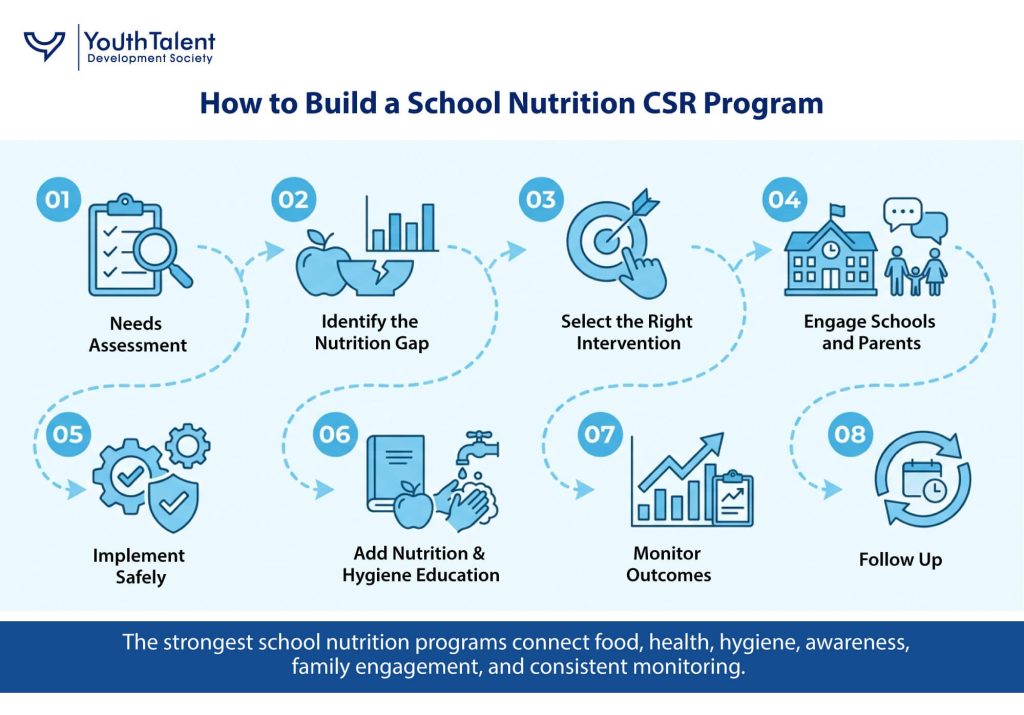
How School Nutrition Can Support Attendance and Learning
Companies should avoid making unsupported claims that a single nutrition intervention will automatically improve academic performance.
However, there is a clear rationale for linking nutrition support with learning readiness.
The PM POSHAN framework itself connects school nutrition with:
- nutritional improvement
- attendance
- retention
- classroom concentration
CSR teams should therefore measure both program delivery and relevant education-related indicators where appropriate.
For example:
- attendance trends
- participation
- teacher observations
- concentration-related feedback
- school retention
- student engagement
These should be interpreted carefully and not presented as direct causal outcomes without sufficient evidence.
How to Measure School Nutrition CSR Outcomes
Companies should measure more than the number of meals distributed.
| Metric | What to Track |
|---|---|
| Students Reached | Number of children participating in the program |
| Schools Covered | Number of schools receiving nutrition support |
| Program Frequency | Number of nutrition sessions, support days, or recurring activities |
| Meal / Snack Delivery | Consistency and number of servings provided |
| Nutrition Awareness | Improvement in students’ understanding of nutrition and healthy habits |
| Parent Participation | Parents or caregivers participating in nutrition-awareness sessions |
| Hygiene Practices | Handwashing, safe-food handling, and related hygiene behaviours |
| Water Access | Students with reliable access to safe drinking water |
| Nutrition Garden Activity | Gardens established, activities conducted, and student participation |
| Health Screening | Students screened where professionally and programmatically appropriate |
| Referral Follow-Up | Health referrals completed and followed up where relevant |
| Student Feedback | Program usefulness, participation, and student understanding |
| Teacher Feedback | Observed changes in student awareness, participation, and program usefulness |
PM POSHAN monitoring guidance also includes review of meal quality, quantity, satisfaction, anthropometric indicators, and nutritional assessment in relevant program contexts.
What Companies Should Avoid
One-Time Food Distribution Events
A single distribution event may provide short-term support, but it is not the same as a structured nutrition program.
Ignoring Existing Government Schemes
CSR should complement existing systems rather than duplicate or disrupt them.
Using the Same Menu Everywhere
Local food preferences, availability, nutritional needs, and cultural considerations vary.
Ignoring Food Safety
Nutrition programs can create risks if sourcing, storage, preparation, or handling is poorly managed.
Measuring Only Quantity
Reporting “10,000 meals distributed” tells you about volume, not necessarily program quality or impact.
Making Medical Claims Without Evidence
Companies should not claim to have cured anaemia, improved academic scores, or changed health outcomes without reliable measurement and professional evidence.
Excluding Parents and Teachers
School nutrition is more sustainable when the adults around students understand and reinforce the program.
How Nutrition Programs Can Connect With Other CSR Areas
School nutrition does not have to operate in isolation.
It can connect with several broader CSR themes.
Education
Healthy students are better positioned to participate consistently in learning.
Companies working on broader education initiatives can also explore YTDS’s guide on CSR education partnerships in India.
School Infrastructure
Nutrition programs may require:
- clean water
- kitchens
- storage
- handwashing stations
- sanitation
These can connect naturally with school-infrastructure improvements.
Environment
School nutrition gardens can introduce students to:
- soil
- composting
- food systems
- water conservation
- biodiversity
- seasonal crops
Empowerment
Programs can involve:
- mothers
- women-led self-help groups
- adolescent girls
- parent groups
- local communities
The PM POSHAN framework also encourages involvement of local groups, including women Self Help Groups and locally available foods where appropriate.
Role of Employee Volunteering
Employee volunteers can support school nutrition initiatives in non-clinical roles such as:
- nutrition-awareness events
- school garden activities
- educational games
- hydration campaigns
- hygiene awareness
- parent engagement
- resource mobilisation
Technical health or nutrition advice should come from qualified professionals.
Companies planning employee engagement can also refer to YTDS’s guide on corporate employee volunteering programs in India.
Role of an NGO Implementation Partner
School nutrition programs often require coordination between:
- companies
- schools
- vendors
- communities
- health professionals
- local stakeholders
- parents
An implementation partner can support:
- needs assessment
- school selection
- stakeholder coordination
- program planning
- vendor coordination
- student mobilisation
- awareness sessions
- documentation
- monitoring
- reporting
- follow-up
Companies evaluating partners can review YTDS’s guide on choosing a CSR implementation partner in India.
How YTDS Can Support School Nutrition Initiatives
Youth Talent Development Society works across Environment, Empowerment, Education, and Employment, with programs designed around community needs and corporate partnerships.
For school-focused nutrition initiatives, YTDS can support areas such as:
- school coordination
- community mobilisation
- needs assessment
- nutrition-awareness activities
- parent engagement
- hygiene awareness
- student participation
- school garden initiatives
- employee volunteering
- documentation
- monitoring
- CSR reporting
- follow-up activities
Nutrition initiatives can also be integrated into wider education programs rather than implemented as isolated activities.
Through initiatives such as Each One Teach One, YTDS works with students, schools, volunteers, and corporate partners across education and student-development needs.
Building a Sustainable School Nutrition Program
A practical school nutrition CSR program can follow this structure:
Needs Assessment
↓
Nutrition Gap Identification
↓
Program Design
↓
School & Parent Engagement
↓
Implementation
↓
Nutrition & Hygiene Education
↓
Monitoring
↓
Follow-Up
The goal should not be to create the largest possible distribution campaign.
It should be to create the right intervention for the right school need.
Conclusion
School nutrition affects much more than hunger.
It is connected with children’s health, energy, participation, attendance, and ability to engage in learning.
Companies can support school nutrition through CSR in several ways, including supplementary nutrition, awareness, school nutrition gardens, clean drinking water, hygiene, health support, parent engagement, and structured monitoring.
The strongest programs begin with an assessment of existing needs and systems.
They complement government initiatives, involve schools and families, maintain strong safety standards, and measure more than the number of items distributed.
When nutrition is integrated thoughtfully with education, health, hygiene, and community engagement, CSR programs can support a stronger environment for children to learn and develop.
Planning a school nutrition, health, or education CSR initiative? Connect with YTDS to discuss a structured school-support program.
Frequently Asked Questions
1. What is a school nutrition program?
A school nutrition program is an initiative designed to improve children’s access to nutritious food, nutrition knowledge, healthy habits, or related health and hygiene support within the school environment.
2. Can companies support school nutrition through CSR?
Companies may support eligible education, health, nutrition, and community-development initiatives through CSR subject to applicable legal requirements, company CSR policy, and professional compliance guidance.
3. What can companies include in a school nutrition CSR program?
Programs may include supplementary nutrition, breakfast support, school nutrition gardens, clean drinking water, nutrition awareness, hygiene education, parent engagement, or professionally supported health initiatives.
4. Is school nutrition only about providing meals?
No. Nutrition programs can also include nutrition education, water, hygiene, school gardens, parent awareness, health support, and monitoring.
5. What is PM POSHAN?
PM POSHAN is India’s centrally sponsored school meal programme, formerly known as the Mid-Day Meal Scheme. It aims to improve nutritional status while supporting attendance, retention, and classroom participation in eligible schools.
6. How can companies avoid duplicating government nutrition schemes?
Companies should first assess existing school entitlements, government-scheme coverage, and gaps before designing an intervention.
7. How can school nutrition programs be measured?
Companies can track students reached, program frequency, meals or snacks delivered, nutrition awareness, hygiene practices, parent participation, water access, school feedback, and relevant health or educational indicators where appropriate.
8. Can companies support school nutrition gardens?
Yes. School nutrition gardens can provide practical learning opportunities around food, plants, health, environment, and locally grown produce.
9. Can employees volunteer in school nutrition programs?
Employees can support awareness campaigns, school gardens, hygiene activities, educational events, and community engagement. Medical or technical nutrition advice should be provided by qualified professionals.
10. How can YTDS support school nutrition CSR programs?
YTDS can support school coordination, needs assessment, community engagement, awareness activities, student participation, employee volunteering, documentation, monitoring, reporting, and follow-up within appropriately structured CSR programs.