






Science and mathematics become easier to understand when students can see, build, test, and experiment with what they are learning.
However, access to practical STEM learning is not equal across schools.
Some students have opportunities to work with science equipment, coding platforms, robotics kits, electronics, and project-based learning. Others may learn the same concepts mainly through textbooks because their schools lack equipment, trained facilitators, digital resources, or dedicated learning spaces.
This is where STEM education through CSR can create meaningful value.
Companies can support schools not only by providing equipment, but by building structured STEM programs that combine hands-on learning, teacher support, student projects, mentoring, and continued use of the resources.
India already has a strong policy and institutional focus on experiential learning. The National Education Policy 2020 emphasizes inquiry-based, discovery-based, interactive, and experiential learning across school education.
Programs such as Atal Tinkering Labs have also demonstrated how school-based innovation spaces can expose students to science, electronics, robotics, sensors, computing, prototyping, and problem-solving.
For companies investing in education CSR, the opportunity is therefore larger than simply setting up a laboratory.
The goal should be to help students use STEM concepts to ask questions, solve problems, build things, and develop confidence with technology and science.
Why STEM Education Matters for Indian Students
STEM stands for:
- Science
- Technology
- Engineering
- Mathematics
But effective STEM education is not simply about teaching four subjects separately.
It connects these areas through practical problem-solving.
For example, students building a simple water-level indicator may use:
- science to understand conductivity
- electronics to create the circuit
- mathematics to measure levels
- engineering thinking to design the system
- problem-solving to improve the prototype
This type of learning helps students understand how concepts work outside textbooks.
STEM activities can also support skills such as:
- critical thinking
- curiosity
- experimentation
- collaboration
- creativity
- digital literacy
- problem-solving
- design thinking
- communication
These skills can benefit students even if they do not eventually pursue a STEM career.
What Does STEM Education Through CSR Mean?
A STEM education CSR program is a corporate-supported initiative designed to improve students’ access to practical science, technology, engineering, mathematics, and innovation learning.
Depending on the school and program objectives, companies may support:
- STEM laboratories
- science experiment kits
- robotics kits
- coding programs
- electronics and sensor kits
- computers or tablets
- mathematics activity kits
- 3D printing
- maker spaces
- teacher training
- student innovation challenges
- STEM workshops
- employee mentoring
- project competitions
However, companies should avoid treating equipment procurement as the entire program.
A successful STEM initiative should answer four questions:
What will students learn?
How often will they use the resources?
Who will guide them?
How will the company measure whether the program is creating learning value?
STEM Labs vs Traditional School Infrastructure
STEM labs are part of the wider school-learning environment, but they serve a more specific educational purpose.
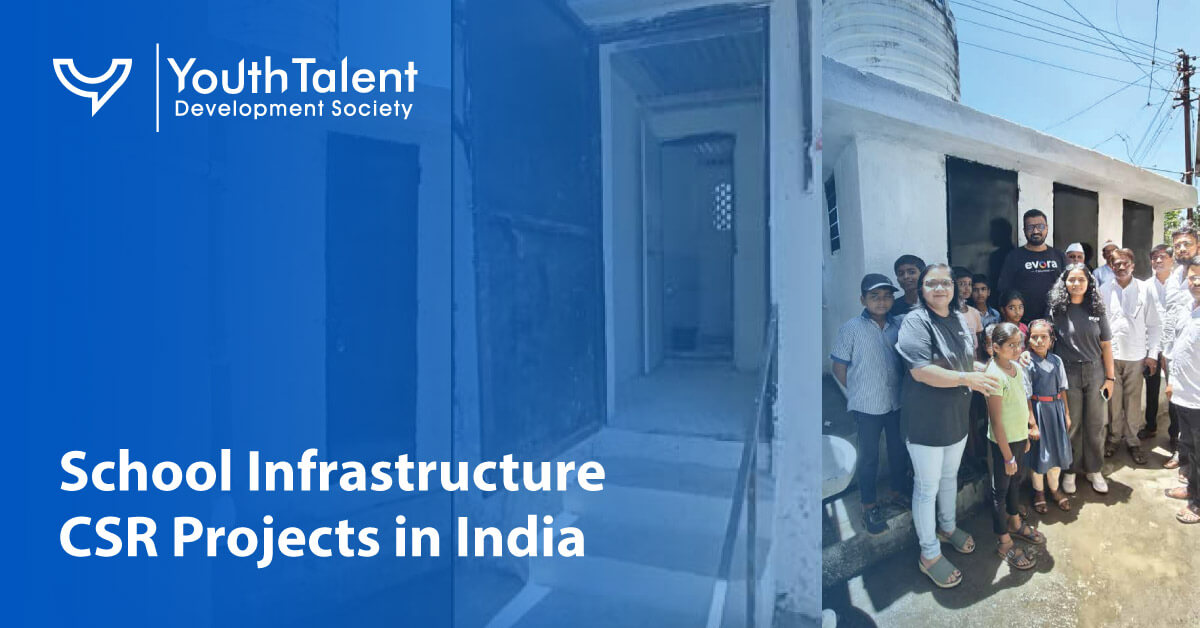
Companies planning broader infrastructure initiatives can also refer to YTDS’s guide on school infrastructure CSR projects in India.
The difference is important.
A company can install an attractive STEM lab, but if students rarely use it, teachers are not trained, or activities are disconnected from learning objectives, the project may create infrastructure without creating meaningful STEM learning.
What Should a School STEM Lab Include?
There is no single equipment list that suits every school.
The design should depend on:
- student age
- curriculum
- school capacity
- available space
- electricity and internet access
- teacher readiness
- program objectives
- maintenance requirements
- budget
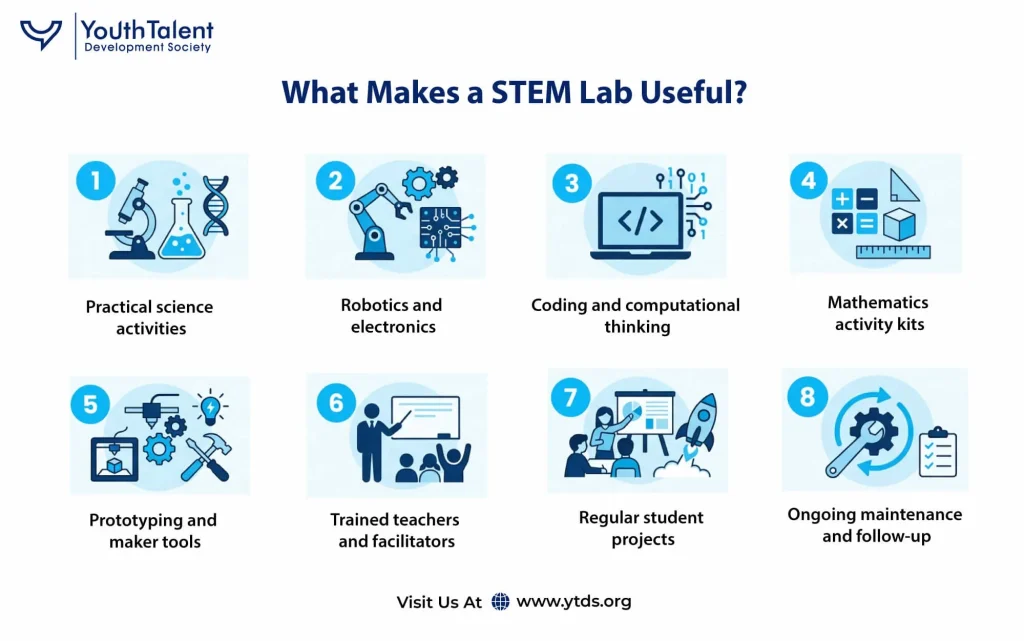
A practical STEM lab may include several categories of resources.
1. Basic Science Experiment Equipment
Students should be able to perform simple experiments related to:
- physics
- chemistry
- biology
- environmental science
- electricity
- mechanics
- measurement
Equipment should be age-appropriate and safe.
2. Electronics and Circuit Kits
Basic electronics can help students understand concepts such as:
- circuits
- sensors
- switches
- current
- voltage
- motors
- LEDs
- automation
Projects can begin with simple circuits before moving toward more advanced applications.
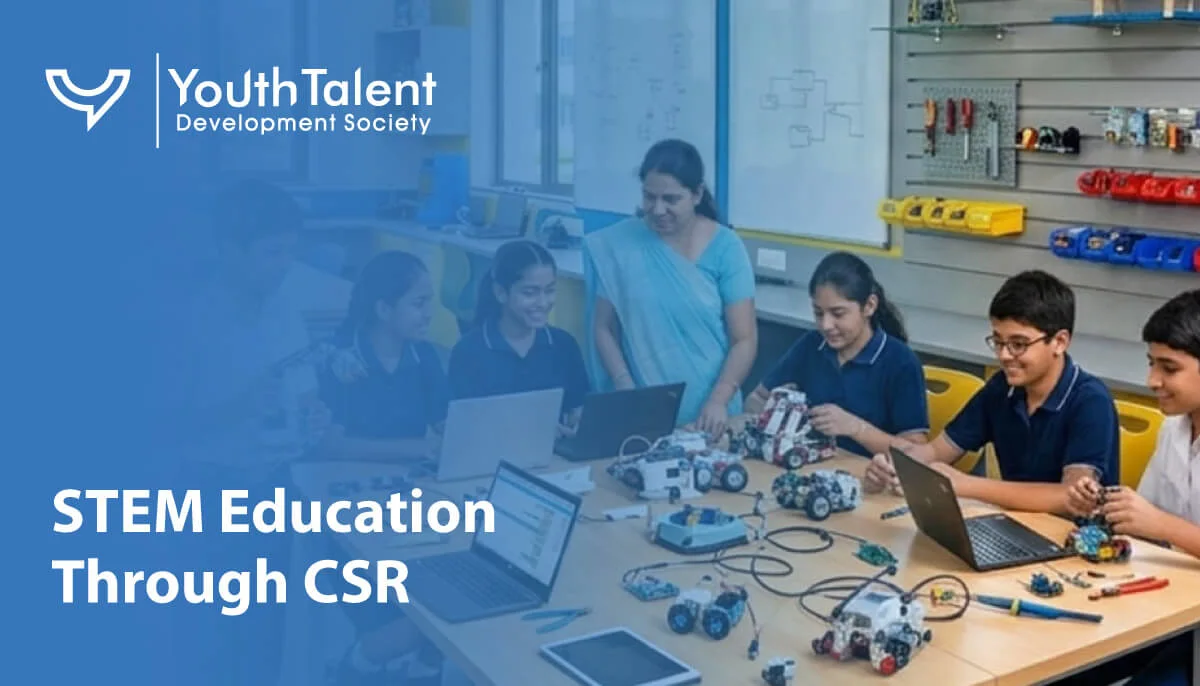
3. Robotics Kits
Robotics can combine mechanical design, electronics, programming, mathematics, and problem-solving.
Students can work on activities such as:
- obstacle-avoiding robots
- line-following robots
- automated alarms
- sensor-based systems
- simple mechanical prototypes
The objective should not be to make every student a robotics engineer.
The real value is in giving students a structured way to experiment and solve problems.
4. Coding Resources
Coding programs can introduce students to:
- computational thinking
- logic
- sequencing
- problem-solving
- simple programming
- digital creation
For younger students, visual block-based programming may be more appropriate than beginning immediately with complex programming languages.
5. Mathematics Activity Kits
Mathematics can become more engaging when students use physical models and practical challenges.
Activities can demonstrate concepts such as:
- geometry
- measurement
- probability
- fractions
- ratios
- patterns
- spatial reasoning
6. Prototyping and Maker Tools
Depending on the program level, students may use:
- cardboard
- basic hand tools
- craft materials
- mechanical parts
- sensors
- microcontrollers
- 3D printers
Atal Tinkering Labs, for example, use hands-on tools and technologies such as robotics, open-source microcontroller boards, sensors, 3D printing and computers to help students develop and test ideas.
STEM Labs Need Activities, Not Just Equipment
One of the biggest risks in STEM CSR is creating a lab that looks impressive during inauguration but is underused afterward.
Equipment does not automatically create learning.
Companies should therefore plan the activity model before deciding what to purchase.
A school STEM program can include:
- weekly STEM periods
- monthly project challenges
- science experiments
- robotics activities
- coding sessions
- innovation competitions
- problem-solving workshops
- environmental STEM projects
- student exhibitions
- community problem-solving projects
Students should be encouraged to build, fail, modify, and try again.
That process is central to practical STEM learning.
Robotics and Coding Under CSR
Robotics and coding are often the most visible parts of modern STEM programs.
They can be valuable, but companies should avoid using them only because they appear innovative.
The right question is:
What learning outcome will the activity create?
For example, a robotics workshop might teach:
- logical thinking
- basic electronics
- teamwork
- coding concepts
- iterative design
- troubleshooting
A coding program might help students:
- break large problems into smaller steps
- understand sequences
- create simple digital projects
- develop computational thinking
These skills become more meaningful when students work on problems connected to their surroundings.
For example:
Can students create a simple water-saving alert?
Can they build a soil-moisture monitoring prototype?
Can they design an automated classroom-lighting model?
Can they create a basic waste-segregation prototype?
This connects STEM learning with practical problem-solving.
Why Teacher Training Is Essential
A STEM lab cannot depend permanently on an external trainer.
Teachers need enough confidence to guide students, manage equipment, conduct basic activities, and integrate STEM resources into learning.
Atal Innovation Mission’s own ATL model includes teacher-training support because teachers play an important role in helping students use tinkering and innovation resources effectively.
Companies should therefore include teacher capacity-building in their CSR plan.
Teacher support may cover:
- equipment orientation
- STEM activity planning
- experiment safety
- coding basics
- robotics fundamentals
- project facilitation
- student assessment
- equipment maintenance
- activity documentation
This increases the likelihood that the STEM lab remains useful after the initial CSR intervention.
How Companies Can Support STEM Education Through CSR
Companies can use several models depending on budget, geography, employee expertise, and school needs.
1. Establish a STEM Lab
Companies can support the setup of a dedicated learning space with relevant equipment and learning resources.
Before procurement, conduct a needs assessment covering:
- existing infrastructure
- teacher availability
- student numbers
- school timetable
- existing science resources
- electricity
- internet
- secure storage
- maintenance capacity
2. Upgrade an Existing Science Lab
Not every school needs a completely new laboratory.
Some schools already have a science space but lack:
- updated equipment
- consumables
- practical learning materials
- digital tools
- teacher support
Upgrading an existing lab may sometimes create better value than building a new one.
3. Run Mobile STEM Programs
Where schools cannot support permanent labs, a mobile STEM program can bring equipment and facilitators to multiple locations.
This can be useful for:
- rural schools
- small schools
- geographically dispersed communities
- pilot programs
4. Sponsor Robotics and Coding Clubs
Companies can support recurring clubs instead of one-time workshops.
Students can participate in:
- weekly challenges
- coding projects
- robotics projects
- competitions
- demonstrations
- exhibitions
This provides continuity.
5. Involve Employee Volunteers
Employees working in:
- engineering
- technology
- data
- manufacturing
- product development
- sustainability
- research
can participate as mentors or speakers.
They can help students understand how STEM concepts are used in real workplaces.
For broader volunteering program design, companies can also explore YTDS’s guide to corporate employee volunteering programs in India.
6. Support Student Innovation Challenges
Instead of giving students predefined projects every time, companies can ask them to solve a problem.
Examples:
- reduce water waste in school
- improve classroom energy efficiency
- monitor plant health
- reduce plastic waste
- design a safer road-crossing model
- improve waste segregation
Students can research the issue, build prototypes, test them, and present their solutions.
This shifts STEM from passive learning to practical innovation.
Reaching Rural and Underserved Schools
STEM education programs can be especially valuable where students have limited exposure to laboratories, technology, professionals, or project-based learning.
However, companies should avoid designing urban-style programs without considering local conditions.
A rural school may face issues such as:
- unstable electricity
- limited internet connectivity
- fewer computers
- limited laboratory space
- teacher shortages
- language barriers
- equipment maintenance challenges
The program should be designed around these realities.
For example, an offline science-and-electronics kit may be more useful than a cloud-dependent coding platform where connectivity is unreliable.
The objective is not to create the most advanced-looking lab.
It is to create a STEM program that students and teachers can actually use consistently.
How STEM Education Connects With Career Awareness
STEM programs can also expose students to careers they may not have considered.
Students may learn about pathways in:
- engineering
- software
- electronics
- data science
- healthcare technology
- manufacturing
- renewable energy
- environmental science
- biotechnology
- automation
- design
- research
This does not mean STEM CSR programs should push students toward specific professions.
Instead, practical exposure can help students understand what different fields involve.
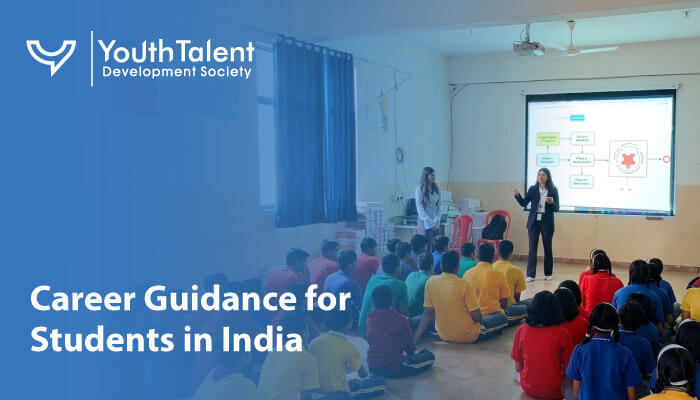
Companies interested in this broader transition from education to careers can also refer to YTDS’s guide on career guidance for students in India.
How to Measure STEM CSR Outcomes
Counting the number of labs established is not enough.
Companies should measure whether students and teachers are actually using the program.
Useful indicators include:
Companies should also document qualitative outcomes.
Examples might include:
- students explaining a scientific concept more confidently
- students developing their first prototype
- teachers independently conducting STEM activities
- students working collaboratively on a local problem
- schools continuing STEM sessions after the initial program period
What Companies Should Avoid in STEM CSR
Buying Equipment Without a Learning Plan
A long equipment list does not guarantee educational impact.
Running Only One-Day Robotics Workshops
A single workshop may create excitement but limited long-term learning.
Ignoring Teacher Training
Students need facilitators who can help them continue using the lab.
Purchasing Equipment the School Cannot Maintain
High-end equipment can become unusable if replacement parts, consumables, servicing, or technical support are unavailable.
Focusing Only on Advanced Technology
STEM does not always require expensive robotics or 3D printers.
Simple science experiments and problem-solving activities can also create strong learning experiences.
Measuring Only Installation
A photograph of a completed lab proves installation, not learning.
Track utilisation, participation, projects, teacher involvement, and follow-up.
How an NGO Can Support STEM Education CSR
STEM projects require coordination between the company, school, teachers, vendors, facilitators, and students.
An implementation partner can support:
- school identification
- needs assessment
- stakeholder coordination
- program design
- equipment planning
- teacher coordination
- facilitator deployment
- student mobilisation
- workshop execution
- employee volunteering
- documentation
- monitoring
- reporting
- follow-up
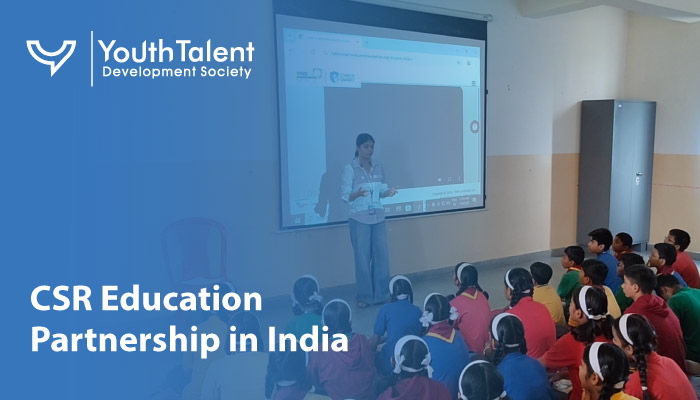
Companies planning broader educational initiatives can also review YTDS’s guide on CSR education partnerships in India.
For partner selection and due diligence considerations, see CSR Implementation Partner in India: What Companies Should Check Before Partnering.
How YTDS Can Support STEM Education Initiatives
Youth Talent Development Society works across Environment, Empowerment, Education and Employment through community-focused programs.
Through its education work and Each One Teach One initiative, YTDS supports students through learning resources, digital access, mentoring and educational development.
For STEM-focused CSR initiatives, YTDS can work with corporate partners to support areas such as:
- school needs assessment
- STEM program planning
- student mobilisation
- school coordination
- learning-resource support
- digital learning activities
- employee volunteering
- student mentoring
- activity documentation
- impact reporting
- follow-up planning
A STEM initiative can also connect with other YTDS focus areas.
For example:
Environment: students can develop projects around water, energy, biodiversity or waste.
Empowerment: project-based learning can build confidence, teamwork and problem-solving.
Education: STEM activities strengthen practical learning and digital exposure.
Employment: older students can gain exposure to technical careers and future skills.
This allows companies to design STEM programs that support both education and wider student development.
Building a STEM Program for Long-Term Impact
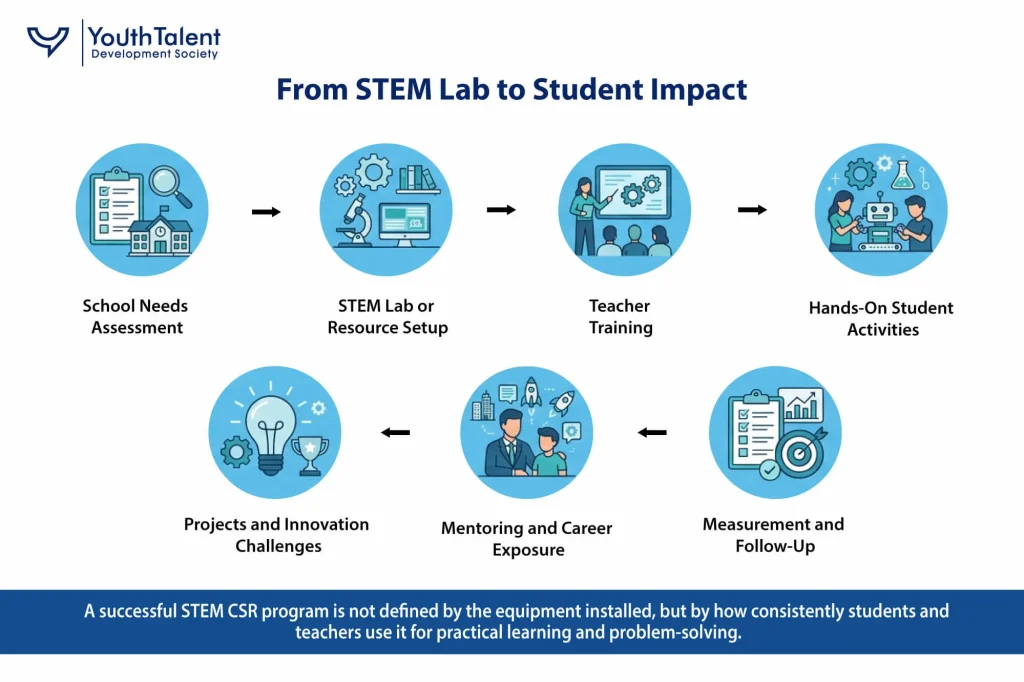
A successful STEM CSR initiative should move through a structured process:
Need Assessment
↓
Program Design
↓
Lab or Resource Setup
↓
Teacher Training
↓
Student Activities
↓
Projects and Mentoring
↓
Measurement
↓
Follow-Up
The strongest programs are not defined by how much equipment is installed.
They are defined by how often students use it, what they learn from it, and whether the school can continue the activities over time.
Conclusion
STEM education through CSR can help schools move from textbook-only learning toward practical exploration, experimentation, technology exposure, and problem-solving.
Companies can support this transition through STEM labs, robotics, coding, science kits, teacher development, employee mentoring, innovation challenges, and structured learning programs.
But successful STEM CSR requires more than purchasing equipment.
Companies should understand school needs, train teachers, create recurring activities, involve students in practical projects, monitor lab utilisation, and track meaningful learning outcomes.
For schools with limited access to practical STEM learning, the right program can create opportunities to experiment, build, question, collaborate, and discover new possibilities.
YTDS can work with companies to plan and implement education-focused CSR initiatives that connect school needs with structured learning, volunteer participation, documentation, and measurable outcomes.
Planning a STEM education or school-learning initiative through CSR? Connect with YTDS to explore a structured education partnership.
Frequently Asked Questions
1. What is STEM education?
STEM education combines Science, Technology, Engineering and Mathematics through practical, interdisciplinary learning. It often uses experiments, projects, coding, robotics and problem-solving activities to help students apply concepts.
2. What is a STEM lab in a school?
A STEM lab is a dedicated learning space where students can conduct experiments, build models, explore electronics, use robotics or coding tools, and work on practical problem-solving projects.
3. Can companies support STEM labs through CSR?
Companies can support education initiatives through CSR subject to applicable CSR laws, policies, eligibility requirements and professional compliance guidance. STEM labs can form part of broader education-focused programs when appropriately structured.
4. What equipment is needed in a school STEM lab?
The equipment depends on student age and program objectives. It may include science experiment kits, electronics, robotics kits, computers, coding resources, mathematics kits, sensors, microcontrollers and prototyping materials.
5. Is robotics necessary for STEM education?
No. Robotics is one useful STEM tool, but STEM education can also include science experiments, mathematics activities, electronics, environmental projects, coding, design challenges and basic engineering activities.
6. Why is teacher training important in a STEM CSR program?
Teachers help students use the equipment consistently and connect activities with learning. Without teacher capacity-building, a STEM lab may depend heavily on external facilitators and become underused.
7. How can companies measure the impact of STEM education CSR?
Companies can track students reached, lab utilisation, teachers trained, student projects, STEM sessions conducted, participation, learning improvement, equipment use, student feedback and continued activities after implementation.
8. How can STEM programs support rural schools?
Programs can give rural students exposure to practical science, technology and innovation resources they may otherwise have limited access to. The program should be adapted to local infrastructure, connectivity, teacher capacity and maintenance conditions.
9. Can employees volunteer in STEM education programs?
Yes. Employees with relevant experience can participate in mentoring, career talks, demonstrations, project reviews, innovation challenges and other structured volunteering activities.
10. How can YTDS support STEM education CSR programs?
YTDS can support companies with school coordination, needs assessment, program planning, student engagement, learning-resource support, employee volunteering, documentation, reporting and follow-up for education-focused CSR initiatives.