







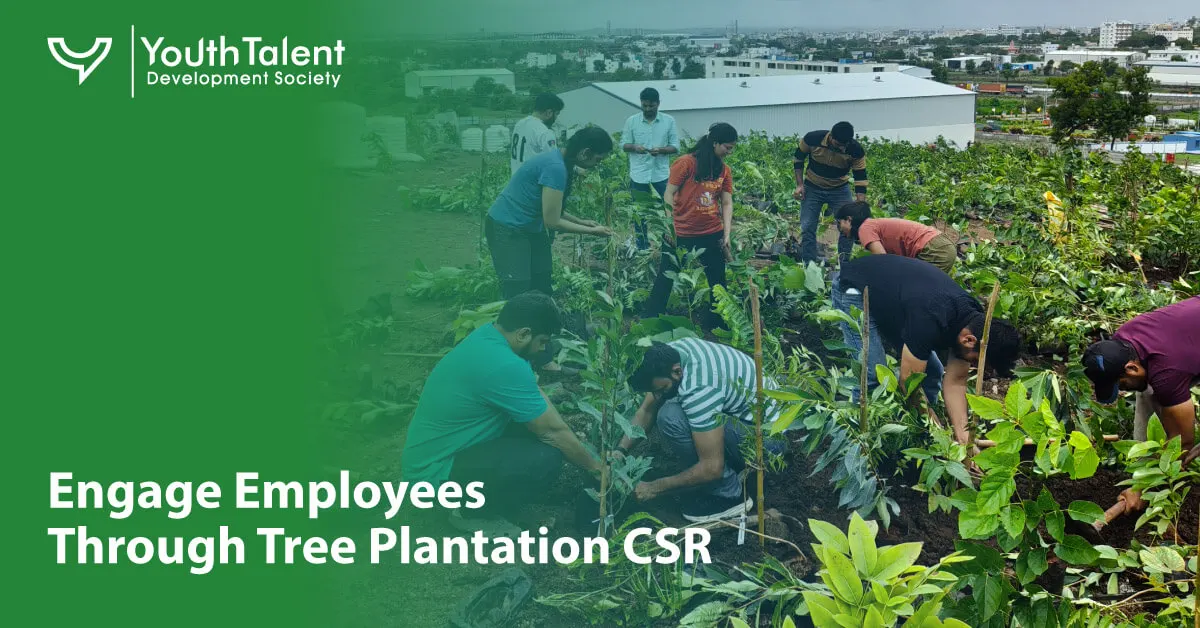
An employee tree plantation drive is one of the simplest ways for companies to connect CSR with employee engagement, environmental responsibility, and community impact. It brings employees out of the office and into a real green action where they can plant saplings, understand tree care, and contribute to a healthier local environment.
For many companies, CSR is often seen as a donation or compliance activity. But when employees participate directly, CSR becomes more personal, visible, and meaningful. A tree plantation drive gives teams a chance to work together, connect with communities, and contribute to long-term environmental sustainability.
Under Schedule VII of the Companies Act, 2013, CSR activities may include ensuring environmental sustainability, ecological balance, protection of flora and fauna, agroforestry, conservation of natural resources, and maintaining the quality of soil, air, and water. This makes tree plantation and green CSR activities highly relevant for companies in India.
However, a good employee tree plantation drive should not be treated as a one-day photo activity. Its real success depends on site selection, native species, employee participation, sapling protection, maintenance, and survival tracking.
What Is an Employee Tree Plantation Drive?
An employee tree plantation drive is a CSR or employee volunteering activity where company employees participate in planting and supporting trees at a selected location. The activity may take place at a school, village, community space, public area, NGO site, industrial area, roadside patch, or institutional campus.
A well-planned employee plantation drive usually includes:
- Site selection
- Sapling selection
- Employee volunteer coordination
- Plantation activity
- Awareness session
- Photo documentation
- Maintenance planning
- Survival tracking
- Impact reporting
The goal is not only to plant trees. The goal is to create environmental awareness, employee involvement, and long-term green impact.
Why Employee Tree Plantation Drives Work for CSR
India’s CSR framework encourages companies to take up social welfare activities, and the National CSR Portal describes CSR under the Companies Act, 2013 as a statutory obligation for select companies to support social welfare projects.
An employee tree plantation drive works well because it combines environmental CSR with employee participation. Employees do not just hear about CSR; they become part of it.
This type of activity helps companies:
- Promote environmental awareness
- Encourage employee volunteering
- Build team participation
- Connect employees with local communities
- Support green spaces
- Contribute to ESG and CSR goals
- Create visible impact documentation
- Build a culture of responsibility
Tree plantation also supports broader environmental goals. Urban trees and green spaces help improve quality of life, support biodiversity, reduce heat, and make cities more livable. FAO notes that urban forests, trees, and green spaces play an important role in enhancing urban life, although access to these benefits is often unequal.
Benefits of Employee Tree Plantation Drives for Companies
A tree plantation drive is useful for both the environment and the organisation. It creates an opportunity for employees to participate in a cause that is easy to understand and meaningful to the community.
1. Strong Employee Engagement
Employees often feel more connected to a company when they get opportunities to participate in meaningful social initiatives. A plantation drive allows teams to step outside their routine work and contribute together.
2. Better Team Bonding
Planting trees as a team encourages collaboration, shared responsibility, and informal bonding. Employees from different departments can work together in a simple and positive environment.
3. Visible Environmental Contribution
Tree plantation creates a visible impact. Employees can see the site, plant saplings, and understand how their effort contributes to the environment.
4. Positive Brand Reputation
Companies that support green CSR activities can strengthen their reputation among employees, communities, clients, and stakeholders. It shows that the company is not only discussing sustainability but taking action.
5. Community Connection
Plantation drives often involve schools, communities, local volunteers, and NGOs. This helps companies build stronger relationships with the communities around them.
6. Internal CSR Storytelling
A well-documented plantation drive can be shared internally through newsletters, intranet updates, social posts, annual reports, and CSR communication. This encourages more employees to participate in future initiatives.
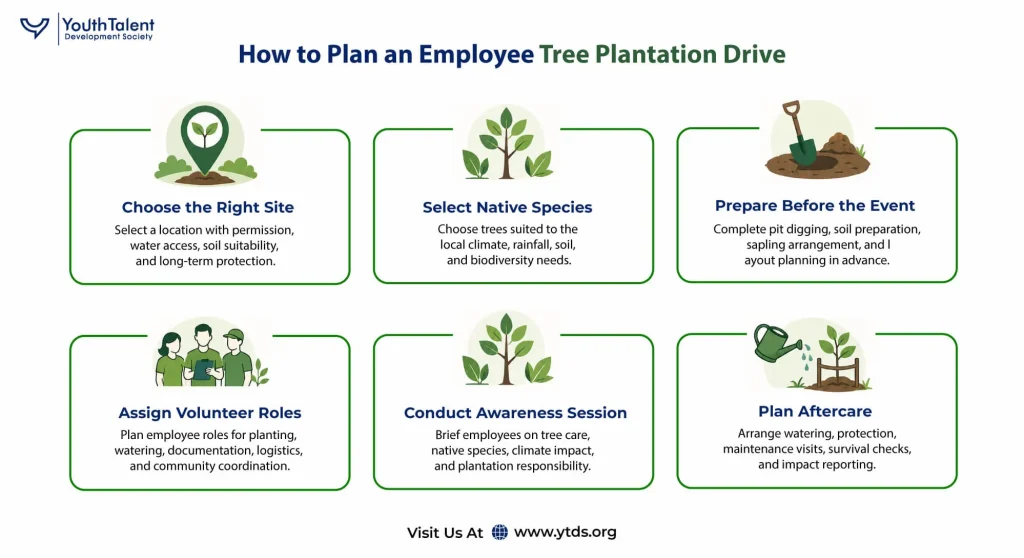
How to Plan an Employee Tree Plantation Drive
A successful employee tree plantation drive requires planning before the event and care after the event. The following steps can help companies execute the activity properly.
1. Choose the Right Location
The location should be selected carefully. A plantation site must have enough space for saplings to grow and should not be at risk of removal due to construction, road widening, or lack of ownership.
A good site should have:
- Clear permission
- Water availability
- Suitable soil
- Protection from grazing or damage
- Long-term maintenance support
- Access for employees and volunteers
Common locations include schools, village spaces, community grounds, public institutions, industrial areas, and NGO-managed plantation sites.
2. Select Native Tree Species
Species selection is one of the most important parts of any plantation activity. Native trees are usually better suited to local climate, soil, rainfall, and biodiversity needs.
Companies should avoid planting random ornamental species only for visual appeal. Instead, they should work with local experts or NGO partners to select trees that have better survival potential.
Native species can support:
- Local biodiversity
- Birds and insects
- Soil health
- Shade and cooling
- Long-term ecological balance
- Better survival in local conditions
3. Get Required Permissions
Before conducting the drive, companies should ensure that the site has proper permission from the landowner, school, community body, institution, or local authority.
This helps avoid future issues and ensures that the plantation site can be maintained properly.
4. Prepare the Site Before the Event
The actual plantation day should be smooth and organised. Site preparation should happen in advance.
Preparation may include:
- Pit digging
- Soil loosening
- Compost or manure arrangement
- Layout marking
- Sapling placement
- Water arrangement
- Tool arrangement
- Safety planning
- Volunteer flow planning
If the site is not prepared in advance, employees may spend more time waiting than participating.
5. Plan Employee Volunteer Roles
A plantation drive becomes more engaging when employees know what they are supposed to do. Clear role distribution also avoids confusion.
Volunteer roles can include:
- Registration support
- Sapling placement
- Plantation support
- Watering team
- Photography and documentation
- Logistics support
- Community coordination
- Safety support
- Awareness session participation
This makes the activity more structured and professional.
6. Conduct a Short Awareness Session
Before plantation starts, conduct a short awareness session for employees. This helps them understand the purpose of the drive and the importance of aftercare.
The session can cover:
- Why native trees matter
- How trees support the environment
- Correct planting method
- Tree care basics
- Importance of survival tracking
- Role of employees in green CSR
This turns the activity into a learning experience, not just a volunteering event.
7. Arrange Saplings, Tools, Water, and Safety Support
Companies should ensure that all required materials are available before the event starts.
This may include:
- Saplings
- Gloves
- Spades and tools
- Water cans or pipes
- Compost or manure
- Tree guards where needed
- First-aid support
- Drinking water for volunteers
- Shade or rest area
- Basic safety instructions
Small planning details can make a big difference in employee experience.
8. Document the Activity
CSR documentation is important for internal reporting, compliance records, and stakeholder communication.
Documentation should include:
- Date and location
- Number of employees involved
- Number of saplings planted
- Species list
- Photos and videos
- Geo-tagged images if possible
- Community participation
- NGO or partner details
- Maintenance plan
Good documentation helps show that the activity was properly executed.
9. Plan Maintenance and Survival Tracking
Plantation does not end on the event day. Saplings need care, especially during the first few months.
Maintenance planning should include:
- Watering schedule
- Mulching
- Tree guards or protection
- Periodic site visits
- Replacement plan if required
- Survival checks
- Impact report updates
This is the difference between a plantation event and a real environmental CSR project.
Common Mistakes Companies Should Avoid
Many plantation drives look successful on the day of the event but fail later due to poor planning. Companies should avoid these mistakes:
- Planting without site permission
- Choosing unsuitable or non-native species
- Ignoring water availability
- Conducting plantation without site preparation
- Treating the activity as a one-day photo event
- Not assigning maintenance responsibility
- Not protecting saplings from damage
- Not tracking survival rate
- Poor employee coordination
- No impact report after the activity
A responsible plantation drive should focus on trees that survive and grow, not only on saplings planted.
How to Measure Employee Plantation Drive Impact
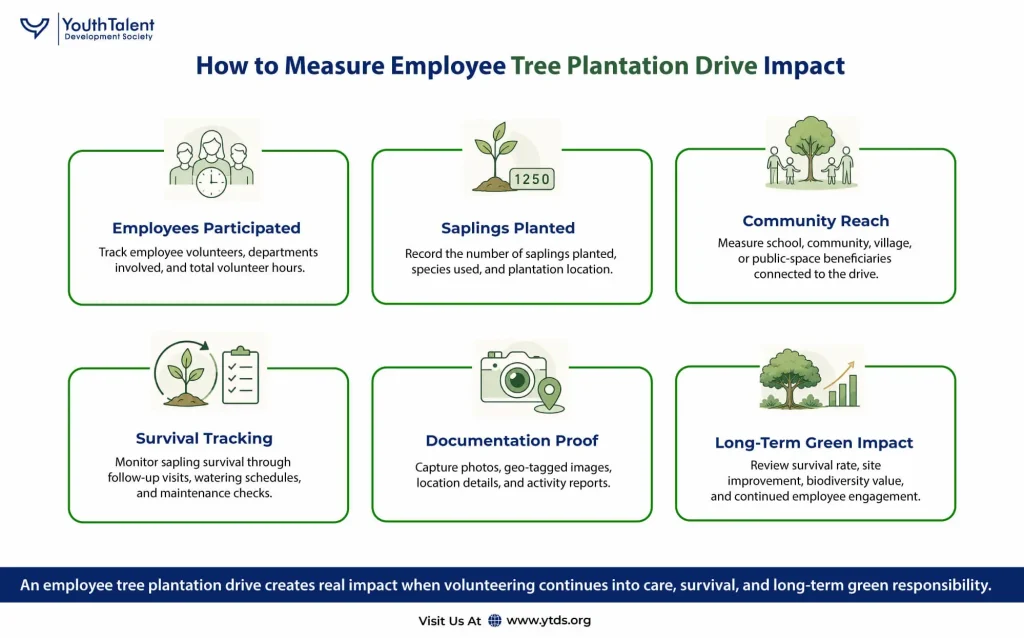
CSR teams should track both participation and environmental outcomes. Counting only the number of saplings planted is not enough.
Useful impact metrics include:
- Number of employees who participated
- Total volunteer hours
- Number of saplings planted
- Native species used
- Site location
- Community beneficiaries
- Geo-tagged photos
- Maintenance visits
- Survival rate
- Watering and care schedule
- Follow-up photos
- Final impact report
These metrics help companies show that employee volunteering created measurable environmental value.
How YTDS Can Support Employee Tree Plantation Drives
Youth Talent Development Society works across Environment, Empowerment, Education, and Employment. Through community-led initiatives, YTDS supports structured CSR programs that create practical and measurable impact.
For employee tree plantation drives, YTDS can support companies with:
- Site identification and coordination
- Native species planning
- Sapling arrangement
- Plantation drive execution
- Employee volunteer coordination
- Community mobilisation
- Awareness session planning
- Photo documentation
- Geo-tagged proof
- Maintenance planning
- Survival tracking
- Impact reporting
YTDS helps companies move beyond one-day plantation events and create green CSR initiatives that focus on participation, survival, and long-term environmental value.
Conclusion
An employee tree plantation drive is a powerful way for companies to combine CSR, employee engagement, and environmental action. It allows employees to participate directly in a meaningful cause while helping communities build greener local spaces.
But the real value of a plantation drive depends on planning and follow-up. The right site, native species, employee roles, awareness session, maintenance plan, and survival tracking can turn a simple event into a long-term CSR impact project.
Companies that invest in employee-led plantation drives can build stronger teams, greener communities, and more responsible CSR outcomes.
Partner with YTDS to plan and execute employee tree plantation drives that create participation, survival, and long-term green impact.
FAQs
1. What is an employee tree plantation drive?
An employee tree plantation drive is a CSR or volunteering activity where company employees participate in planting trees at a selected site and support environmental awareness, community engagement, and green impact.
2. Why should companies organise employee tree plantation drives?
Companies should organise employee tree plantation drives because they combine employee engagement with environmental CSR. These drives help build team participation, community connection, sustainability awareness, and measurable green impact.
3. How can companies plan a corporate tree plantation drive?
Companies can plan a corporate tree plantation drive by selecting a suitable site, choosing native species, getting permissions, preparing the site, assigning employee roles, arranging saplings and tools, documenting the activity, and planning maintenance.
4. What should companies track after a tree plantation drive?
Companies should track number of employees involved, saplings planted, species used, location details, geo-tagged photos, volunteer hours, maintenance visits, survival rate, and impact reports.
5. Why are native trees important in plantation drives?
Native trees are important because they are better suited to local soil, climate, rainfall, and biodiversity. They usually have better survival potential and support local ecological balance.
6. Can NGOs help companies organise employee tree plantation drives?
Yes. NGOs can help companies identify plantation sites, select native species, mobilise communities, coordinate employee volunteers, execute the activity, document the drive, plan maintenance, and track survival.