








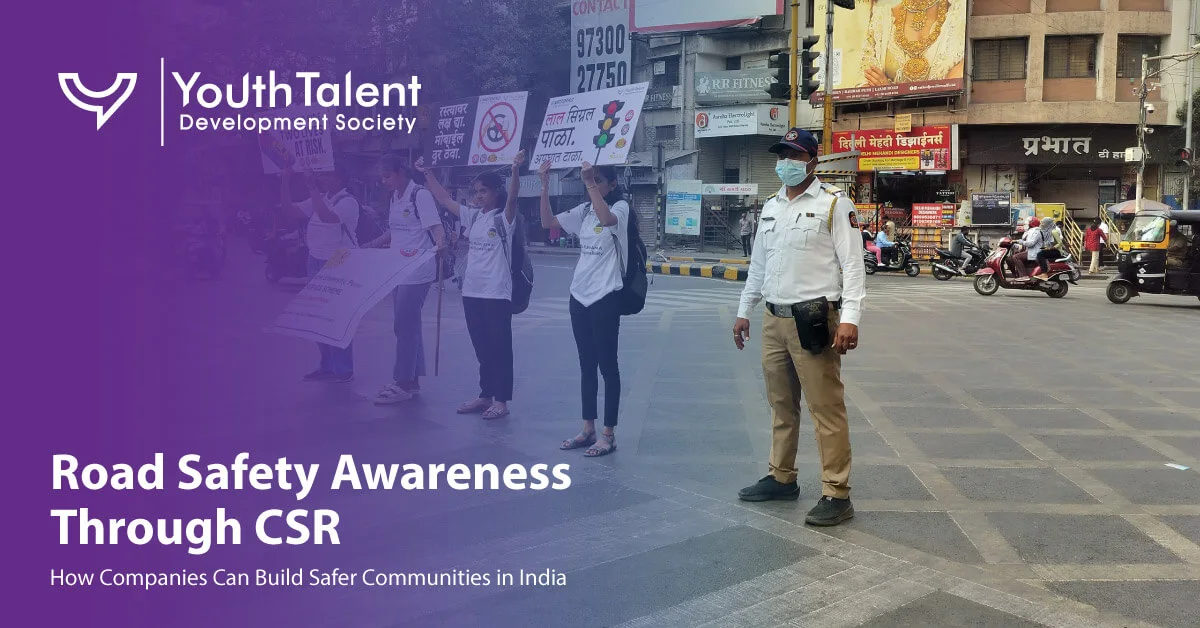
Road safety affects far more than drivers.
Every day, employees, delivery workers, two-wheeler riders, pedestrians, cyclists, commercial drivers, families and local communities depend on roads to reach workplaces, markets, healthcare facilities and public services safely.
This makes road safety awareness an important community issue as well as a practical area where companies can contribute through responsible CSR and employee-engagement initiatives.
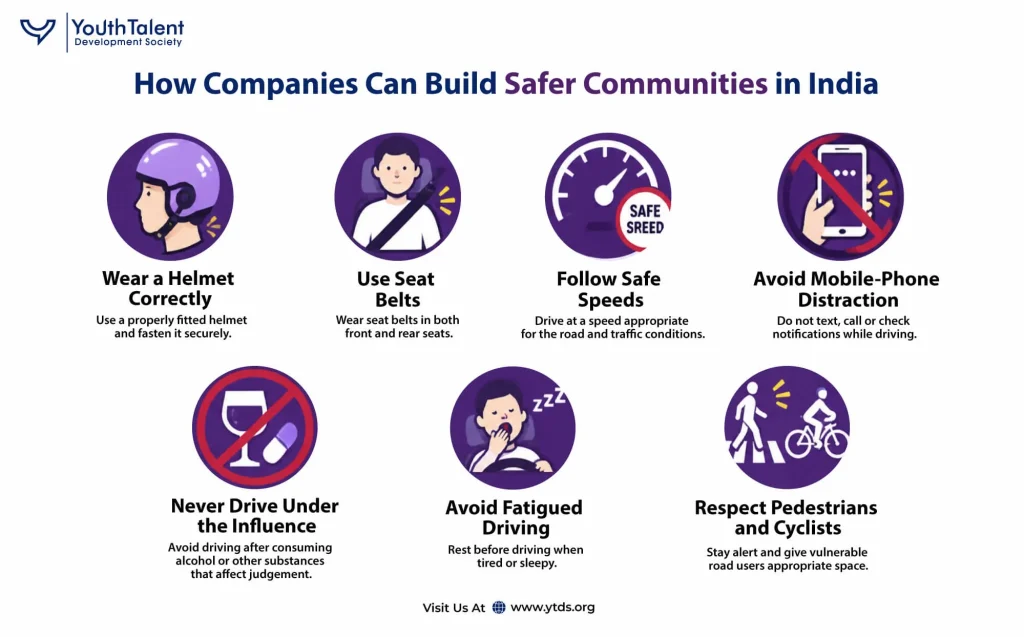
In February 2026, the United Nations launched the Indian edition of its global road safety awareness campaign, highlighting simple behaviours such as wearing helmets and seat belts, following safer speeds, avoiding mobile-phone distraction, not driving under the influence or while fatigued, and respecting pedestrians and cyclists.
But effective road safety programs should go beyond posters or one-day campaigns.
Companies can support structured awareness programs that identify specific local risks, reach the right groups, work with relevant authorities and implementation partners, and measure whether participants actually understand safer road behaviour.
This guide explains how companies can plan road safety awareness programs through CSR, the activities they can support, and how to move from one-time awareness toward longer-term community engagement.
What Is Road Safety Awareness?
Road safety awareness means helping people understand the behaviours, responsibilities and precautions that can reduce risk while using roads.
It can include awareness around:
- helmet use
- seat-belt use
- safe speeds
- distracted driving
- drink-driving
- driving while fatigued
- pedestrian safety
- cyclist safety
- two-wheeler safety
- road signs and traffic rules
- responsible commuting
- emergency preparedness
Road safety awareness is not limited to drivers.
Pedestrians, passengers, cyclists, employees travelling to work and community members all influence how safely roads are used.
A good road safety awareness program therefore focuses on practical behaviour, not only on memorising traffic rules.
It should help participants understand:
What is the risk?
What behaviour can reduce that risk?
What should someone do in a real situation?
Why Road Safety Awareness Matters in India
India has a large and rapidly changing mobility environment.
Roads may be shared by:
- private vehicles
- buses
- commercial vehicles
- two-wheelers
- cyclists
- pedestrians
- delivery workers
- school and office transport
- informal transport
These road users may have very different levels of protection.
That is why road safety requires more than enforcement alone.
It also requires:
- safer infrastructure
- responsible road behaviour
- awareness
- appropriate driver training
- emergency preparedness
- institutional coordination
The Ministry of Road Transport and Highways has established the Centre of Excellence for Road Safety at IIT Madras to support road-safety best practices and collaboration between government, academia and industry.
Current road-safety initiatives also include technology-based enforcement, incident detection, driver-readiness programs and volunteer capacity building.
This broader approach is important for companies as well.
A CSR awareness campaign should be treated as one part of the road-safety ecosystem rather than as a complete solution by itself.
Why Companies Should Support Road Safety Awareness Through CSR
Companies interact with roads in many ways.
Employees commute to offices and worksites.
Sales and field teams travel between locations.
Delivery and logistics networks depend on road transport.
Corporate facilities may be located near residential areas, industrial zones or busy transport corridors.
Companies also have relationships with communities surrounding their offices, plants and project locations.
This creates opportunities to support road safety in a structured and responsible way.
A company may support a road safety awareness initiative to:
- improve community awareness
- promote safer commuting
- engage employees in volunteering
- support driver awareness
- strengthen local-community relationships
- encourage responsible mobility
- support public-interest campaigns
- complement broader safety initiatives
The objective should not simply be:
“Conduct a road safety event.”
A better question is:
“What specific road-safety behaviour or awareness gap are we trying to address?”
That distinction improves both program design and measurement.
Road Safety Awareness Activities Companies Can Support
Companies can support different activities depending on the target audience and local road-safety needs.
1. Helmet Safety Awareness
Helmet-awareness programs can focus on:
- regular helmet use
- wearing helmets correctly
- fastening helmets properly
- pillion-rider awareness
- understanding why protective equipment matters
The session should avoid becoming a product-distribution exercise without accompanying awareness.
If safety equipment is distributed, participants should also understand its correct use.
2. Seat-Belt Awareness
Seat-belt campaigns can cover:
- front-seat use
- rear-seat use
- passenger responsibility
- consistent use even for short journeys
The message should be simple and behaviour-focused.
3. Speed Awareness Campaigns
Programs can help road users understand how speed affects:
- reaction time
- stopping distance
- pedestrian risk
- severity of crashes
The purpose is not to teach advanced driving techniques.
It is to strengthen awareness around responsible speed behaviour.
4. Distracted Driving Awareness
Mobile-phone use is an important area for awareness.
Programs can discuss distractions such as:
- texting
- calling while driving
- checking notifications
- using navigation unsafely
- other attention-diverting behaviour
The message should encourage drivers to keep attention on the road.
5. Pedestrian Safety Awareness
Road safety campaigns should not focus only on drivers.
Pedestrians also need clear awareness around:
- safe crossing behaviour
- using designated crossings where available
- visibility
- walking near moving traffic
- understanding vehicle blind spots
- avoiding distractions while crossing
Community campaigns can also help drivers understand their responsibilities toward pedestrians.
6. Cyclist and Two-Wheeler Awareness
Cyclists and two-wheeler users can be particularly exposed in mixed traffic environments.
Awareness programs can focus on:
- visibility
- helmets
- predictable road behaviour
- signalling
- safe lane positioning
- awareness of larger vehicles
7. Safe Commute Awareness
Companies can include road safety within employee commute programs.
Topics may include:
- safe two-wheeler use
- seat-belt use
- avoiding distracted travel
- fatigue awareness
- responsible use of company transport
- emergency contact procedures
The purpose should be education and awareness rather than transferring responsibility for road safety entirely to employees.
8. Road Safety Awareness for Commercial and Delivery Drivers
Companies that work with:
- logistics providers
- transport contractors
- field teams
- delivery personnel
- commercial fleets
may consider targeted road-safety awareness for these groups.
Programs can be adapted around:
- fatigue
- distraction
- responsible speeds
- journey planning
- emergency preparedness
- vehicle-safety awareness
Where technical driver training is involved, companies should work with qualified professionals.
Different Road Safety CSR Program Models
| Program Model | Target Group | Corporate Role | Possible Outcome |
|---|---|---|---|
| Community Awareness Drive | Local communities | Funding, volunteers, outreach support | Improved awareness |
| Helmet Awareness Program | Two-wheeler users | Awareness and safety communication | Better understanding of helmet use |
| Employee Road Safety Program | Employees | Internal awareness and communication | Safer commute awareness |
| Driver Safety Awareness | Commercial or fleet drivers | Program support and specialist coordination | Improved safety knowledge |
| Pedestrian Safety Campaign | Community road users | Awareness and local engagement | Better understanding of pedestrian safety |
| Road Safety Week Campaign | Employees and communities | Events, communication and volunteering | Large-scale awareness reach |
Different program models serve different purposes.
A large awareness event may reach many people, while a smaller driver-awareness session may create deeper engagement with a specific audience.
Companies should choose the model according to the problem they are trying to solve, not simply the number of people they want to reach.
How Companies Can Plan a Road Safety Awareness Program
A structured road safety program can follow a simple planning process.
Step 1: Identify the Road Safety Problem
Start by identifying the specific issue.
Examples could include:
- low helmet awareness
- unsafe commuting behaviour
- speeding concerns
- distracted driving
- pedestrian-safety gaps
- driver fatigue
- limited community awareness
Local conversations can help identify which issue is most relevant.
This may involve discussions with:
- employees
- communities
- transport teams
- traffic authorities
- NGOs
- road-safety specialists
Avoid starting with a pre-selected activity before understanding the need.
Step 2: Define the Target Group
Different groups require different communication.
Possible audiences include:
- employees
- local communities
- two-wheeler users
- commercial drivers
- delivery workers
- pedestrians
- cyclists
- transport contractors
For example, a campaign for employees may focus heavily on commuting.
A community campaign may need broader messaging around pedestrians, two-wheelers and public-road behaviour.
Step 3: Select the Right Awareness Format
Road safety awareness can be delivered through:
- workshops
- awareness booths
- community sessions
- digital campaigns
- posters and visual communication
- demonstrations
- road-safety pledges
- interactive activities
- employee-volunteering events
- targeted driver sessions
Do not assume one format will work for every audience.
A digital campaign may create reach.
A facilitated workshop may create deeper understanding.
Often, a combination works better.
Step 4: Work With Relevant Authorities and Implementation Partners
Road safety involves multiple stakeholders.
Depending on the program, companies may need to coordinate with:
- traffic police
- transport departments
- local authorities
- NGOs
- road-safety professionals
- community organisations
United Way Mumbai’s road-safety initiative, for example, works with traffic police, transport authorities, community volunteers and corporate CSR stakeholders as part of a broader road-safety model.
Companies should also confirm required permissions before carrying out activities in public spaces or near active roads.
For broader CSR implementation planning, companies can review YTDS’s guide to choosing a CSR implementation partner in India.
Step 5: Prepare Clear Awareness Messages
Messages should be:
- simple
- practical
- easy to remember
- locally relevant
- behaviour-focused
Avoid overcrowding a single campaign with too many messages.
Instead of attempting to cover every road-safety issue, a campaign may focus on a smaller set such as:
Helmet + Speed + Distraction
or:
Seat Belt + Commute Safety + Fatigue
Clear messaging is easier for participants to remember.
Step 6: Execute the Program Safely
Execution should consider:
- venue
- permissions
- participant movement
- trainer qualifications
- volunteer responsibilities
- communication materials
- emergency arrangements
- documentation
Activities should never create additional road risk.
For example, volunteers should not be positioned in unsafe traffic locations merely to increase campaign visibility.
Step 7: Measure and Follow Up
Measurement should go beyond attendance.
Companies can ask:
- Did participants understand the key messages?
- Which behaviours did they remember?
- Did awareness improve?
- Was the program relevant?
- Should another session be conducted?
- Did the target group change after the first intervention?
Follow-up can include:
- refresher communication
- repeat sessions
- digital reminders
- additional community outreach
- stronger partnerships
Road Safety Awareness for Employees
Road safety can also form part of employee wellbeing and workplace-safety communication.
Employees may commute through:
- heavy traffic
- industrial areas
- highways
- public transport corridors
- late-shift routes
Field-based teams may spend substantial time travelling.
Companies planning broader workplace safety initiatives can also explore our guide to corporate safety week ideas for commute safety, which looks at employee transit risks and practical safety readiness.
Companies can therefore include road safety awareness around:
- helmet use
- seat belts
- mobile-phone distraction
- fatigue
- responsible speeds
- safe commute practices
- company transport procedures
- emergency contacts
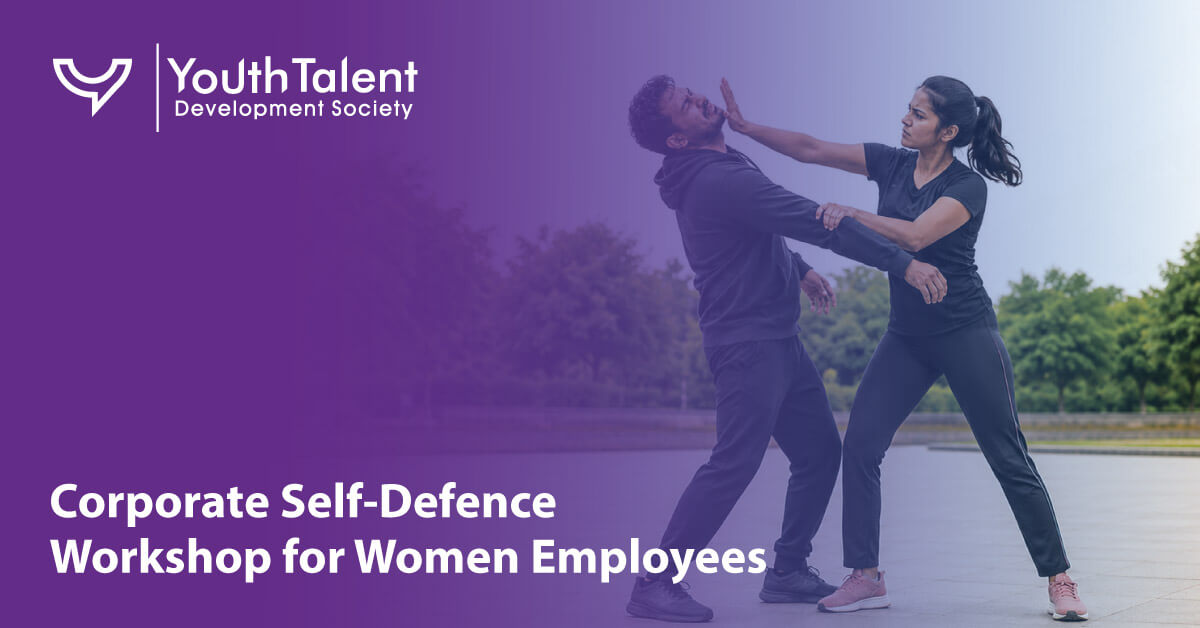
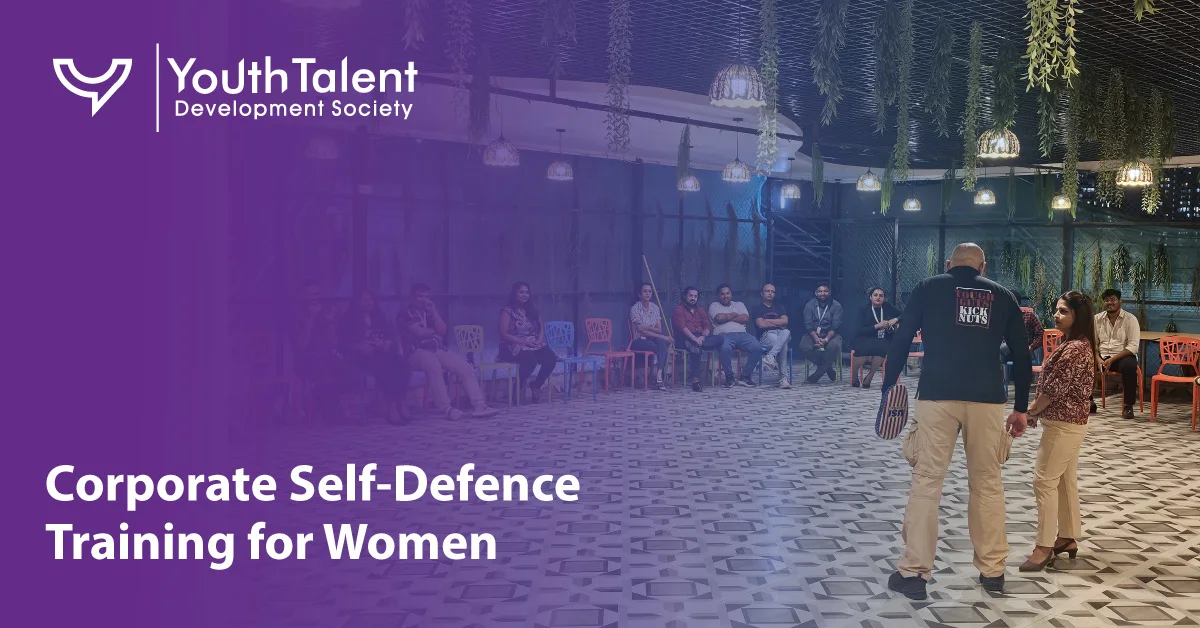
For HR teams planning broader safety support for women employees, YTDS also has a practical guide to organizing a corporate self-defence workshop for women employees.
The goal should be practical awareness.
It should not imply that employees alone are responsible for every road-safety risk they may face.
Organizations should continue to address broader factors such as:
- transport processes
- driver quality
- vehicle condition
- scheduling
- fatigue risk
- workplace travel policies
How Employee Volunteering Can Support Road Safety Campaigns
Employee volunteers can support non-technical parts of road safety programs.
Possible volunteering roles include:
- registration
- community mobilisation
- awareness booths
- distributing approved educational material
- digital campaign promotion
- event coordination
- safety pledges
- feedback collection
- documentation
Companies already running employee-engagement initiatives can integrate road safety into a wider volunteering calendar.
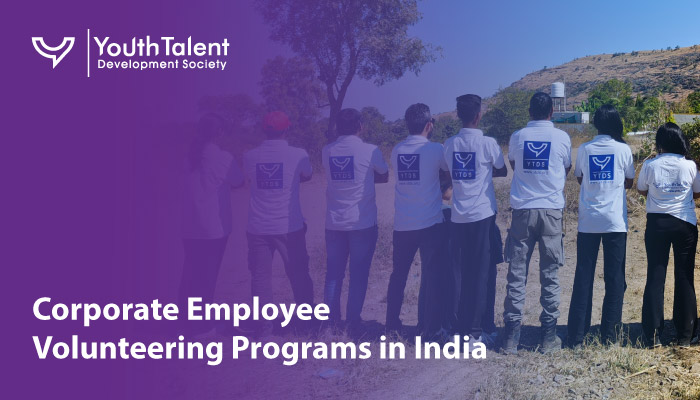
For more ideas, see YTDS’s guide to corporate employee volunteering programs in India.
Employee volunteers should not be asked to provide specialist road-safety or driver training unless they are appropriately qualified.
Technical content should remain with trained road-safety professionals.
Road Safety Week vs Long-Term Road Safety Programs
Many companies consider road safety activities during Road Safety Week or similar observances.
These campaigns can be useful.
But a short awareness period and a long-term program serve different purposes.
Road Safety Week Campaign
Useful for:
- awareness
- events
- high employee participation
- internal communication
- community outreach
- road-safety pledges
It can create visibility and start conversations.
Long-Term Road Safety Program
A longer program can include:
- recurring sessions
- multiple locations
- refresher communication
- driver engagement
- community follow-up
- employee volunteering
- repeated measurement
The important point is not that every company needs a year-round program.
Instead, companies should match program duration to the actual objective.
A one-day activity can create awareness.
It should not automatically be described as long-term behavioural change.
How to Measure a Road Safety CSR Program
Road safety programs should use realistic metrics.
| Metric | What Companies Can Measure |
|---|---|
| Participants Reached | Number of people participating |
| Awareness Sessions | Number of sessions conducted |
| Locations Covered | Communities or workplaces reached |
| Employee Volunteers | Number of participating employees |
| Pre/Post Awareness | Change in basic safety knowledge |
| Safety Pledges | Participants committing to safer behaviours |
| Digital Reach | Campaign views and engagement |
| Participant Feedback | Relevance and usefulness |
| Follow-Up Activities | Repeat sessions or continued outreach |
Whenever possible, use simple pre- and post-session questions.
For example:
Before session:
“Which behaviours increase road risk?”
After session:
“Which three safety actions will you remember?”
This is more useful than reporting attendance alone.
Companies should also avoid claiming that a single awareness event reduced road accidents unless they have suitable evidence linking the intervention to that outcome.
Common Mistakes Companies Should Avoid
Treating Road Safety as a One-Day Photo Activity
Photos and participation numbers may help document an event.
They are not the same as impact.
The program should have a clear awareness objective.
Using Fear-Based Messaging
Graphic or highly alarming communication may attract attention but can make campaigns uncomfortable or ineffective.
Messages should emphasize practical safer behaviour.
Distributing Safety Equipment Without Awareness
Equipment alone does not guarantee correct use.
Distribution should be accompanied by proper communication where relevant.
Running Programs Without Local Coordination
Public-space activities may require coordination with traffic or local authorities.
Implementation should be planned carefully.
Measuring Only Attendance
A large turnout does not automatically mean participants understood the message.
Measure knowledge, feedback and follow-up where practical.
Making Unsupported Impact Claims
Avoid claims such as:
“Our campaign prevented accidents.”
unless there is reliable evidence.
Better claims include:
- participants reached
- awareness improvement
- volunteers engaged
- locations covered
No Follow-Up
If the program identifies a significant local problem, consider whether another intervention is needed.
How Road Safety Programs Can Go Beyond Awareness
Road safety awareness is important, but safer roads depend on multiple systems working together.
These can include:
- awareness
- safer infrastructure
- responsible behaviour
- enforcement
- driver training
- emergency response
- technology
- institutional coordination
This is visible in India’s current road-safety approach.
For example, the Ministry of Road Transport and Highways has supported advanced traffic-management systems, incident-detection technologies and collaboration through the Centre of Excellence for Road Safety at IIT Madras.
In March 2026, the Centre also conducted training for Sadak Suraksha Mitra volunteers, covering areas such as first response, road-safety audits and support for district-level road-safety initiatives.
This highlights an important principle for CSR teams:
Awareness works best when it complements broader systems rather than attempting to replace them.
Role of an NGO Implementation Partner
An NGO implementation partner can support companies by helping translate CSR objectives into practical community programs.
For road safety awareness, an implementation partner may support:
- community needs assessment
- participant mobilisation
- local coordination
- authority liaison
- campaign planning
- volunteer coordination
- awareness-session logistics
- feedback collection
- documentation
- follow-up
The partner should also recognise when specialist road-safety expertise is required.
For example, technical driver training or road-safety auditing should involve appropriately qualified professionals.
How YTDS Can Support Road Safety Awareness Programs
YTDS works across community development, employee engagement and CSR implementation.
YTDS also works on community and personal safety through its SafeHerIndia women safety initiative, which focuses on awareness, preparedness, confidence-building and structured safety training.
For companies exploring road safety awareness initiatives, YTDS can support program coordination around areas such as:
- community outreach
- participant mobilisation
- employee-volunteer engagement
- awareness-event planning
- stakeholder coordination
- documentation
- feedback collection
- follow-up planning
Where technical road-safety expertise or permissions are required, these should be coordinated with the appropriate specialists and authorities.
The focus should remain on building a structured awareness initiative rather than treating road safety as a one-day activity.
Conclusion
Road safety affects employees, communities, pedestrians, cyclists, riders, drivers and families.
For companies, road safety awareness through CSR can create a practical opportunity to support safer behaviour while engaging employees and local communities.
A strong program begins by identifying the real safety issue.
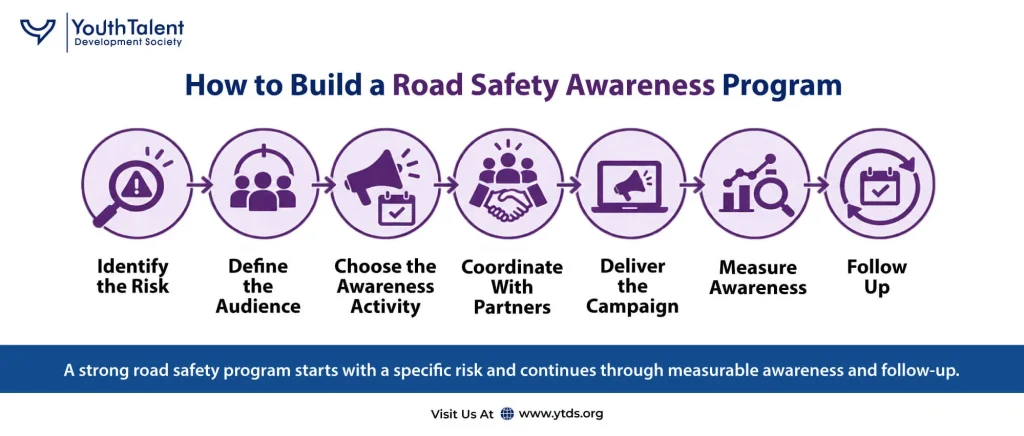
It then moves through:
Risk Identification → Target Audience → Awareness Activity → Partner Coordination → Program Delivery → Measurement → Follow-Up
The most effective campaigns do not try to solve every road-safety issue at once.
They focus on clear behaviours, appropriate audiences, credible partnerships and measurable awareness.
Planning a road safety awareness initiative through CSR? Connect with YTDS to discuss community outreach, employee volunteering and implementation support.
Frequently Asked Questions
1. What is road safety awareness?
Road safety awareness means helping people understand safer road behaviour, including helmet and seat-belt use, safe speeds, avoiding distracted driving, pedestrian awareness and responsible commuting.
2. How can companies support road safety awareness through CSR?
Companies can support community awareness campaigns, employee road-safety programs, helmet and seat-belt awareness, pedestrian campaigns, driver-awareness sessions, employee volunteering and longer-term community outreach.
3. What activities can be included in a road safety awareness program?
Activities may include workshops, community sessions, digital campaigns, awareness booths, road-safety pledges, helmet-awareness activities, pedestrian-safety communication and targeted driver sessions.
4. Can employees volunteer in road safety awareness campaigns?
Yes. Employees can support registration, awareness communication, event coordination, community outreach, documentation and feedback collection. Specialist training should be handled by appropriately qualified professionals.
5. How can companies measure road safety awareness?
Companies can measure participants reached, awareness sessions conducted, pre- and post-session knowledge, employee-volunteer participation, feedback, digital reach and follow-up activities.
6. What is the difference between Road Safety Week and a long-term road safety program?
Road Safety Week is useful for concentrated awareness and engagement. A longer program can include recurring communication, repeat sessions, community follow-up and ongoing measurement.
7. Why should companies work with an NGO for road safety programs?
An NGO implementation partner can support community mobilisation, local coordination, volunteer engagement, program execution, documentation and follow-up while helping companies coordinate with relevant authorities or specialists when required.