








Women’s safety at work is not limited to what happens inside the office.
Employees may travel early in the morning, work late shifts, use public transport, travel by cab, visit client locations, attend events, or commute through unfamiliar areas.
For HR teams, this means employee safety initiatives can extend beyond policy communication and workplace infrastructure.
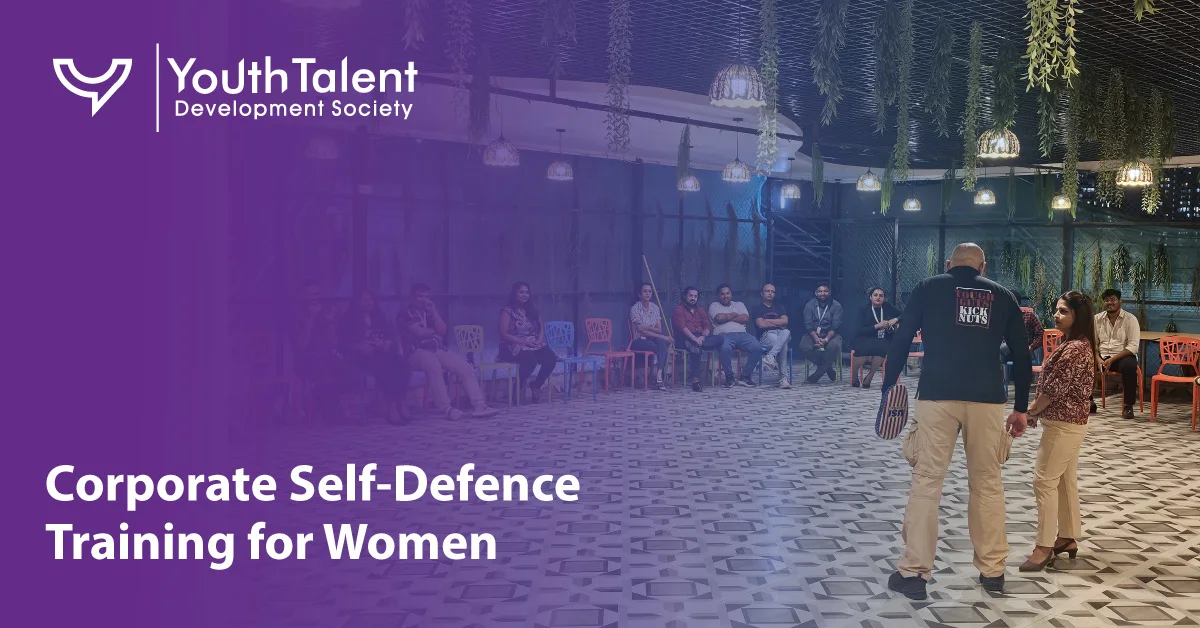
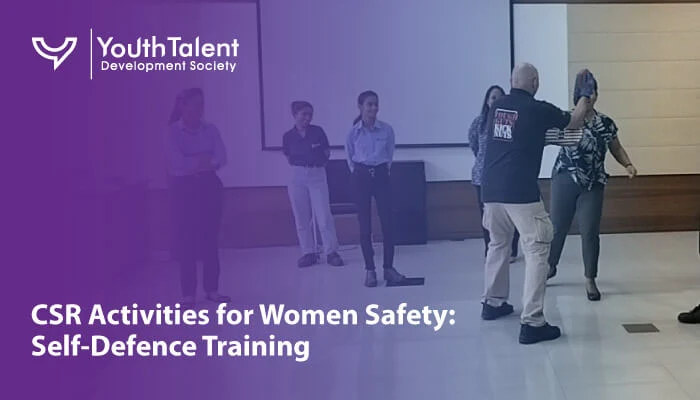
A corporate self-defence workshop can provide women employees with practical safety awareness, confidence-building, situational preparedness, and professionally guided self-defence training in a structured workplace setting.
But simply inviting a trainer and booking a conference room does not automatically create a good program.
The workshop needs to be planned around:
- clear objectives
- qualified trainers
- employee comfort
- physical safety
- realistic scenarios
- voluntary participation
- suitable group size
- appropriate venue
- feedback
- follow-up
This guide explains how HR, administration, employee-engagement, and corporate social-impact teams can organize a safe and practical self-defence workshop for women employees.
For companies looking for a broader CSR and community-focused perspective, YTDS also has a detailed guide on corporate self-defence training for women.
Why Companies Organize Self-Defence Workshops for Women Employees
Companies may organize self-defence and safety-awareness workshops for several reasons.
These can include:
- employee wellbeing
- workplace safety awareness
- commute safety
- confidence-building
- employee engagement
- women-focused workplace initiatives
- International Women’s Day activities
- safety-week programs
- late-shift workforce support
- broader diversity and inclusion initiatives
The objective should not be to suggest that employees are responsible for preventing unsafe situations.
Instead, the workshop should provide practical awareness and professionally guided skills that participants can choose to learn as part of a broader employee-safety approach.
A well-run workshop should leave employees feeling more informed and prepared, not more fearful.
Corporate Self-Defence Workshop vs General Women Safety Session
A self-defence workshop and a women-safety awareness session are related but not identical.
| Format | Main Focus | Typical Content |
|---|---|---|
| Self-Defence Workshop | Practical preparedness and guided physical training | Situational awareness, defensive positioning, safe-response concepts and supervised practice |
| Women Safety Awareness Session | Broader personal and workplace safety awareness | Commute safety, emergency planning, reporting channels, digital safety and awareness |
| Combined Safety Workshop | Practical training plus workplace-safety awareness | Self-defence basics, situational awareness, commute safety, communication and reporting |
For most workplaces, a combined format is more useful than treating physical self-defence as the entire program.
Employees need context around awareness, communication, emergency support, and workplace reporting in addition to professionally supervised practical training.
When Should HR Consider a Corporate Self-Defence Workshop?
A workshop can be considered when a company wants to strengthen women-focused employee wellbeing or safety initiatives.
It may be particularly relevant for organizations with:
- women working late shifts
- large office campuses
- manufacturing facilities
- employees travelling between sites
- field-based staff
- customer-facing teams
- frequent business travel
- younger workforces
- large employee-engagement programs
It can also be included as one activity within a broader women-employee safety program.
The decision should be based on employee needs rather than scheduling the workshop only because a calendar event is approaching.
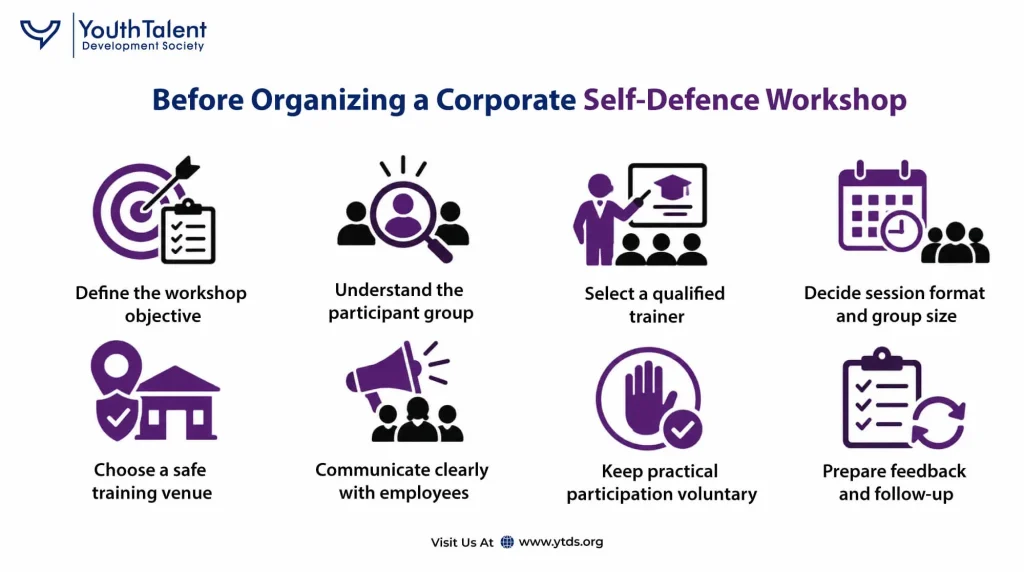
Step 1: Define the Workshop Objective
Before choosing a trainer or venue, HR should decide what the workshop is meant to achieve.
Possible objectives include:
- improving general safety awareness
- building confidence
- introducing practical self-defence concepts
- supporting women working late shifts
- improving commute-safety awareness
- strengthening emergency preparedness
- creating an engaging employee-wellbeing activity
The objective will influence the workshop format.
For example, a 60-minute awareness session cannot reasonably deliver the same depth as a multi-session practical training program.
Avoid promising unrealistic outcomes from a short workshop.
Step 2: Understand the Participant Group
The same workshop format will not suit every workforce.
HR should consider:
- participant age range
- job roles
- work location
- shift patterns
- travel requirements
- previous training experience
- physical accessibility needs
- expected participant count
Participation should be voluntary.
Employees should also be informed in advance that practical participation can be adapted according to comfort and ability.
Step 3: Choose a Qualified Trainer or Implementation Partner
Trainer selection is one of the most important decisions in the program.
Physical self-defence instruction should be led by trained professionals with relevant experience.
HR should ask:
- What is the trainer’s background?
- Have they trained women employees before?
- How do they handle participants with different fitness levels?
- How do they maintain a respectful training environment?
- What safety precautions are used?
- How much of the session is practical versus awareness-based?
- Can the content be adapted for the workplace context?
Companies should avoid using unqualified employees or volunteers to demonstrate physical techniques.
YTDS’s SafeHerIndia initiative uses structured awareness, self-defence training, confidence-building, and follow-up as part of its women-safety approach.
Step 4: Decide the Workshop Format
Different organizations need different formats.
Short Awareness Session
Best for:
- large employee groups
- safety weeks
- introductory sessions
Typical focus:
- situational awareness
- commute safety
- personal preparedness
- emergency response awareness
Half-Day Workshop
Allows more time for:
- awareness
- trainer demonstration
- supervised practical participation
- questions
- scenario discussion
Multi-Session Program
Better for organizations that want deeper learning.
Sessions can be spread across several days or weeks and may include:
- awareness
- practical training
- confidence-building
- refresher sessions
- feedback and follow-up
A one-time workshop can introduce concepts.
Repeated sessions are better for reinforcement.
Step 5: Choose the Right Group Size
Group size affects training quality.
A very large group may be suitable for awareness, but practical training requires closer instructor supervision.
HR should ask the trainer for an appropriate trainer-to-participant ratio based on:
- workshop format
- venue
- number of instructors
- level of practical activity
- participant experience
If employee demand is high, running multiple smaller sessions may create a better experience than putting everyone into one large session.
Step 6: Select a Safe Training Venue
The venue should match the physical nature of the workshop.
A suitable space should have:
- adequate floor area
- good lighting
- ventilation
- clear emergency exits
- minimal obstacles
- safe flooring
- easy access to drinking water
- privacy where appropriate
Avoid conducting practical sessions in spaces crowded with:
- tables
- chairs
- exposed cables
- sharp furniture edges
- decorative equipment
If the office does not have a suitable space, consider a dedicated training venue.
Step 7: Communicate Clearly Before the Workshop
Employee communication should explain what the session involves.
A pre-workshop message can include:
- date and time
- venue
- workshop purpose
- session duration
- trainer details
- suggested comfortable clothing
- whether practical participation is optional
- how employees can register
- whom to contact with questions
Avoid dramatic messaging such as:
“Learn how to fight attackers.”
A better framing is:
“Practical safety awareness and professionally guided self-defence training for women employees.”
The tone should be professional and empowering.
What Should a Corporate Self-Defence Workshop Cover?
The workshop should balance awareness with practical learning.
1. Situational Awareness
Employees can learn to pay attention to:
- surroundings
- unusual behaviour
- isolated areas
- travel conditions
- environmental warning signs
The emphasis should be on awareness rather than fear.
2. Personal Boundaries and Assertive Communication
Safety workshops can include guidance around:
- clear verbal communication
- boundary-setting
- seeking assistance
- leaving uncomfortable situations
- attracting attention when help is needed
These skills can complement physical training.
3. Commute Safety Awareness
This can be particularly relevant for employees working late shifts or travelling frequently.
Topics may include:
- pre-planning travel
- staying aware during public transport use
- verifying cab details
- keeping trusted contacts informed
- understanding company transport procedures
- knowing whom to contact during an emergency
The workshop should also remind employees about existing company transport and escalation procedures.
4. Professionally Guided Self-Defence Practice
Practical training may include basic defensive concepts under trainer supervision.
The focus should remain on:
- creating space
- disengaging safely
- protecting oneself
- seeking help
- leaving the situation when possible
Detailed physical techniques should be taught only in person by qualified instructors.
HR should not distribute unsupervised technique instructions as a substitute for professional training.
5. Emergency Preparedness
Employees should know:
- company emergency contacts
- workplace security contacts
- available internal escalation channels
- relevant public emergency services
- whom to contact during commute-related incidents
Keep this information current and location-specific.
6. Workplace Reporting Awareness
The workshop can remind employees about appropriate internal reporting channels.
Depending on the organization, this may include:
- HR
- workplace security
- managers
- designated internal committees or grievance channels
- employee assistance resources
The workshop should not replace formal company policies or professional legal guidance.
7. Digital and Location Safety Basics
A short module can also cover:
- privacy settings
- location sharing
- suspicious messages
- online harassment
- protecting personal information
This should remain a supporting topic rather than turning the session into a full cyber-safety workshop.
What Trainers Should Avoid
HR should also evaluate what should not happen during the session.
Avoid:
Fear-Based Training
The session should not make participants feel that danger is everywhere.
Unrealistic Demonstrations
Training should not create false confidence or promise guaranteed outcomes.
Forced Physical Participation
Employees should be allowed to observe or opt out of physical exercises.
Embarrassing Participants
No participant should be pressured to perform in front of colleagues.
Unsafe Contact
Practical exercises should use clear consent and professional training protocols.
Graphic or Disturbing Scenarios
The workshop should remain workplace-appropriate and sensitive.
How to Make the Workshop Inclusive and Voluntary
Women employees may have different levels of:
- mobility
- fitness
- confidence
- comfort with physical contact
- previous experiences
- health limitations
A professional workshop should allow participants to engage at an appropriate level.
HR should communicate that:
- participation is voluntary
- employees can observe demonstrations
- exercises can be adapted
- participants can stop at any time
- questions can be raised privately if needed
This creates a safer and more respectful learning environment.
How HR Can Measure Workshop Effectiveness
A workshop should be measured beyond attendance.
| Metric | What HR Can Track |
|---|---|
| Registrations | Number of employees who registered for the session |
| Attendance | Number of employees who actually participated |
| Session Completion | Participants completing the planned workshop |
| Employee Feedback | Usefulness, comfort and relevance ratings |
| Confidence Feedback | Self-reported change in confidence or preparedness |
| Awareness Improvement | Understanding of safety procedures, reporting and emergency response |
| Repeat Demand | Employees requesting refresher or advanced sessions |
| Follow-Up Participation | Attendance in refresher or recurring workshops |
A short pre- and post-session questionnaire can help HR understand whether employees found the workshop useful.
Avoid making exaggerated claims based only on one workshop.
One-Time Workshop vs Recurring Safety Program
A one-time workshop can work well as an introduction.
But companies that want stronger employee engagement can consider a broader program.
One-Time Workshop
Suitable for:
- awareness campaigns
- Women’s Day programs
- safety-week activities
- introductory employee engagement
Recurring Program
Can include:
- refresher training
- commute-safety sessions
- emergency preparedness
- confidence-building
- workplace-safety awareness
- periodic practical workshops
YTDS’s broader SafeHerIndia model also includes follow-up rather than treating self-defence as a single standalone activity.
How Employee Volunteers Can Support the Workshop
Employees can help with non-technical parts of the program, such as:
- registration
- communication
- venue coordination
- attendance
- feedback collection
- documentation
- follow-up communication
They should not conduct physical self-defence training unless professionally qualified.
Companies planning broader employee-engagement programs can also review YTDS’s guide to corporate employee volunteering programs in India.
Checklist for HR Before the Workshop
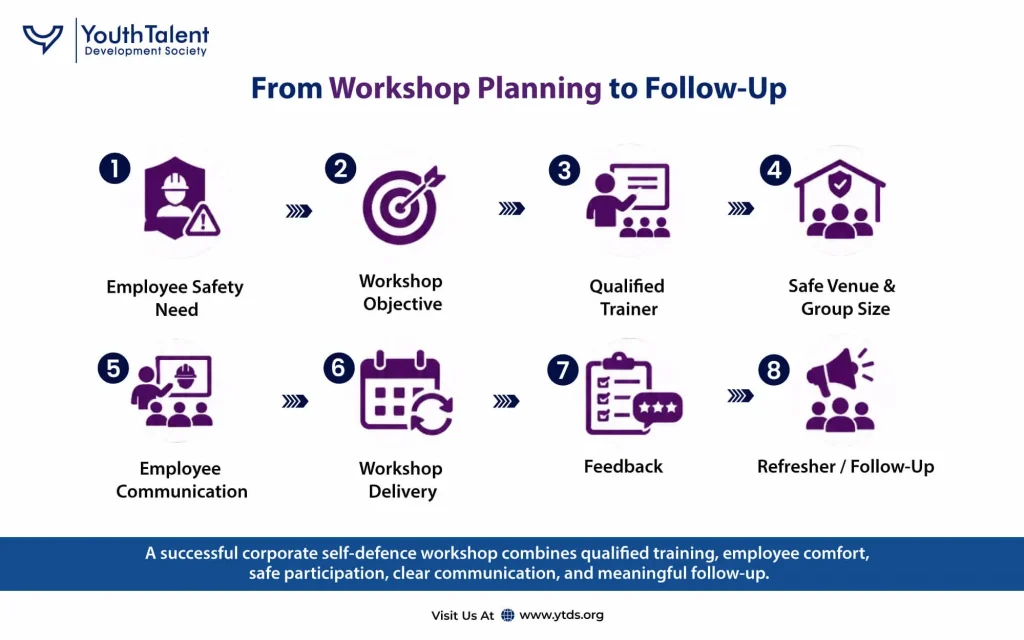
Before confirming the session, HR can use this simple checklist:
- Workshop objective defined
- Participant group identified
- Qualified trainer confirmed
- Venue inspected
- Group size finalized
- Employee communication prepared
- Registration process ready
- Participation kept voluntary
- Safety arrangements confirmed
- Internal emergency contacts available
- Feedback form prepared
- Follow-up plan defined
This reduces last-minute issues and makes the session easier to manage.
How YTDS and SafeHerIndia Can Support Corporate Workshops
Youth Talent Development Society runs the SafeHerIndia women-safety initiative focused on awareness, confidence, practical preparedness, and structured self-defence training.
SafeHerIndia has delivered workplace, college, and community sessions, and YTDS’s case study documents corporate sessions with organizations including Forbes Marshall, Only B2B, and SP Infocity.
For corporate self-defence workshops, YTDS can support:
- workshop planning
- trainer coordination
- employee registration support
- session scheduling
- venue coordination
- safety-awareness modules
- self-defence training coordination
- feedback collection
- documentation
- follow-up session planning
Companies that need broader program execution support can also review YTDS’s guide to choosing a CSR implementation partner in India.
When Should HR Consider a Follow-Up Session?
A follow-up session may be useful when:
- employee feedback is positive
- participants request deeper training
- multiple locations need coverage
- new employees join frequently
- the organization operates late shifts
- the first session was primarily awareness-based
Follow-up does not always mean more advanced physical training.
It may include:
- refresher awareness
- commute safety
- workplace emergency preparedness
- confidence-building
- reporting-awareness sessions
The goal should be continuous employee support rather than simply increasing the number of events.
Common Mistakes HR Teams Should Avoid
Treating It Only as a Women’s Day Activity
The workshop should still have a real employee-safety objective.
Choosing a Trainer Based Only on Cost
Trainer quality and professionalism matter more than simply finding the cheapest option.
Overloading a Short Session
A one-hour workshop cannot cover every aspect of women’s safety in depth.
Making Participation Mandatory
Physical participation should remain voluntary.
Ignoring Feedback
Employees may identify useful improvements for future sessions.
No Follow-Up
If employees want additional training, the company should have a clear next step.
Using Fear as the Main Message
The workshop should build awareness and confidence, not anxiety.
Conclusion
A corporate self-defence workshop for women employees can be a valuable part of workplace safety, employee wellbeing, and women-focused engagement when it is planned responsibly.
For HR teams, the most important part is not simply arranging a trainer.
A successful workshop requires:
- a clear objective
- qualified instructors
- the right venue
- appropriate group size
- clear employee communication
- voluntary participation
- safe training practices
- feedback
- follow-up
The goal should be to give women employees practical awareness and professionally guided learning in a respectful workplace environment.
YTDS, through SafeHerIndia, can support companies in planning and coordinating structured women-safety and self-defence workshops for employees.
Planning a self-defence or women-safety workshop for your employees? Connect with YTDS to discuss a structured corporate session.
Frequently Asked Questions
1. What is a corporate self-defence workshop?
A corporate self-defence workshop is a structured employee-safety session that combines awareness, confidence-building, emergency preparedness, and professionally guided self-defence training for employees.
2. Who should conduct a corporate self-defence workshop?
Practical physical training should be delivered by qualified instructors with experience working with the relevant participant group.
3. How long should a corporate self-defence workshop be?
The right duration depends on the objective. A short awareness session may last around an hour, while practical workshops or multi-session programs may require more time.
4. Should self-defence workshops be mandatory for women employees?
Participation in practical training should generally be voluntary and designed to respect different comfort levels and physical abilities.
5. What should HR include in a women-safety workshop?
The program can include situational awareness, commute safety, personal boundaries, emergency preparedness, reporting awareness, digital safety basics, and professionally supervised self-defence training.
6. How can HR measure workshop effectiveness?
HR can track attendance, feedback, participant confidence, awareness improvement, repeat-session demand, and follow-up participation.
7. Can employee volunteers conduct self-defence training?
Employees can help with coordination and support activities, but physical self-defence instruction should be handled by qualified professionals.
8. Is one workshop enough?
A single workshop can create awareness, but refresher or recurring sessions may provide stronger reinforcement depending on employee needs.
9. How is this different from a general corporate women-safety program?
This article focuses specifically on how HR teams organize and execute a workplace workshop. A broader women-safety program may also include transport policies, workplace reporting systems, digital safety, emergency response, and long-term organizational measures.
10. How can YTDS support corporate self-defence workshops?
YTDS can support workshop planning, trainer coordination, employee engagement, session execution, documentation, feedback collection, and follow-up through its SafeHerIndia initiative.