








Choosing the right CSR implementation partner in India can decide whether a corporate social responsibility project becomes a one-time activity or a long-term social impact program.
Many companies have the intention, budget, and CSR goals to support communities. But successful execution requires more than funding. It needs local understanding, beneficiary mobilisation, program planning, volunteer coordination, documentation, reporting, compliance awareness, and follow-up.
This is where a strong CSR implementation partner becomes important.
A good implementation partner helps companies convert CSR budgets into practical programs that create measurable impact across areas such as education, skill development, youth employment, women empowerment, environment, tree plantation, hill restoration, digital literacy, and community development.
Under Schedule VII of the Companies Act, 2013, CSR activities may include promoting education, employment-enhancing vocational skills, livelihood enhancement projects, gender equality and women empowerment, and environmental sustainability, including ecological balance, protection of flora and fauna, conservation of natural resources, and maintaining quality of soil, air, and water.
For companies, the question is not only “Which CSR activity should we do?” The more important question is:
“Who can implement this CSR activity properly, transparently, and with measurable outcomes?”
Why Companies Need the Right CSR Implementation Partner
A CSR project may look simple on paper, but implementation can be complex on the ground. A tree plantation drive needs the right site, permissions, native species, volunteer planning, maintenance, and survival tracking. An education program needs school coordination, student mobilisation, learning material, session planning, and outcome measurement. A skill development program needs training, attendance, assessments, placement readiness, and follow-up.
Without the right partner, CSR projects may face common problems such as poor planning, weak documentation, low beneficiary participation, no follow-up, unclear impact metrics, or activities that look good in photos but do not create lasting value.
India’s National CSR Portal describes CSR under the Companies Act, 2013 as a framework through which eligible companies take up social welfare projects. This makes execution quality important because CSR should move beyond activity completion and create responsible, measurable, community-focused outcomes.
The right CSR implementation partner can help companies:
- Identify real community needs
- Select suitable CSR activities
- Mobilise beneficiaries and volunteers
- Coordinate with schools, communities, local bodies, and institutions
- Execute programs on the ground
- Document every stage of implementation
- Track participation and impact
- Prepare reports for CSR teams
- Plan follow-up and long-term engagement
A strong partner helps companies move from CSR spending to CSR impact.
What Is a CSR Implementation Partner?
A CSR implementation partner is commonly the eligible implementing agency that helps a company execute, monitor, and report CSR projects. Under the Companies (CSR Policy) Rules, eligible implementing agencies can include specified Section 8 companies, registered public trusts, registered societies, and other entities that meet the applicable requirements under Rule 4.
Implementing agencies covered by Rule 4 are required to register on the MCA21 portal through Form CSR-1 before undertaking CSR activities on behalf of a company.
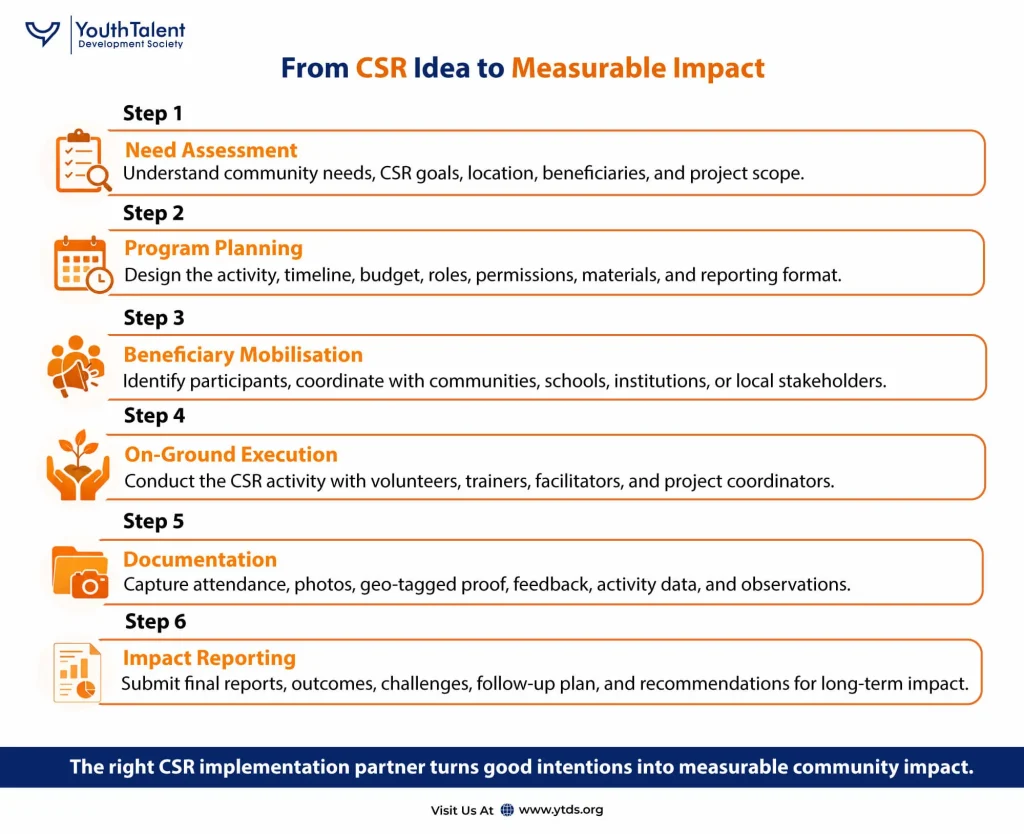
The partner may support one or more stages of the CSR project lifecycle, such as:
- Need assessment
- Program design
- Site selection
- Beneficiary identification
- Volunteer coordination
- Activity execution
- Documentation
- Impact measurement
- Reporting
- Follow-up and maintenance
The role of an implementation partner is not only to conduct an event. A credible partner should help ensure that the CSR activity is relevant, compliant, practical, and measurable.
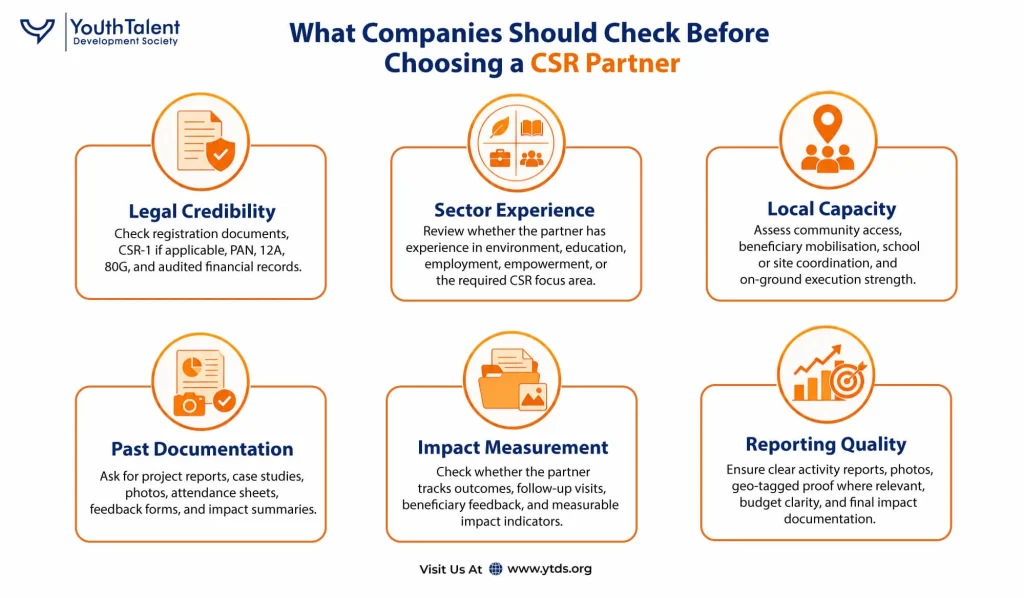
10 Things Companies Should Check Before Choosing a CSR Implementation Partner
Before selecting a CSR partner, companies should evaluate both credibility and execution capacity. The right checklist can help reduce risk and improve project outcomes.
1. Legal Eligibility, CSR-1 and Governance Documents
Before evaluating project capability, companies should verify whether the organisation meets the applicable eligibility requirements for acting as a CSR implementing agency and whether its CSR-1 registration can be verified.
Depending on the type of organisation, due diligence may include reviewing its incorporation or registration documents, PAN, applicable 12A and 80G records, CSR-1 registration, audited financial statements, organisation profile, and relevant governance information.
These documents help establish basic eligibility and transparency, but companies should separately evaluate sector experience, implementation capacity, reporting systems, and past project performance before selecting a partner.
2. Sector Experience
Every CSR sector requires different expertise. A partner that is good at tree plantation may not automatically be strong in youth employment. A partner working in women safety may need trained facilitators, while an education program may need school access and learning support systems.
Companies should check whether the partner has experience in the specific CSR area they want to support.
For example:
- Environment projects need site planning, plantation knowledge, cleanup execution, and survival tracking.
- Education projects need student engagement, school coordination, learning resources, and mentoring.
- Employment projects need skill training, assessments, resume support, and employer connections.
- Women empowerment projects need sensitivity, safety awareness, trained facilitators, and community trust.
Sector experience reduces implementation risk.
3. Local Implementation Capacity
CSR projects are executed in real communities, not only in presentations. A strong partner should understand the local area, community needs, language, institutions, permissions, and ground challenges.
For companies implementing CSR projects across different states or districts, local execution capacity is important because community needs, language, permissions, infrastructure, beneficiary mobilisation, and on-ground coordination can vary by location.
A partner with local networks can help with:
- Community mobilisation
- School and college coordination
- Local volunteer support
- Site permissions
- Beneficiary identification
- Follow-up visits
- Faster problem-solving
Local presence helps convert plans into action.
4. Past Project Documentation
Companies should ask for examples of past project reports, photos, beneficiary data formats, case studies, or activity summaries.
Past documentation shows whether the partner can execute and report properly.
Useful documents may include:
- Activity reports
- Beneficiary lists
- Attendance sheets
- Before-and-after photos
- Geo-tagged photos where relevant
- Feedback forms
- Impact summaries
- Case studies
- Completion reports
A partner that cannot show past work clearly may struggle with CSR reporting expectations.
5. Beneficiary Mobilisation Process
CSR impact depends on reaching the right beneficiaries. Companies should ask how the partner identifies, verifies, and mobilises participants.
For education programs, this may include students, schools, teachers, and parents. For employment programs, it may include youth, women, job seekers, or underserved communities. For environment programs, beneficiaries may include communities, schools, public spaces, or local residents.
A good partner should have a clear process for:
- Identifying beneficiaries
- Understanding needs
- Mobilising participants
- Maintaining attendance
- Collecting feedback
- Following up after the activity
This prevents CSR programs from becoming poorly attended or misdirected.
6. Volunteer and Employee Engagement Support
Many companies want CSR programs that also involve employees. Employee volunteering can make CSR more meaningful, visible, and participatory.
A good CSR implementation partner should be able to manage employee engagement activities such as:
- Tree plantation drives
- Hill cleanup drives
- Student mentoring sessions
- Digital literacy workshops
- Career guidance programs
- Women safety awareness sessions
- Community volunteering events
- Corporate blood donation drives
For healthcare-related employee initiatives such as blood donation drives, the implementation partner should also coordinate with authorised medical institutions while keeping clinical activities under qualified medical supervision.
The partner should also support registration, briefing, role allocation, safety instructions, activity coordination, photography, and reporting.
This helps employees feel connected to the cause while ensuring the activity remains structured.
7. Impact Measurement Approach
CSR programs should be measured through outcomes, not only activities.
For example, a plantation project should not only report how many saplings were planted. It should also track species, location, maintenance, survival, and follow-up. A skill development program should not only report the number of trainees. It should track attendance, completion, skills gained, interviews, placements, or livelihood outcomes.
Companies should ask the partner:
- What metrics will be tracked?
- How will data be collected?
- Will there be before-and-after documentation?
- Will beneficiary feedback be included?
- Will there be follow-up reporting?
- What follow-up intervals are appropriate for this project, and how will outcomes be tracked over time?
A good partner should be comfortable with measurable impact.
8. Financial Transparency
CSR partners should be transparent about how funds are used. Companies should ask for clear budgets, cost heads, implementation expenses, and reporting formats.
Financial transparency is important for trust and accountability.
A good budget should clearly show:
- Program costs
- Material costs
- Trainer or facilitator costs
- Logistics
- Documentation
- Follow-up or maintenance
- Reporting expenses
This helps companies understand whether funds are being used responsibly.
9. Reporting and Photo Documentation
CSR teams need proper documentation for internal review, compliance records, stakeholder communication, and annual reporting.
A reliable CSR implementation partner should provide:
- Project summary
- Activity photos
- Geo-tagged images where relevant
- Attendance data
- Beneficiary details where appropriate
- Feedback summary
- Impact metrics
- Challenges and observations
- Follow-up plan
- Final report
Good reporting helps companies show the value of their CSR investment.
10. Long-Term Follow-Up Capacity
Many CSR projects need follow-up to create real impact. Tree plantation needs survival tracking. Skill training needs placement or livelihood follow-up. Education programs need continued support. Women safety programs may need repeat sessions or advanced workshops.
Companies should check whether the partner can support the project beyond the launch day.
Long-term follow-up may include:
- Maintenance visits
- Beneficiary check-ins
- Repeat workshops
- Survival tracking
- Progress reports
- Refresher training
- Impact updates
This is often the difference between a short-term event and a meaningful CSR program.
Why Sector Experience Matters in CSR Project Execution
Different CSR activities require different execution models. That is why companies should avoid choosing a partner only because they are available or low-cost.
For example, environment CSR requires knowledge of local ecology, permissions, native species, maintenance, and waste disposal. Education CSR requires school coordination, student engagement, learning material, and session design. Employment CSR requires training, assessment, career guidance, employer connections, and placement readiness. Women empowerment CSR requires sensitivity, trust, trained facilitators, and safe implementation.
Schedule VII covers multiple CSR-relevant areas, including education, employment-enhancing vocational skills, gender equality and women empowerment, and environmental sustainability. This means companies have many valid CSR options, but each option requires the right implementation approach.
A strong CSR partner should not offer only generic execution. It should understand the specific needs of the sector.
Red Flags Companies Should Avoid
Choosing the wrong CSR partner can lead to poor outcomes, weak reporting, and reputational risk. Companies should be careful if they notice the following red flags:
- No clear registration documents
- No past project reports
- No defined implementation plan
- No reporting format
- No impact metrics
- No beneficiary mobilisation process
- Only event photos, no follow-up
- No site permissions for environment projects
- No maintenance plan for plantation projects
- No trained facilitators for safety or education programs
- No financial clarity
- No feedback mechanism
- Unclear communication after the project starts
A good CSR implementation partner should be transparent before, during, and after the project.
How Companies Can Measure CSR Partner Performance
After selecting a CSR partner, companies should measure performance through clear indicators. This helps improve accountability and future project planning.
Useful performance indicators include:
- Project completed as planned
- Beneficiaries reached
- Attendance and participation
- Employee volunteers engaged
- Volunteer hours contributed
- Materials distributed or activities completed
- Before-and-after documentation
- Geo-tagged proof where relevant
- Feedback collected
- Follow-up visits completed
- Impact report submitted
- Challenges documented
- Next-step recommendations shared
For environmental projects, companies can also track sapling survival, waste collected, site improvement, and maintenance visits. For education and employment projects, companies can track learning outcomes, skills gained, resumes created, interviews attended, certifications completed, or placements supported.
The goal is to make CSR reporting practical, honest, and useful.
12 Questions to Ask a CSR Implementation Partner Before Signing an Agreement
Before finalising a CSR implementation partner, companies can ask these questions:
- What legal registrations and documents can you provide?
- Do you have CSR-1 registration, if applicable?
- What sectors do you have experience in?
- Can you share past project reports or case studies?
- How do you identify beneficiaries?
- How do you manage employee volunteers?
- What impact metrics will you track?
- What documentation will be provided?
- How will funds be used?
- What follow-up support will be included?
- Who will coordinate the project from your side?
- How will you handle challenges during execution?
These questions help companies choose partners based on capability, not only claims.
How YTDS Can Support CSR Implementation in India
Youth Talent Development Society works across four core areas: Environment, Empowerment, Education, and Employment. Through community-led and youth-focused initiatives, YTDS supports companies in designing and executing CSR programs that are practical, measurable, and connected to real needs.
YTDS can support CSR implementation across:
Environment
- Tree plantation drives
- Employee tree plantation activities
- Hill ecosystem restoration
- Clean The Hills campaigns
- Native plantation
- Seedball activities
- Environmental awareness
- Documentation and reporting
Education
- Student learning support
- Digital literacy programs
- Cyber safety awareness
- #EachOneTeachOne support
- School and community workshops
- Career guidance
- Learning resource support
Employment
- Youth skill development
- Employability workshops
- Resume and interview preparation
- Digital skills training
- Career readiness programs
- Women livelihood support
- Impact tracking
Empowerment
- Women safety programs
- Self-defence training
- Mentorship programs
- Community awareness sessions
- Confidence-building workshops
- Volunteer-led empowerment activities
YTDS helps CSR teams move from idea to execution by supporting planning, mobilisation, implementation, documentation, and impact reporting.
Why Companies Should Look for Long-Term CSR Partnerships
One-time activities can create visibility, but long-term CSR partnerships create deeper impact.
A long-term partnership helps companies:
- Understand community needs better
- Build trust with beneficiaries
- Track progress over time
- Improve program quality
- Strengthen employee participation
- Create better annual CSR reporting
- Build a consistent impact story
For example, a company may begin with a tree plantation drive, then add survival tracking, employee volunteering, school awareness sessions, and environmental education. Another company may begin with a skill development workshop and later add mentoring, interview preparation, and placement-readiness support.
A good CSR implementation partner helps companies build this journey step by step.
Conclusion
Choosing the right CSR implementation partner in India is one of the most important decisions a company can make for its CSR strategy. The right partner brings credibility, local experience, sector knowledge, community trust, documentation discipline, and impact measurement.
Companies should not choose a CSR partner only based on cost or convenience. They should check legal registration, sector experience, local capacity, beneficiary mobilisation, reporting quality, financial transparency, and follow-up support.
CSR works best when it is planned, executed, measured, and improved over time.
By partnering with an experienced NGO like YTDS, companies can implement CSR programs across environment, education, employment, and empowerment with practical execution and measurable impact.
Partner with YTDS to design and execute CSR programs that move beyond one-day activities and create long-term community impact.
FAQs
1. What is a CSR implementation partner?
A CSR implementation partner is commonly an eligible implementing agency that supports a company in executing, monitoring, and reporting CSR projects. Eligible implementing agencies may include specified Section 8 companies, registered public trusts, registered societies, and other entities permitted under Rule 4 of the Companies (CSR Policy) Rules.
2. Why do companies need a CSR implementation partner in India?
Companies need a CSR implementation partner to execute projects effectively on the ground. A partner helps with need assessment, beneficiary mobilisation, local coordination, activity execution, documentation, reporting, and follow-up.
3. What should companies check before choosing a CSR partner?
Companies should check legal registration, sector experience, local implementation capacity, past project documentation, beneficiary mobilisation process, employee engagement support, impact measurement, financial transparency, reporting quality, and follow-up capacity.
4. Can NGOs be CSR implementation partners?
Yes. Eligible Section 8 companies, registered public trusts and registered societies can act as CSR implementing agencies when they meet the applicable requirements under Rule 4 of the Companies (CSR Policy) Rules. Implementing agencies covered by Rule 4 are also required to register on the MCA21 portal through Form CSR-1 before undertaking CSR activities on behalf of a company.
5. What are examples of CSR projects NGOs can implement?
NGOs can implement CSR projects such as tree plantation, hill restoration, education support, digital literacy, youth skill development, women safety programs, employment readiness workshops, and community development initiatives.
6. How can companies measure the performance of a CSR implementation partner?
Companies can measure performance through project completion, beneficiaries reached, attendance, employee participation, documentation quality, geo-tagged proof where relevant, feedback collected, follow-up visits, and impact reports.
7. How can YTDS support CSR implementation?
YTDS can support CSR implementation across Environment, Education, Employment, and Empowerment through program planning, community mobilisation, employee volunteering, activity execution, documentation, and impact reporting.