





Tree plantation is one of the most popular CSR activities in India. It is visible, easy to communicate, and allows employees and communities to participate directly in environmental action.
But for CSR teams, the real question is not just:
“How many trees did we plant?”
The better question is:
“How many trees survived, how much land improved, and what long-term environmental value was created?”
A plantation project becomes meaningful only when it is measured beyond the plantation day. Companies need clear impact metrics, survival tracking, maintenance reports, and transparent documentation to understand whether their CSR investment is creating real change.
This guide explains how companies can measure the impact of tree plantation CSR projects in a practical and credible way.
Why Impact Measurement Matters in Tree Plantation CSR
Many plantation drives are promoted through large numbers. But planting numbers alone can be misleading.
A project may plant 10,000 saplings, but if most do not survive, the actual environmental impact is low.
Impact measurement helps companies understand:
- whether trees are surviving
- whether maintenance is happening
- whether the site is improving
- whether the project supports carbon and biodiversity goals
- whether CSR funds are being used effectively
For CSR teams, this also improves reporting, transparency, and stakeholder trust.
Why “Number of Trees Planted” Is Not Enough
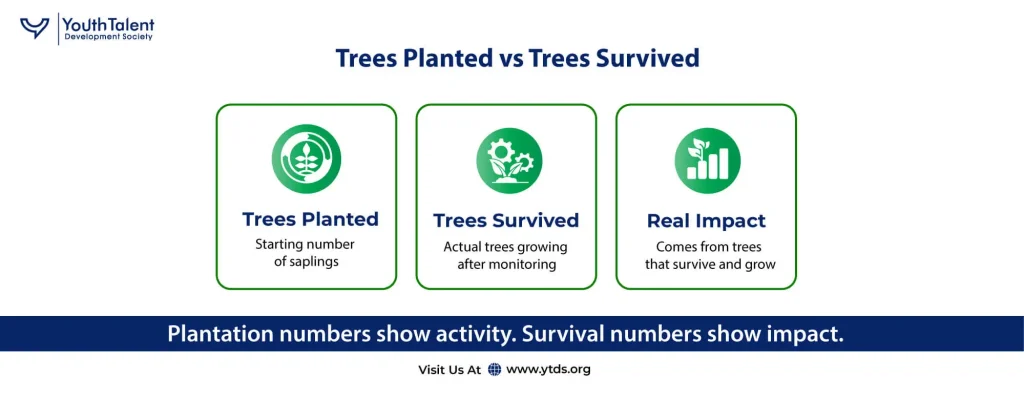
The number of trees planted is only the starting point.
It does not tell you:
- how many trees survived
- whether the species were suitable
- whether the trees are being maintained
- whether the land condition improved
- whether the plantation created long-term ecological value
A plantation drive should not be measured like a one-day event. It should be measured as a long-term environmental project.
Key Metrics to Measure Tree Plantation CSR Impact
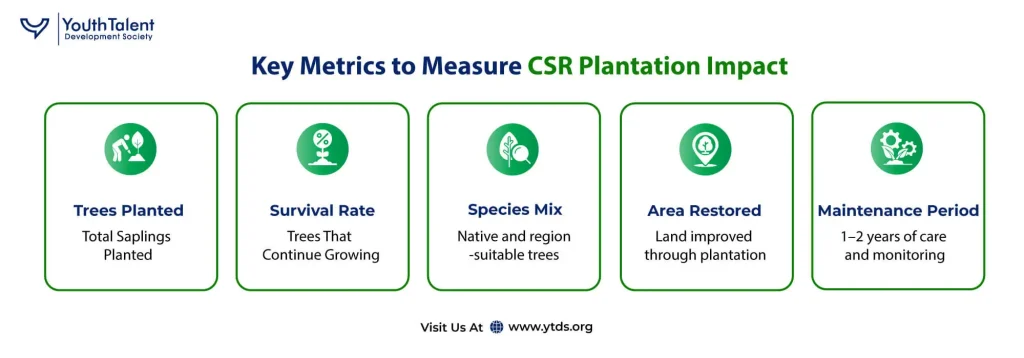
1. Number of Trees Planted
This is the basic metric every project should record.
Companies should track:
- total saplings planted
- plantation date
- plantation location
- species planted
- implementing partner details
This creates the baseline for future monitoring.
2. Tree Survival Rate
Survival rate is one of the most important impact metrics.
It shows how many planted trees continue to grow after a defined period.
For example:
- 10,000 trees planted
- 8,000 trees surviving after monitoring
That means the project has an 80% survival rate.
Survival rate gives a more honest picture of plantation quality than plantation numbers alone.
3. Maintenance and Care
Tree survival depends heavily on maintenance.
A strong CSR plantation project should track:
- watering cycles
- mulching
- soil care
- tree guard usage, if needed
- replacement of damaged saplings
- maintenance visits
Without maintenance, plantation impact becomes uncertain.
4. Species Selection
Not all trees create the same impact.
CSR teams should check whether the project uses:
- native species
- climate-suitable species
- biodiversity-supporting species
- non-invasive species
Native and region-appropriate trees usually have better survival potential and stronger ecological value.
5. Area Restored
Impact should also be measured by the land improved through the project.
This can include:
- degraded land restored
- public spaces improved
- institutional campuses greened
- community areas revived
- hill or trail zones protected
Area-based reporting helps companies understand the physical scale of environmental improvement.
6. Indicative Carbon Impact
Tree plantation can support carbon absorption over time, but carbon impact should be reported carefully.
CSR teams should treat carbon estimates as indicative unless the project is formally certified under a carbon standard.
A responsible report may include:
- estimated lifecycle carbon absorption
- assumptions used
- tree survival basis
- species considered
- monitoring period
This avoids exaggerated claims and keeps reporting credible.
7. Community Participation
Community involvement improves long-term success.
CSR teams should track:
- number of volunteers engaged
- local community participation
- school or college involvement
- employee volunteering hours
- awareness sessions conducted
When communities are involved, plantations are more likely to be protected and maintained.
8. Monitoring Frequency
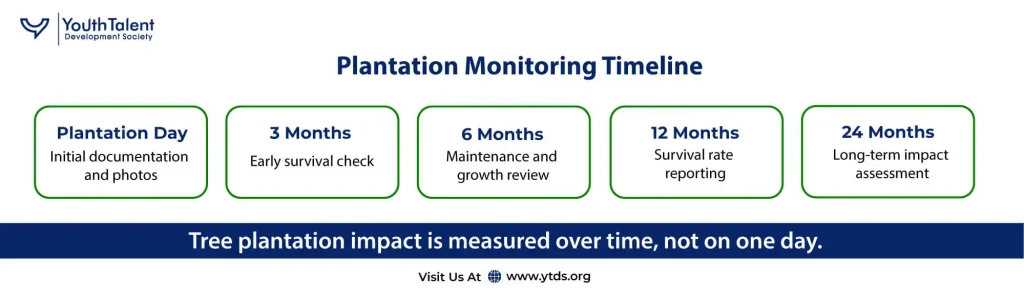
A one-time plantation photo is not impact proof.
Good monitoring should happen at defined intervals, such as:
- immediately after plantation
- after 3 months
- after 6 months
- after 12 months
- after 24 months
Regular monitoring helps identify issues early and improves survival outcomes.
What Should a CSR Plantation Impact Report Include?
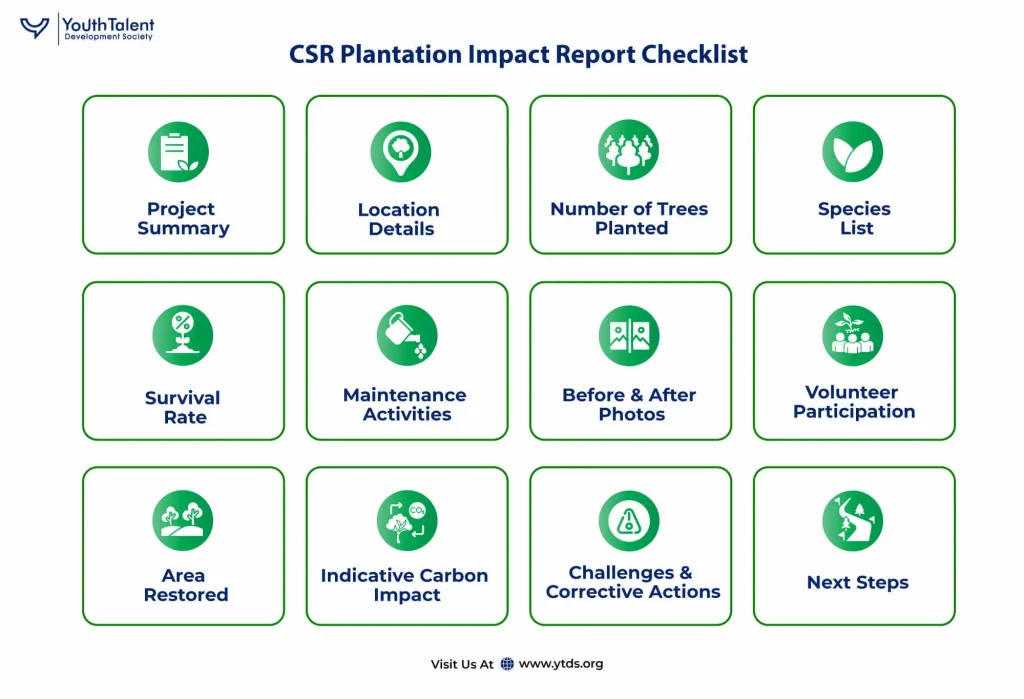
A good impact report should be simple, visual, and evidence-based.
It should include:
- project summary
- location details
- number of trees planted
- species list
- survival rate
- maintenance activities
- before and after visuals
- volunteer participation
- area restored
- indicative carbon impact
- challenges and corrective actions
- next steps
This helps CSR teams report impact clearly to leadership, employees, auditors, and stakeholders.
Common Mistakes in Plantation Impact Reporting
1. Reporting Only Plantation Numbers
Large numbers look impressive, but they do not prove impact.
2. Ignoring Survival Rate
Without survival tracking, the real outcome remains unclear.
3. No Maintenance Data
If maintenance is not reported, the project appears incomplete.
4. Overclaiming Carbon Impact
Companies should avoid claiming verified carbon offsets unless the project has formal certification.
5. No Visual Proof
Before-after images and site photos help build trust.
How Companies Can Improve Plantation Impact Measurement
CSR teams can improve measurement by:
- setting clear impact goals before execution
- choosing native species
- including 1–2 years of maintenance
- tracking survival rate
- documenting every stage
- working with experienced on-ground partners
- using transparent reporting formats
The best CSR plantation projects are not the ones with the biggest numbers. They are the ones with the strongest survival, care, and accountability.
How YTDS Supports Measurable Plantation Impact
YTDS focuses on execution-driven plantation programs where impact is measured beyond the plantation day.
The approach includes:
- site selection
- native and suitable species planning
- youth and community participation
- maintenance support
- survival-focused monitoring
- transparent impact reporting
YTDS’s broader environmental work includes tree plantation, seedball deployment, hill clean-ups, and restoration-focused initiatives, making plantation part of a larger ecological impact model.
This helps companies execute CSR plantation programs that are not only visible, but also measurable and long-term.
FAQs
1. How do you measure the impact of tree plantation CSR projects?
Impact can be measured through survival rate, number of trees planted, species selection, area restored, maintenance activity, carbon estimates, and community participation.
2. What is the most important metric in a plantation project?
Survival rate is one of the most important metrics because only surviving trees create long-term environmental impact.
3. How often should plantation sites be monitored?
Plantation sites should ideally be monitored at intervals such as 3 months, 6 months, 12 months, and 24 months.
4. Can tree plantation impact be used in ESG reporting?
Yes, tree plantation data such as survival rate, area restored, maintenance, and indicative carbon impact can support ESG and CSR reporting.
5. Is carbon impact from tree plantation immediate?
No. Carbon impact develops over time as trees grow and survive. It should be reported as an indicative long-term estimate unless certified under a formal carbon standard.
Conclusion
Tree plantation CSR projects should be measured by long-term outcomes, not just plantation-day activity.
The real impact comes from trees that survive, grow, and improve the local environment over time.
For companies, measuring survival rate, maintenance, area restored, species selection, community participation, and indicative carbon impact creates stronger reporting and greater trust.
A well-measured plantation project becomes more than a CSR activity. It becomes a credible environmental investment.