







When corporate sustainability teams across India plan their environmental CSR allocations, they face a severe real estate bottleneck. Rapid industrialization and expanding tech parks mean that finding massive, contiguous acres of land for traditional afforestation is nearly impossible near major tier-1 and tier-2 cities.
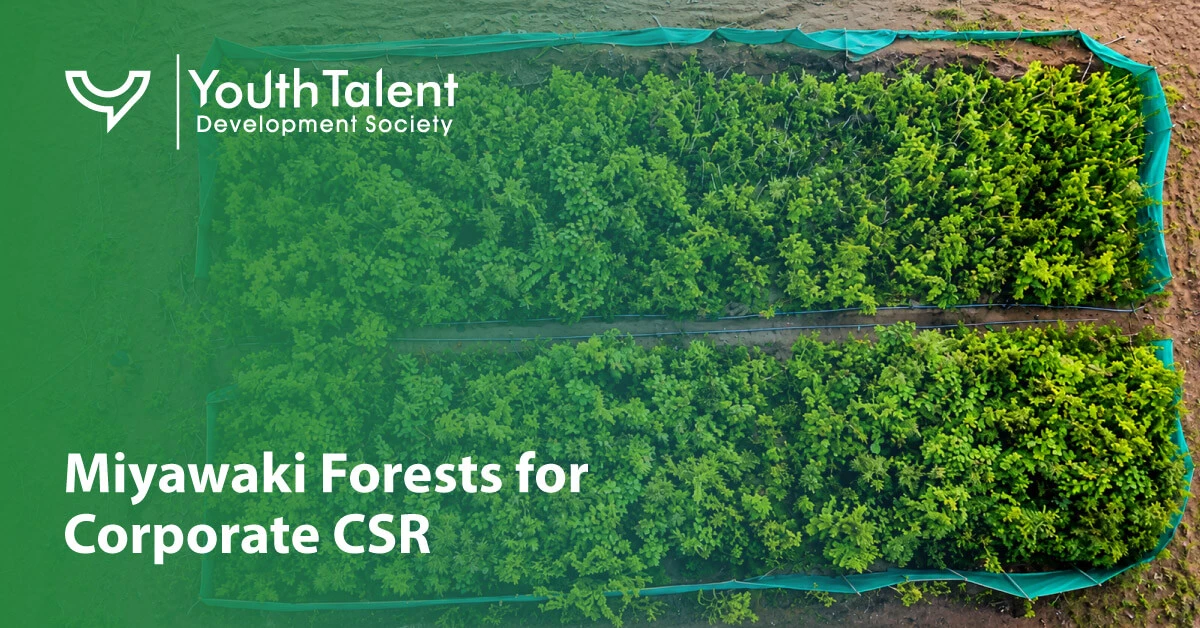
This land constraint is one reason the Miyawaki forest method has attracted interest for urban CSR projects. The method uses dense planting of locally appropriate species to establish multi-layered vegetation within relatively small areas.
Developed from the ecological restoration work of Japanese botanist Akira Miyawaki, the approach focuses on site preparation, native species selection, high-density planting and early-stage care. For CSR teams, the important question is not whether Miyawaki is automatically better than conventional plantation, but whether the method is suitable for the available site, ecological objectives and long-term monitoring capacity.
What Makes the Miyawaki Forest Method Different?
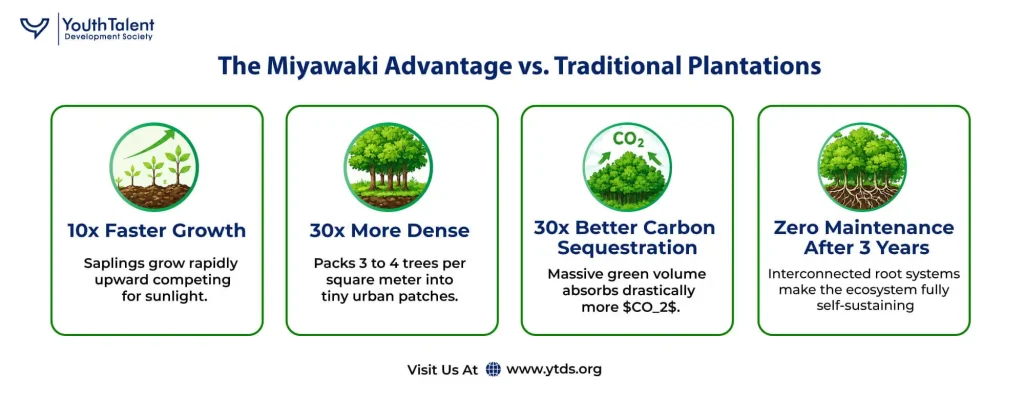
Compared with conventional tree plantation drives, the Miyawaki method uses denser planting, multiple vegetation layers, intensive soil preparation and a stronger focus on locally suitable species. These differences can make it useful for compact urban sites, but the results still depend on site conditions, species selection, early-stage care and long-term monitoring.
When you plant native shrubs, sub-trees, trees, and canopy species in close proximity, the natural competition triggers rapid ecological development:
- Rapid Early Growth: High planting density, careful soil preparation and competition for light can encourage rapid early growth and canopy development. Actual growth rates vary depending on species, soil conditions, climate, irrigation and site management.
- High-Density Planting: Miyawaki forests use closely spaced planting, often with multiple native species and vegetation layers within a small area. This makes the method suitable for compact urban sites, although the ideal planting density should depend on species mix, site conditions and the long-term maintenance plan.
- Carbon Storage Potential: Dense native planting can build substantial biomass as the forest develops, creating long-term carbon storage potential. However, actual carbon sequestration varies by species, tree survival, growth rate, site conditions and forest age, so CSR teams should use site-specific estimates rather than a fixed multiplier.
- Native Species and Reduced Maintenance Over Time: Miyawaki projects are typically designed around native species suited to local ecological conditions. After the establishment phase, maintenance needs may decline, but continued monitoring or intervention can still be necessary depending on tree survival, water availability, invasive species and site conditions.
Survival rates in Miyawaki plantations can vary significantly depending on species selection, soil preparation, irrigation, climate, maintenance and site conditions. CSR teams should therefore monitor survival across multiple seasons rather than assume a fixed survival percentage or treat short-term visual density as proof of long-term ecological success.
Technical Specifications: The 4-Layer Ecosystem Structure
Miyawaki planting typically uses multiple vegetation layers to create a dense, diverse plant community. Species selection should be based on the local ecological context rather than using the same plant list for every project. Soil conditions, rainfall, available space and naturally occurring native vegetation should all be considered before finalising the species mix.
How the Miyawaki Forest Method Works
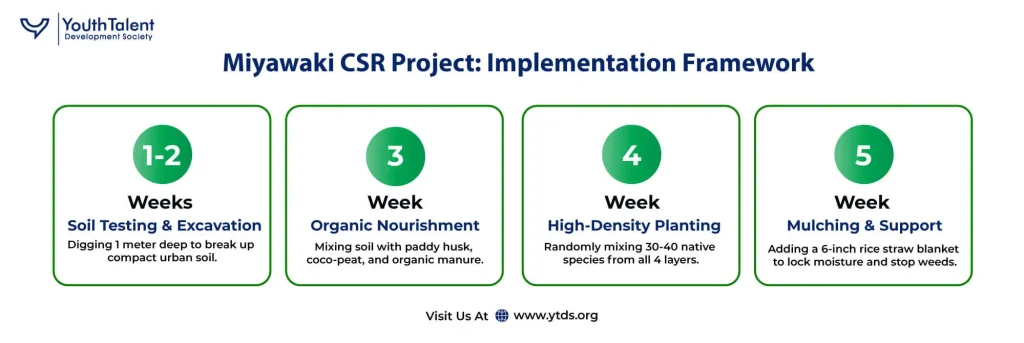
A Miyawaki project typically involves careful site assessment, soil preparation, organic amendments, dense multi-layer planting, and early-stage mulching and care. The steps below explain how the method is generally structured; exact specifications should be adapted to local soil, climate, species mix and site conditions.
1. Soil Assessment and Preparation
Urban corporate land is frequently compacted or filled with construction debris. The target area must be excavated down to a depth of 1 meter. The soil is completely loosened to ensure young roots can spread rapidly without meeting dense resistance.
2. Improving Soil With Organic Biomass
To fix water retention and air perforation, the native soil is mixed heavily with local organic materials. This includes mixing agricultural by-products like paddy husk or coco-peat for water retention, and organic vermicompost or cow manure for immediate nutrition.
3. High-Density Layered Planting
Saplings are planted at a very high density of 3 to 4 plants per square meter. Species from the 4 distinct layers are mixed randomly across the patch to prevent plants with identical root depths from competing directly with one another.
4. Mulching and Early Establishment
The entire ground surface is covered with a thick, 6-inch layer of organic mulch (such as rice straw). This acts as a protective blanket that prevents water evaporation, keeps the soil cool, and stops invasive weeds from choking the young saplings.
When Is the Miyawaki Method Suitable for a CSR Project?
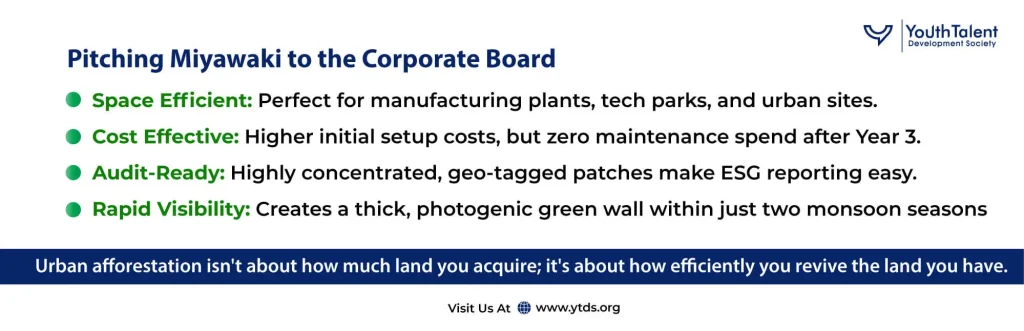
The Miyawaki method is not automatically the right choice for every plantation project. CSR teams should evaluate available land, ecological objectives, native species suitability, water access, maintenance capacity and long-term monitoring requirements before selecting the approach.
1. When Space Is Limited but Dense Green Cover Is the Goal
The Miyawaki method can be suitable for urban or corporate sites where available land is limited but the objective is to establish dense native vegetation. Because the method uses close planting and multiple vegetation layers, companies should first assess the available space, soil condition, water access and long-term site suitability before choosing it over a conventional plantation approach.
For broader budgeting considerations, see our guide to CSR Tree Plantation Cost in India
2. When Biodiversity and Long-Term Monitoring Matter
The Miyawaki method can be useful when a CSR project aims to improve native biodiversity and track ecological progress over time. Companies can monitor indicators such as species diversity, sapling survival, canopy development and overall forest establishment. However, meaningful results depend on suitable native species, proper early-stage care and regular monitoring rather than treating the activity as a one-day plantation event.
For a broader measurement framework, see How to Measure the Impact of Tree Plantation CSR Projects
3. When the Site Can Support Long-Term Forest Establishment
A Miyawaki forest needs more than a one-day plantation event. The site should have suitable soil, reliable water access, protection from disturbance and a clear maintenance plan during the establishment period. Companies should choose the method when they can support long-term survival and ecological development, rather than treating it mainly as a short-term branding or carbon-offset activity.
For more context on the carbon side of plantation projects, read Tree Plantation and Carbon Offset in India: What CSR Teams Should Know
Key Takeaway: When the Miyawaki Method Makes Sense
The Miyawaki method can be a strong option for urban CSR projects where land is limited, native biodiversity is a priority, and the site can support intensive early-stage preparation and long-term monitoring. It should be selected based on site suitability and ecological objectives rather than simply because it offers faster or denser plantation.
Companies ready to explore an actual Miyawaki mini-forest project can review YTDS’s implementation approach and project requirements.