+91-9881904974
 info@ytds.org
.webp)
Tree plantation is one of the most popular environmental CSR activities in India. It is visible, scalable, and easy for employees and communities to participate in.
But as companies become more serious about ESG, carbon footprint reduction, and sustainability reporting, one question comes up often:
Can tree plantation help with carbon offset goals?
The answer is yes — but with important conditions.
Tree plantation can support long-term carbon absorption and environmental restoration. However, not every plantation project automatically qualifies as a certified carbon credit or official offset. For CSR teams, understanding this difference is important before making claims in reports, campaigns, or ESG communication.
This guide explains how tree plantation, carbon offset, CSR, and impact reporting are connected.
What is a Carbon Offset?
A carbon offset is a way to compensate for greenhouse gas emissions by supporting projects that reduce, avoid, or remove carbon dioxide from the atmosphere.
Examples of carbon offset projects may include:
- renewable energy projects
- energy efficiency projects
- methane reduction projects
- reforestation or afforestation projects
- nature-based climate solutions
In simple terms:
If a company emits carbon in one area, it may support verified projects that reduce or remove carbon elsewhere.
But for a project to become a certified carbon offset, it usually needs proper documentation, scientific estimation, third-party verification, and compliance with an accepted carbon standard or framework.
How Tree Plantation Helps Reduce CO₂
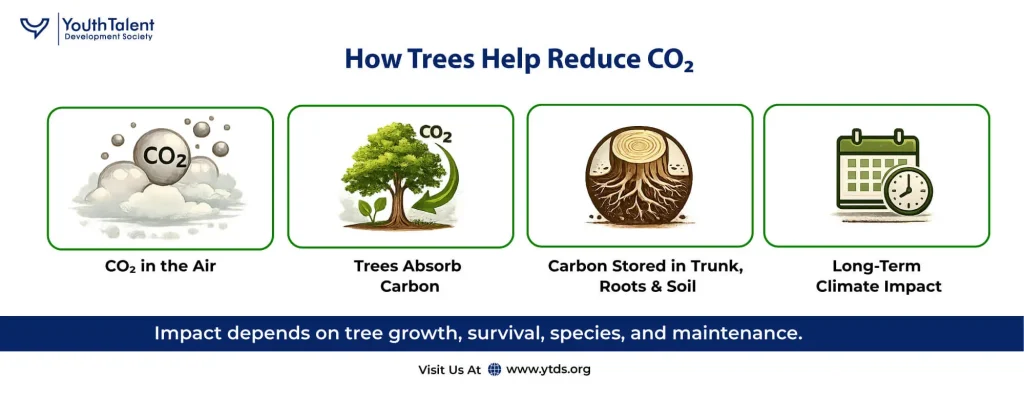
Trees absorb carbon dioxide through photosynthesis and store carbon in their trunks, branches, roots, leaves, and surrounding soil.
Over time, healthy and surviving trees can contribute to:
- carbon absorption
- temperature reduction
- biodiversity support
- improved air quality
- soil protection
- local ecosystem restoration
But the key phrase is: over time.
A sapling planted today does not create full carbon impact immediately. The real impact depends on how long it survives, how well it grows, the species planted, and the ecological conditions around it.
CSR Tree Plantation vs Carbon Credit Project
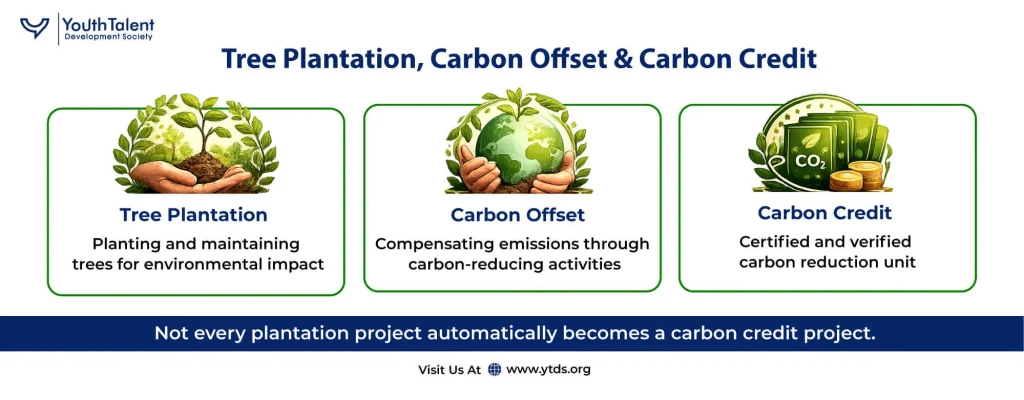
This is the most important distinction CSR teams should understand.
CSR Tree Plantation
A CSR tree plantation project is usually designed for:
- environmental sustainability
- community participation
- employee volunteering
- ecological restoration
- CSR reporting
- local green cover improvement
These projects can create strong environmental and social value.
Certified Carbon Credit Project
A certified carbon credit project requires a more formal process, including:
- baseline calculation
- carbon sequestration methodology
- long-term monitoring
- third-party validation or verification
- documentation under an accepted carbon framework
- clear ownership of carbon rights
So, while CSR plantation can support carbon impact, it should not be marketed as a certified carbon credit project unless it has gone through the required process.
India’s Carbon Credit Trading Scheme is being developed around a formal market framework and MRV approach, which reinforces the importance of credible measurement and reporting.
Why Survival Rate Matters for Carbon Offset Claims
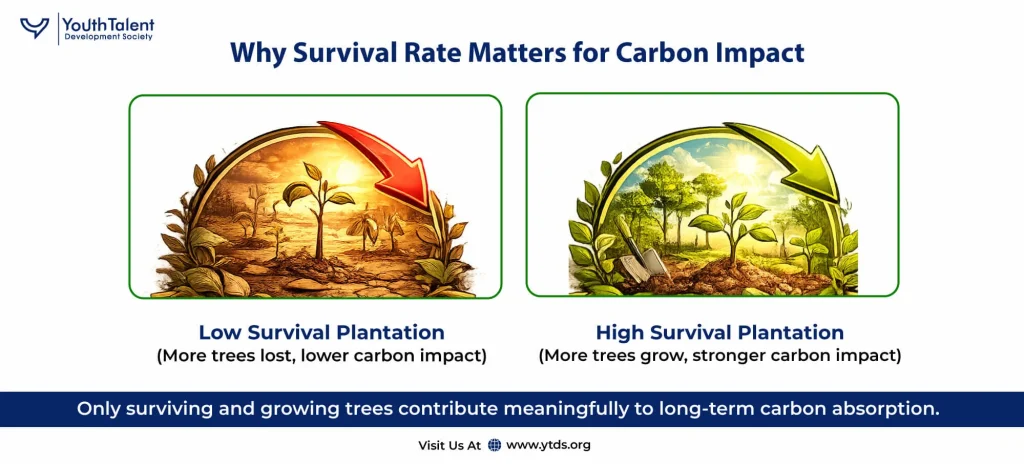
Carbon impact depends on trees that survive and grow.
If 10,000 trees are planted but only 4,000 survive, then the long-term carbon impact is very different from a project where 8,000 or 9,000 trees survive.
That is why survival rate is one of the most important metrics in any plantation project.
A strong plantation program should track:
- number of trees planted
- number of trees surviving
- species planted
- location and site condition
- maintenance period
- monitoring timeline
Without survival tracking, carbon impact claims become weak.
What CSR Teams Should Measure
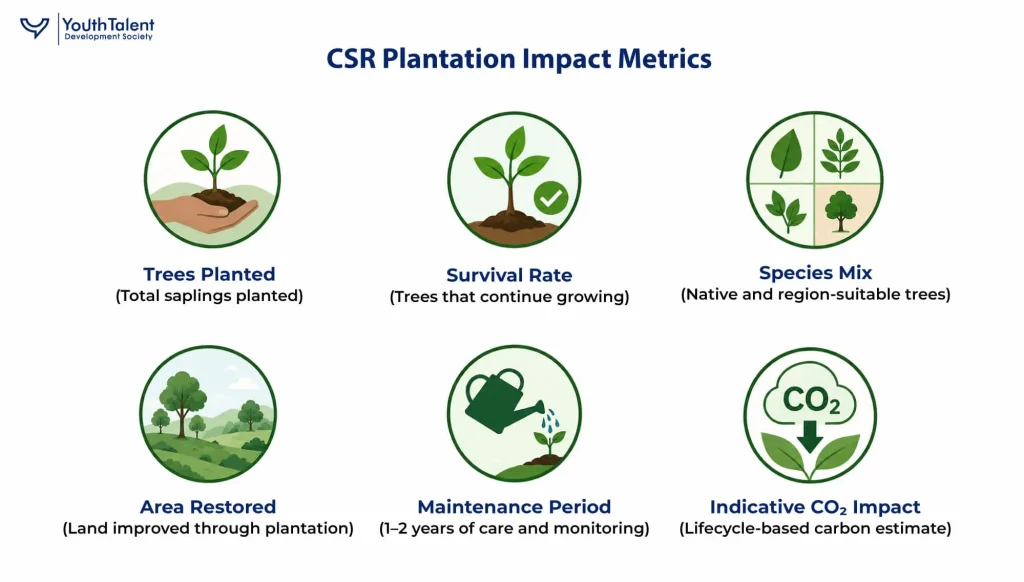
If a company wants to report plantation impact responsibly, it should measure more than the number of trees planted.
Key metrics include:
1. Number of Trees Planted
This is the starting point, but not the final impact metric.
2. Survival Rate
The percentage of trees that continue growing after plantation.
3. Species Mix
Native species are usually better for local ecosystems and long-term survival.
4. Area Restored
CSR teams should track whether the project improves a meaningful land area.
5. Maintenance Period
A plantation project with 1–2 years of maintenance has stronger impact potential.
6. Indicative CO₂ Impact
Carbon estimates should be presented carefully as indicative, lifecycle-based projections — not instant offsets.
7. Community Participation
Local involvement improves protection, care, and long-term sustainability.
How Tree Plantation Supports ESG Reporting
Tree plantation can support ESG and CSR reporting when it is backed by proper data.
Companies can report:
- plantation locations
- trees planted
- survival percentage
- volunteer participation
- area restored
- maintenance activity
- indicative carbon impact
- biodiversity and community benefits
This makes the CSR project more credible than a one-day plantation event.
Common Mistakes Companies Should Avoid
1. Claiming carbon neutrality from basic plantation
A plantation drive alone should not be used to claim carbon neutrality unless scientifically assessed and verified.
2. Reporting only the number of trees planted
CSR impact should include survival and maintenance data.
3. Ignoring native species
Wrong species selection can reduce survival and ecological value.
4. No post-plantation maintenance
Without watering, soil care, and monitoring, saplings may not survive.
5. Calling every plantation a carbon credit project
Certified carbon credits require formal verification and documentation.
Best Practices for CSR Tree Plantation and Carbon Impact
CSR teams should follow a structured approach:
- choose native and region-suitable species
- select sites with long-term protection potential
- include maintenance for at least 1–2 years
- monitor survival regularly
- use transparent reporting
- avoid exaggerated carbon claims
- work with experienced implementation partners
The goal should be responsible impact, not inflated numbers.
How YTDS Supports Measurable Plantation Impact
YTDS focuses on plantation programs that are execution-driven and impact-oriented.
The approach includes:
- site selection
- native plantation
- community and youth participation
- maintenance support
- survival-focused monitoring
- impact reporting
YTDS’s plantation work is positioned around real ecological restoration, not just one-day activity. The organization’s broader environmental work includes tree plantation, seedball deployment, hill clean-ups, and restoration-focused initiatives.
This makes plantation more meaningful for CSR teams looking for measurable and credible environmental outcomes.
Frequently Asked Questions
1. Can tree plantation help offset carbon emissions?
Yes, tree plantation can support long-term carbon absorption, but the impact depends on tree survival, growth, species, and monitoring.
2. Is CSR tree plantation the same as carbon credit?
No. CSR plantation can create environmental impact, but a certified carbon credit requires formal calculation, verification, and registration under an accepted framework.
3. Can companies claim carbon neutrality through tree plantation?
Companies should be careful. Carbon neutrality claims require proper carbon accounting, credible offsets, and verification.
4. What should CSR teams track in plantation projects?
CSR teams should track trees planted, survival rate, species, area restored, maintenance, monitoring, and indicative carbon impact.
5. Why is survival rate important for carbon impact?
Only surviving and growing trees contribute meaningfully to long-term carbon absorption.
Conclusion
Tree plantation can be a powerful CSR activity for companies in India. It supports environmental sustainability, community engagement, and long-term climate action.
But CSR teams must understand the difference between plantation impact, carbon offset, and certified carbon credits.
The most credible approach is to focus on survival, monitoring, native species, and transparent reporting.
That is how tree plantation becomes more than a photo opportunity — it becomes measurable environmental action.
Plan a Responsible Tree Plantation CSR Program
YTDS works with companies to execute plantation programs focused on survival, maintenance, community participation, and measurable impact.
Partner with YTDS to build credible environmental CSR initiatives with long-term value.