






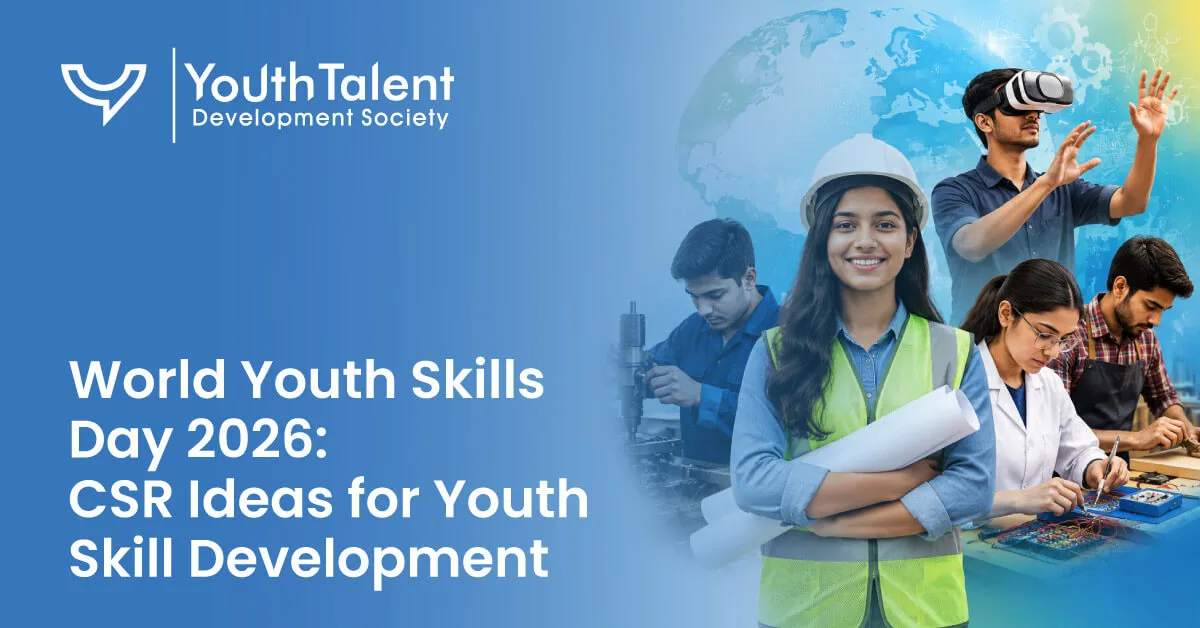
World Youth Skills Day 2026 is a timely reminder that India’s young population needs more than education alone. Young people need practical, future-ready skills that connect them to employment, entrepreneurship, digital confidence, and financial independence.
Observed every year on 15 July, World Youth Skills Day was declared by the United Nations to highlight the importance of equipping young people with skills for employment, decent work, and entrepreneurship.
For companies planning meaningful CSR initiatives, this day offers an opportunity to move beyond one-time activities and invest in long-term livelihood impact. Skill development programs can help bridge the gap between education and employability, especially for youth from underserved communities.
The theme for World Youth Skills Day 2026 is “Skills for a shared future.” UNESCO-UNEVOC highlights the need for innovative youth skills programs that prepare young people to participate in society and the economy with empathy, resilience, communication, and future-ready capabilities.
For CSR teams in India, this makes youth skill development one of the most practical and measurable areas of social impact.
Why World Youth Skills Day Matters for CSR Teams in 2026
India has a large youth population, but many young people continue to face challenges when moving from education to employment. A degree alone does not always guarantee job readiness. Many students and job seekers need practical exposure, communication skills, digital skills, workplace confidence, and industry-relevant training.
This is where CSR-led skill development programs can create real change.
A well-designed skill development CSR program can help young people:
- Build employable skills
- Improve confidence and workplace readiness
- Access internships or placement opportunities
- Learn digital and financial tools
- Explore entrepreneurship or self-employment
- Support their families through stable income
For companies, youth skill development is not only a social responsibility. It is also a long-term investment in India’s workforce, local communities, and inclusive economic growth.
India’s CSR ecosystem is also expanding. A Ministry of Corporate Affairs update shared through PIB stated that CSR expenditure reported by companies crossed ₹1,44,159 crore over five financial years from 2019–20 to 2023–24. This creates a strong opportunity for companies to direct CSR funds towards programs that deliver measurable livelihood outcomes.
6 Skill Areas Companies Can Support on World Youth Skills Day 2026
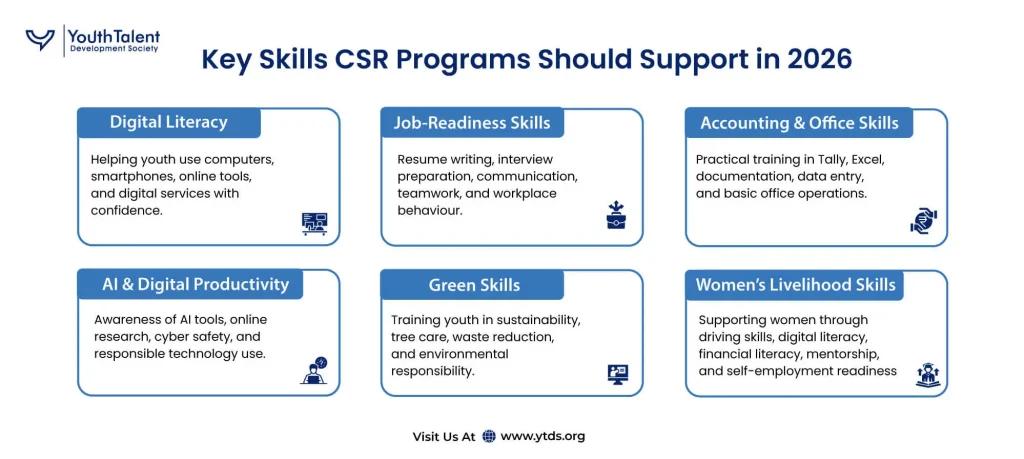
The future of work is changing quickly. Young people need a mix of technical, digital, social, and practical skills to succeed. CSR programs should therefore focus not only on certification, but also on real employability.
Some high-impact skill areas include:
1. Digital Literacy
Digital literacy is now essential for education, employment, banking, communication, and access to government services. CSR programs can support basic computer training, smartphone safety, digital payments, online applications, email usage, and responsible internet behaviour.
This is especially important for rural and semi-urban youth who may have access to mobile phones but limited confidence in using digital tools for learning or work.
2. Job-Readiness and Communication Skills
Many young people struggle during interviews because they have not received structured training in communication, resume writing, workplace behaviour, and professional confidence.
CSR-supported job-readiness programs can include:
- Resume-building workshops
- Interview preparation
- Spoken English practice
- Workplace etiquette
- Time management
- Teamwork and problem-solving
These skills may look simple, but they often determine whether a trained candidate can successfully enter and sustain formal employment.
3. Accounting and Office Skills
Practical office skills such as Tally, basic accounting, data entry, Excel, documentation, and customer handling can open employment opportunities in small businesses, offices, retail, logistics, and service industries.
Short-term training in these areas can be especially useful for youth who need fast, practical pathways into entry-level jobs.
4. AI Awareness and Digital Productivity
Artificial Intelligence is becoming part of daily work across sectors. Young people do not need to become AI engineers to benefit from AI awareness. They need to understand how to use digital productivity tools responsibly and safely.
CSR programs can introduce youth to:
- Basic AI awareness
- Online research skills
- Digital content creation
- Productivity tools
- Cyber safety
- Responsible use of technology
This helps students and job seekers become more confident in a technology-driven workplace.
5. Green Skills and Sustainability
As India grows, there will be increasing demand for people who understand sustainability, waste reduction, tree care, biodiversity, water conservation, and climate responsibility.
Green skills can connect youth with employment opportunities in environmental projects, CSR implementation, nursery management, plantation monitoring, waste management, and sustainability awareness campaigns.
For CSR teams, this also creates a strong connection between employment and environmental impact.
6. Women-Focused Livelihood Skills
Skill development becomes even more powerful when it supports women’s economic independence. Many women face barriers such as limited mobility, financial dependence, safety concerns, and lack of access to mentorship.
CSR programs can support women through:
- Driving skills
- Digital literacy
- Financial literacy
- Entrepreneurship training
- Self-defence and confidence-building
- Mentorship programs
- Small business support
When women gain skills, the impact extends beyond one individual. Families, children, and communities benefit from improved income, confidence, and decision-making power.
7 Practical CSR Ideas for World Youth Skills Day 2026
World Youth Skills Day is a good moment for companies to launch, announce, or scale youth-focused CSR initiatives. The most effective programs are those that combine training with mentoring, measurement, and long-term follow-up.
Here are practical CSR ideas for companies in India.
1. Sponsor Skill Development Batches for Underprivileged Youth
Companies can sponsor structured training batches for youth from low-income communities. These batches can focus on digital literacy, accounting, office administration, communication skills, or vocational training.
A strong model includes:
- Baseline assessment
- Training curriculum
- Attendance tracking
- Practical assignments
- Certification
- Placement or internship support
- Post-training follow-up
This ensures the program does not stop at training, but moves towards real employability.
2. Run Employability Bootcamps in Colleges and Communities
Short employability bootcamps can be conducted in colleges, community halls, NGO centres, or corporate campuses. These bootcamps can prepare youth for interviews, workplace expectations, and entry-level jobs.
A 1-day or 3-day bootcamp can include:
- Resume writing
- Mock interviews
- Group discussion practice
- Workplace communication
- Digital safety
- Career guidance
- Employer interaction
This is a practical CSR activity for companies that want visible, high-engagement impact.
3. Support Digital Literacy and Cyber Safety Workshops
Digital skills are now linked to both employment and safety. Youth use smartphones for study, job search, payments, and communication, but many are unaware of online fraud, phishing, fake links, privacy risks, and unsafe digital behaviour.
CSR teams can support workshops on:
- Safe smartphone usage
- Password safety
- Online fraud prevention
- Digital payments awareness
- Email and document basics
- Online job application safety
- Responsible social media use
This connects education, employment, and cyber safety in one practical initiative.
4. Create Apprenticeship-Readiness Programs
Many young people are not ready for apprenticeships or internships because they lack workplace basics. CSR programs can prepare candidates before they enter real work environments.
Apprenticeship-readiness training can include:
- Professional discipline
- Attendance and punctuality
- Communication with supervisors
- Basic workplace safety
- Practical task orientation
- Career expectations
NSDC’s industry partnership and CSR models include approaches such as candidate sponsorship, skill centres, trade-specific labs, and apprenticeship support. Companies can use similar models while partnering with credible implementation agencies.
5. Support Women’s Livelihood and Mobility Programs
Women-focused livelihood programs can create strong and measurable outcomes. For example, driving skills, digital literacy, financial literacy, or entrepreneurship training can help women become more independent and employable.
CSR teams can design programs that include:
- Skills training
- Self-defence or personal safety awareness
- Confidence-building sessions
- Mentorship
- Financial literacy
- Placement or income-generation support
This kind of program directly supports women’s empowerment and employment.
6. Build Skill Labs in Schools or Community Centres
Companies can support computer labs, digital learning spaces, training rooms, or mobile skill labs. These spaces can be used year-round for students, women, youth, and community members.
A skill lab can support:
- Basic computer training
- Online learning
- Career guidance
- Digital form filling
- Job application support
- Financial literacy sessions
- Youth mentoring
This creates a long-term community asset rather than a one-day CSR activity.
7. Partner with NGOs for Training and Impact Tracking
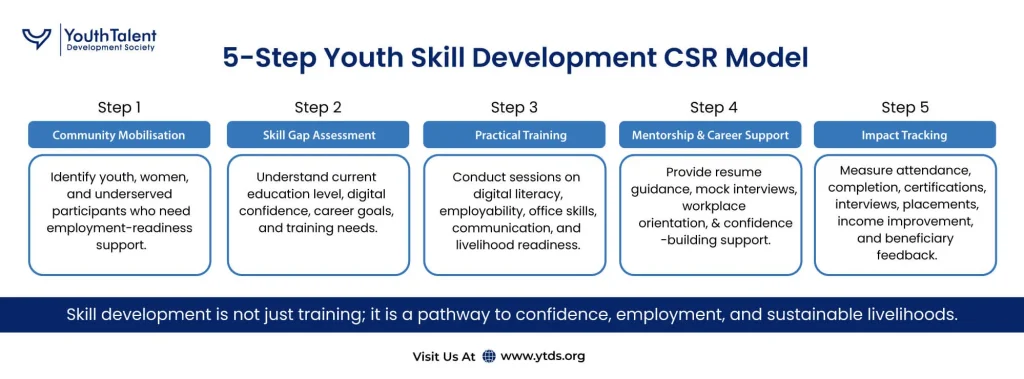
NGOs play an important role in identifying beneficiaries, mobilising communities, conducting training, and tracking outcomes. A corporate may have the CSR budget, but NGOs often have local trust and implementation experience.
A good NGO partner can help with:
- Community outreach
- Beneficiary selection
- Training delivery
- Volunteer engagement
- Documentation
- Impact reports
- Follow-up with trained candidates
This helps CSR teams convert budgets into visible and measurable outcomes.
How Companies Can Measure Skill Development CSR Impact
For CSR programs, impact measurement is as important as implementation. Companies should not measure only the number of sessions conducted. They should measure whether the training created real progress for participants.
Useful impact indicators include:
- Number of youth enrolled
- Attendance rate
- Completion rate
- Number of women participants
- Assessment scores before and after training
- Certifications completed
- Number of resumes created
- Number of interviews attended
- Internship or placement opportunities generated
- Income improvement after 3 to 6 months
- Number of youth starting self-employment
- Beneficiary feedback
- Employer feedback
These indicators help companies understand whether the program created meaningful livelihood impact.
How to Extend World Youth Skills Day Beyond a One-Day Event
World Youth Skills Day can be used as a starting point for a longer youth-development program rather than ending with a single awareness session or workshop. Companies can follow the initial activity with structured training, mentoring, practical assignments, apprenticeships, career guidance or placement support.
CSR teams can also define follow-up milestones such as course completion, skill assessments, interviews attended, internships, placements or self-employment outcomes. This helps connect a seasonal World Youth Skills Day initiative with measurable progress over the following months.
How YTDS Supports Youth Skill Development and Employment
Youth Talent Development Society works across four core areas: Environment, Empowerment, Education, and Employment. Through youth-led action and community-based programs, YTDS focuses on creating practical development opportunities for individuals and communities.
In the area of employment, YTDS supports skill-building, digital awareness, livelihood readiness, and practical training initiatives that help youth and women become more confident, capable, and employable.
YTDS also works with CSR partners, volunteers, institutions, and communities to design programs that are structured, measurable, and aligned with real social needs.
For companies planning World Youth Skills Day 2026 initiatives, YTDS can support programs such as:
- Youth skill development workshops
- Digital literacy sessions
- Employability bootcamps
- Women-focused livelihood training
- Cyber safety and responsible technology awareness
- Career guidance and mentorship
- Community-based employment readiness programs
The goal is simple: help young people gain skills that lead to confidence, opportunity, and sustainable livelihoods.
Conclusion
World Youth Skills Day 2026 is more than an awareness day. It is an opportunity for companies, NGOs, institutions, and communities to work together for India’s youth.
When CSR programs invest in youth skill development, they create impact that lasts beyond a single event. A young person who learns a practical skill can access employment, support a family, contribute to the economy, and inspire others in the community.
As the future of work continues to evolve, skill development must become practical, inclusive, and measurable. By supporting youth with digital skills, job-readiness training, mentorship, livelihood skills, and placement pathways, CSR teams can create real change.
YTDS invites CSR partners, volunteers, and institutions to collaborate on youth skill development initiatives that turn potential into opportunity.
Partner with YTDS to build future-ready youth through skill development, employment readiness, and community-led impact.
FAQs
1. What is World Youth Skills Day 2026?
World Youth Skills Day is observed every year on 15 July. It highlights the importance of equipping young people with skills for employment, decent work, and entrepreneurship.
2. What is the theme of World Youth Skills Day 2026?
The theme for World Youth Skills Day 2026 is “Skills for a shared future.” It focuses on preparing young people with future-ready skills for inclusive, peaceful, and sustainable societies.
3. Why should companies support youth skill development through CSR?
Companies should support youth skill development because it creates long-term livelihood impact. Skill programs improve employability, support income generation, reduce social inequality, and help build a stronger workforce.
4. What are the best CSR ideas for youth skill development in India?
Some effective ideas include digital literacy workshops, employability bootcamps, Tally and office-skills training, apprenticeship-readiness programs, women’s livelihood training, career guidance sessions, and community skill labs.
5. How can CSR teams measure skill development impact?
CSR teams can measure impact through enrolment, attendance, completion rate, certifications, interviews attended, placements, internships, income improvement, women participation, and beneficiary feedback.
6. How can companies use World Youth Skills Day for CSR?
Companies can use World Youth Skills Day to launch or strengthen youth-focused CSR initiatives such as skill-development batches, employability bootcamps, digital literacy training, apprenticeship readiness, career guidance and livelihood programs. The strongest initiatives continue beyond 15 July with training, mentoring, follow-up and measurable employment outcomes.