






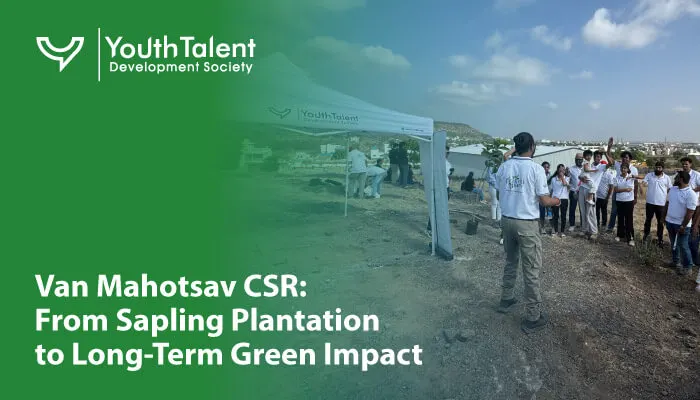
Van Mahotsav 2026 gives companies a timely opportunity to turn environmental responsibility into visible community action. Celebrated every year from 1 July to 7 July, Van Mahotsav is known as India’s annual tree-planting festival. It was launched in 1950 by Shri K. M. Munshi, the then Union Minister for Agriculture and Food, to encourage tree plantation and environmental awareness across the country.
For CSR teams, Van Mahotsav is more than a symbolic plantation week. It is a practical moment to bring employees, communities, schools, NGOs, and local stakeholders together for climate action, biodiversity protection, and long-term green impact.
However, a successful tree plantation CSR activity is not only about planting saplings. It is about choosing the right site, planting the right species, protecting young trees, monitoring survival, and reporting impact transparently.
That is where structured planning matters.
What Is Van Mahotsav?
Van Mahotsav means “festival of trees.” It is celebrated across India from 1 July to 7 July every year. During this week, plantation drives are organised in schools, colleges, communities, public spaces, institutions, and corporate CSR programs.
The purpose of Van Mahotsav is to encourage people to plant more trees and understand the role of forests in maintaining ecological balance. Trees help reduce heat, prevent soil erosion, support biodiversity, improve air quality, conserve water, and create healthier local environments.
For companies, this week creates the right context to plan meaningful CSR tree plantation activities with employee participation and measurable outcomes.
Why Van Mahotsav Matters for Corporate CSR
Environmental CSR has become an important part of responsible business. Companies are increasingly expected to go beyond donations and create measurable social and environmental value.
India’s CSR ecosystem is also growing. According to a Ministry of Corporate Affairs update shared by PIB, CSR expenditure reported by companies crossed ₹1,44,159 crore over five financial years from 2019–20 to 2023–24.
This creates a strong opportunity for companies to direct CSR funds toward environmental programs that are planned, trackable, and community-linked.
Van Mahotsav matters for CSR because it helps companies:
- Promote environmental awareness
- Engage employees in volunteering
- Support local biodiversity
- Create community participation
- Contribute to climate action
- Build green spaces in urban and rural areas
- Generate measurable ESG and CSR impact
A well-executed Van Mahotsav CSR activity can also strengthen the company’s connection with local communities.
Practical Van Mahotsav CSR Ideas for Companies
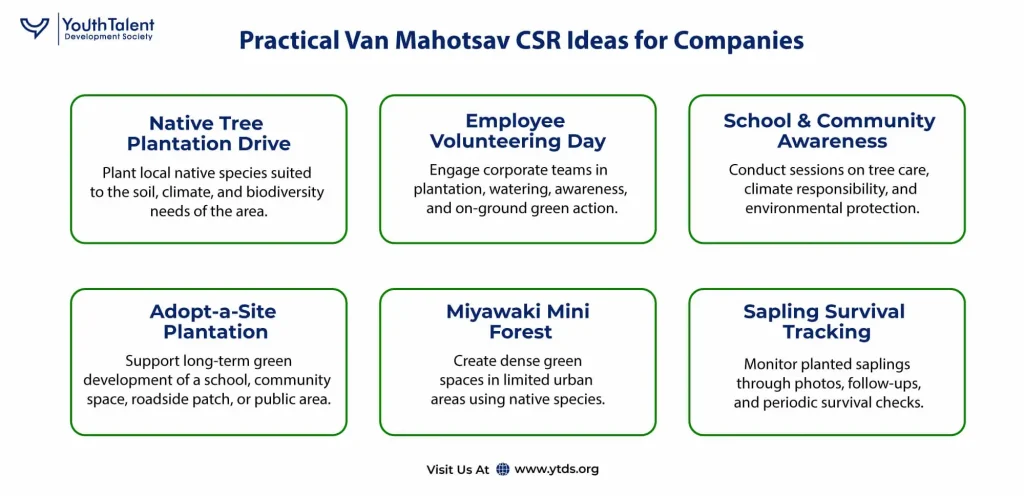
Companies can celebrate Van Mahotsav in many ways. The best activities are those that combine plantation with awareness, care, and long-term monitoring.
1. Native Tree Plantation Drive
A native tree plantation drive is one of the most effective CSR activities for Van Mahotsav. Native species are better suited to local soil, rainfall, and climate conditions. They also support birds, insects, and local biodiversity.
Instead of planting random ornamental trees, companies should work with local experts or NGOs to select species that have better survival potential.
A good plantation drive should include:
- Site assessment
- Native species selection
- Pit preparation
- Sapling arrangement
- Employee participation
- Watering and mulching
- Tree guards where needed
- Survival monitoring
2. Employee Volunteering Plantation Day
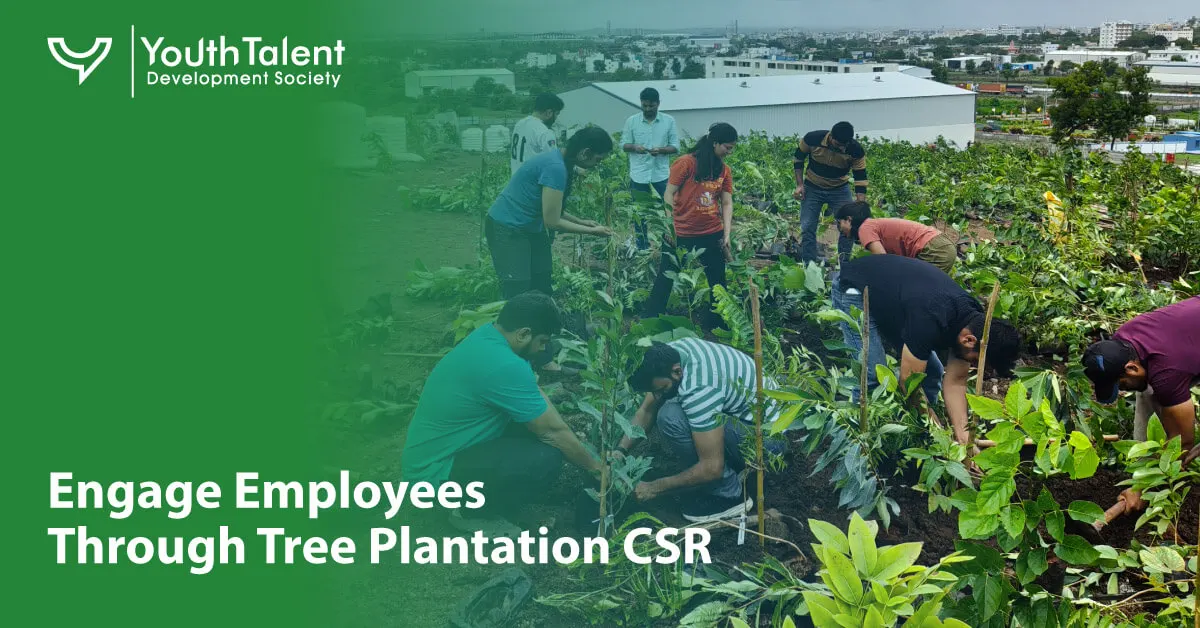
Van Mahotsav is a strong opportunity to involve employees in direct environmental action. Corporate teams can participate in plantation drives at schools, public spaces, community areas, or selected CSR project sites.
Employee volunteering adds emotional value to the CSR activity. It helps teams understand the importance of environmental responsibility and creates a stronger connection with the project.
Companies can also include short awareness sessions before the plantation activity so employees understand why species selection, planting depth, watering, and aftercare matter.
3. School or Community Awareness Session
Tree plantation becomes more effective when communities understand why trees matter. Companies can support awareness sessions in schools, colleges, and local communities during Van Mahotsav week.
Topics can include:
- Importance of trees
- Climate change awareness
- Native species
- Waste reduction
- Water conservation
- Tree care after plantation
- Role of students and citizens in protecting green spaces
This helps turn plantation from a one-day activity into a community-led movement.
4. Adopt-a-Site Plantation Project
Instead of organising a one-time plantation event, companies can adopt a site for long-term green development. This could be a school campus, village area, roadside patch, public ground, community space, or institutional campus.
An adopt-a-site model allows companies to track real progress over time.
It can include:
- Plantation planning
- Soil improvement
- Sapling protection
- Periodic watering
- Maintenance visits
- Survival tracking
- Impact reporting
This model is especially useful for companies that want long-term CSR impact instead of one-day visibility.
5. Miyawaki Mini Forest
A Miyawaki mini forest can be a high-impact urban CSR activity. It uses dense planting with native species to create fast-growing green patches in limited spaces.
Companies can support Miyawaki forests in schools, communities, industrial areas, office campuses, or urban public spaces.
This activity is suitable where land is limited but the goal is to create dense biodiversity zones. It can also become a strong employee volunteering and environmental education initiative.
6. Sapling Donation With Survival Tracking
Many plantation activities fail because saplings are distributed without follow-up. A better approach is sapling donation with survival tracking.
Companies can distribute saplings to schools, communities, employees, or local families and then track their growth through photos, updates, or periodic check-ins.
This makes the activity more accountable.
A simple tracking model can include:
- Sapling recipient name
- Species name
- Location
- Photo at distribution
- Follow-up photo after 30, 60, and 90 days
- Survival status
7. Tree Care and Maintenance Pledge
Plantation is only the first step. Tree care decides whether the CSR activity creates real impact.
Companies can run a “tree care pledge” with employees, students, volunteers, and community members. Each participant or group can take responsibility for watering, protecting, and monitoring selected saplings.
This creates shared ownership and improves survival rates.
8. Plantation Impact Report With Photos and Geo-Tagging
CSR teams need documentation for internal reporting, stakeholder communication, and annual CSR records. Therefore, every Van Mahotsav plantation drive should include impact documentation.
A useful report can include:
- Date and location
- Number of saplings planted
- Species list
- Employee volunteers involved
- Community beneficiaries
- Before-and-after photos
- Geo-tagged images
- Survival monitoring plan
- Maintenance schedule
This helps companies prove that the activity was properly executed and not just conducted for photo opportunities.
How to Make a Van Mahotsav Plantation Drive Successful
A successful plantation drive requires planning before the event and care after the event.
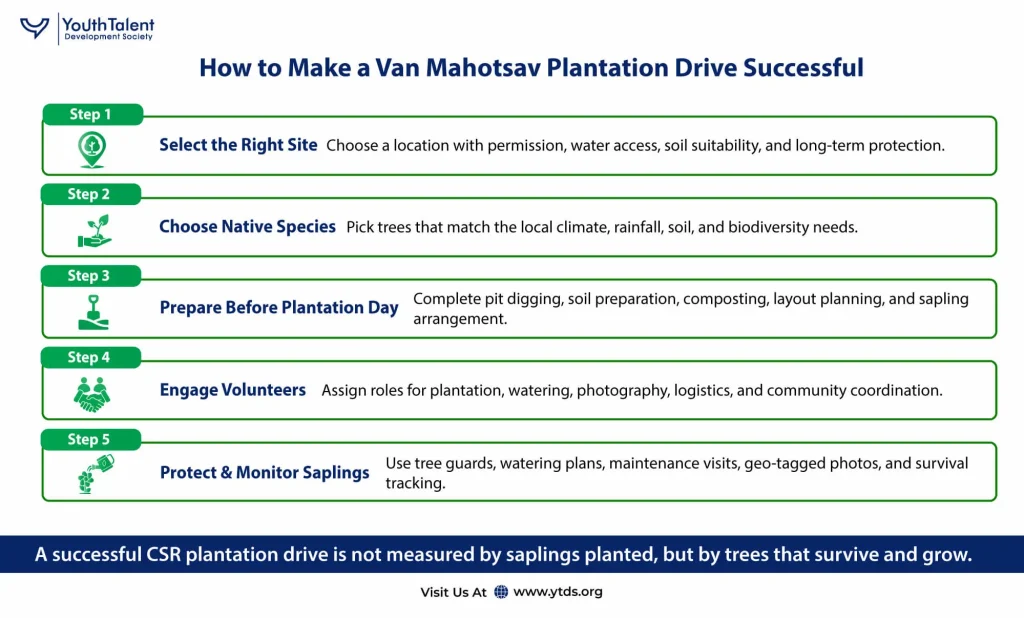
Here are the key steps companies should follow.
1. Select the Right Site
Choose a site where saplings have enough space to grow. Avoid areas where trees may be removed later due to construction, road expansion, or lack of ownership.
The site should have:
- Clear permission
- Water availability
- Soil suitability
- Protection from grazing or damage
- Long-term maintenance support
2. Choose Local Native Species
Native trees usually survive better because they are adapted to local conditions. They also support local biodiversity.
Species selection should depend on:
- Region
- Soil type
- Rainfall
- Water availability
- Space available
- Purpose of plantation
For example, shade trees, fruit trees, biodiversity-supporting trees, and soil-protection species may all serve different purposes.
3. Prepare the Site Before Plantation Day
Pit digging, soil preparation, composting, and layout planning should happen before the main event. This avoids confusion on the actual plantation day and ensures that employees or volunteers can participate smoothly.
4. Plan Volunteer Roles
Employee volunteering becomes more effective when roles are clear.
Assign roles such as:
- Registration support
- Sapling placement
- Plantation support
- Watering team
- Photography and documentation
- Community coordination
- Safety and logistics support
5. Protect the Saplings
Saplings are vulnerable during the first few months. Tree guards, mulching, watering, and protection from animals or accidental damage can improve survival.
6. Monitor Survival After Plantation
A plantation drive should not end on the same day. CSR teams should plan follow-up visits to check survival and maintenance.
Survival tracking should ideally be done after:
- 30 days
- 60 days
- 90 days
- 6 months
- 1 year
This creates accountability and helps companies understand the real impact of the project.
What CSR Teams Should Track After Tree Plantation
CSR tree plantation impact should be measured clearly. Counting only the number of saplings planted is not enough.
Companies should track:
- Number of saplings planted
- Species used
- Location and site details
- Number of employee volunteers
- Number of community participants
- Survival rate
- Maintenance visits
- Geo-tagged photos
- Watering and care plan
- Community ownership
- Estimated environmental benefit
- Final impact report
These metrics help CSR teams move from activity-based reporting to outcome-based reporting.
Common Mistakes Companies Should Avoid
Many plantation drives look successful on the event day but fail later because of poor planning. Companies should avoid these common mistakes:
- Planting non-native or unsuitable species
- Choosing sites without long-term permission
- Planting saplings without water access
- Ignoring soil preparation
- Skipping tree guards where protection is needed
- Treating plantation as a one-day photo event
- Not tracking survival rate
- Not assigning maintenance responsibility
A successful Van Mahotsav CSR program should focus on survival, care, and long-term environmental value.
How YTDS Can Support Van Mahotsav CSR Drives
Youth Talent Development Society works across Environment, Empowerment, Education, and Employment. Through community-led and volunteer-driven initiatives, YTDS supports practical CSR programs that create measurable impact.
For Van Mahotsav CSR activities, YTDS can support companies with:
- Plantation drive planning
- Site coordination
- Native species selection support
- Volunteer mobilisation
- Community engagement
- Plantation execution
- Photo documentation
- Follow-up monitoring
- Impact reporting
YTDS helps companies move beyond symbolic plantation and build structured green initiatives that are practical, measurable, and community-connected.
Conclusion
Van Mahotsav 2026 is the right moment for companies to take meaningful environmental action. But the real success of a plantation drive is not measured only by how many saplings are planted. It is measured by how many survive, how well they are cared for, and how much value they create for the environment and community.
Companies that plan Van Mahotsav CSR activities with proper site selection, native species, employee volunteering, sapling care, and impact tracking can create long-term green outcomes.
By partnering with NGOs like YTDS, CSR teams can make plantation drives more structured, accountable, and impactful.
Partner with YTDS to plan and execute Van Mahotsav CSR tree plantation drives that grow beyond one day and create long-term environmental impact.
FAQs
1. When is Van Mahotsav 2026?
Van Mahotsav is celebrated every year from 1 July to 7 July across India. It is known as India’s annual tree-planting festival.
2. Why is Van Mahotsav celebrated?
Van Mahotsav is celebrated to promote tree plantation, reforestation, environmental awareness, and public participation in protecting nature.
3. What are the best Van Mahotsav CSR ideas for companies?
Some effective Van Mahotsav CSR ideas include native tree plantation drives, employee volunteering, school awareness sessions, adopt-a-site plantation projects, Miyawaki mini forests, sapling donation with survival tracking, and tree care pledges.
4. Why is monsoon suitable for tree plantation?
Monsoon supports tree plantation because rainfall helps young saplings receive natural water during the early growth stage. However, proper site selection, soil preparation, and aftercare are still important.
5. How can companies measure CSR tree plantation impact?
Companies can measure impact through number of saplings planted, species used, survival rate, employee volunteers, community participation, geo-tagged photos, maintenance visits, and impact reports.
6. Can NGOs help companies organize Van Mahotsav plantation drives?
Yes. NGOs can help companies identify sites, mobilise communities, coordinate volunteers, select suitable saplings, execute plantation drives, monitor survival, and prepare impact documentation.