







Over the past few years, the landscape of education in India has undergone a massive digital transformation. Driven by the availability of affordable mobile data and accessible devices, classrooms in both urban centers and adopted Tier-2 or Tier-3 schools have increasingly integrated digital learning. Today, a student’s smartphone is no longer just a luxury-it is their primary portal to textbooks, homework, and global information.
However, this rapid digital acceleration has bypassed a critical foundational step: comprehensive digital safety training.
While young students are highly comfortable navigating app interfaces, they possess minimal understanding of data privacy, digital footprints, online financial fraud, or social engineering.
When corporate boards plan their tech-focused digital literacy csr initiatives, funding standard computer hardware is no longer enough. If a student does not know how to handle an unsafe web link, a donated device can quickly turn into a security risk.
To bridge this critical vulnerability, our #ThinkBeforeYouClick campaign provides a structured, highly practical framework that turns passive mobile users into secure, cyber-aware digital citizens.
The Digital Literacy Gap: Tech Access vs. Security Awareness
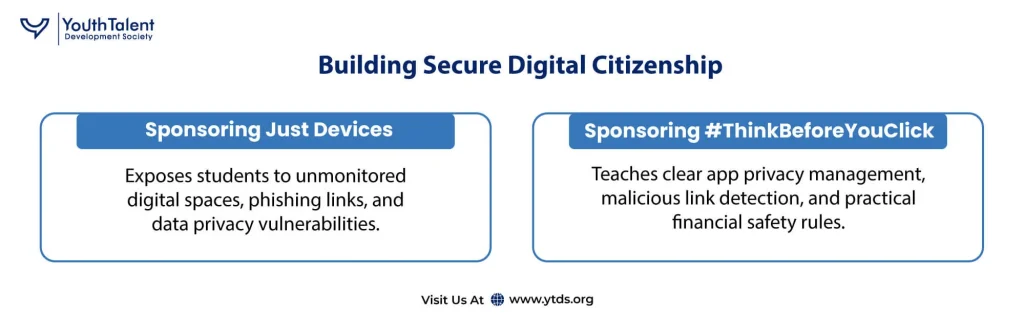
Distributing digital devices without teaching core digital safety creates an operational blind spot. When assessing community impact, it is essential to look at the differences between standard hardware distribution and an active digital hygiene training model:
| CSR Program Approach | Immediate Delivery | Hidden Risk Vector | Long-Term Student Impact |
|---|---|---|---|
| Hardware-Only Donations (e.g., Distributing tablets or laptops) | Provides physical access to digital tools and applications. | Students are left exposed to cyberbullying, malware, and social engineering due to a lack of guidance. | High rate of device misuse or neglect; fails to build safe internet habits. |
| Active Cyber-Hygiene Workshops (e.g., #ThinkBeforeYouClick Model) | Delivers practical, case-study-driven digital safety protocols. | None. Teaches defensive browsing, privacy optimization, and threat validation techniques. | Builds life-long digital resilience; creates self-reliant users who protect their personal data. |
Inside the #ThinkBeforeYouClick Curriculum Blueprint
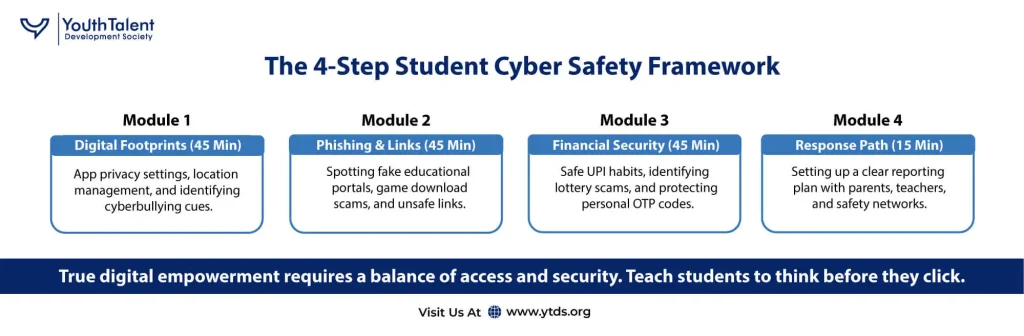
The #ThinkBeforeYouClick program is designed specifically for schools and colleges, translating complex cybersecurity concepts into clear, actionable rules that students can use immediately on their mobile devices:
1. Digital Footprints & Boundary Management: Module 1: 45 Mins.
Students learn that everything shared online leaves a permanent trace. Instructors demonstrate how to configure privacy settings on mobile applications, manage location permissions, and identify online grooming or cyberbullying red flags.
2. Phishing, Links & Malware Recognition: Module 2: 45 Mins.
Using real-world visual examples, this module teaches students how to spot fake educational websites, malicious download links masquerading as mobile games, and suspicious WhatsApp forward messages designed to steal data.
3. Financial Fraud & UPI Safety Basics: Module 3: 45 Mins.
As young students increasingly handle micro-transactions and online fees, we teach them the rules of basic financial safety. This covers identifying fake lottery scams, protecting OTP codes, and navigating digital payment gateways securely.
4. The Student Cyber-Shield Pledge: Module 4: 15 Mins.
The session wraps up with practical step-by-step guidance on how to report online harassment to parents, teachers, or national cybercrime portals, leaving every student with an actionable personal response strategy.
The Strategic Alignment: Why Your Tech Board Should Sponsor Digital Safety
Sponsoring a targeted cyber safety awareness for students campaign allows your organization to align its corporate identity with a highly impactful social cause:
1. Direct Alignment with Corporate Information Security Values
For technology, software, and banking companies, cybersecurity is an essential daily focus. Sponsoring a campaign like #ThinkBeforeYouClick allows your firm to extend its professional expertise directly into community welfare, making your CSR profile stand out on annual sustainability reports. To see how these targeted safety initiatives strengthen your external brand presence, read our analysis on Why Self-Defence Training is Important for Women in India.
2. High-Impact, Auditable Educational Metrics
Unlike open-ended social spending, a digital safety workshop provides distinct, measurable results. Your CSR committee can easily track the exact number of students certified, the volume of local schools reached, and pre-versus-post training safety scores, providing clear, auditable data for board reviews. To align these training metrics with your broader community development goals, review our reporting framework in How to Measure the Impact of Tree Plantation CSR Projects.
3. Creating a Safe Foundation for School Adoption Programs
If your organization is already backing long-term school adoption plans, adding digital hygiene training is a natural next step to maximize that investment. Integrating digital safety workshops with infrastructure support ensures that your digital labs and smart classrooms remain safe learning environments. To see how structured school support platforms manage these layered programs across the academic year, check out our piece on How Mentorship Programs Drive Women Empowerment in CSR Initiatives.
The Bottom Line for Innovative Tech Leaders:
True digital empowerment requires a balance of access and security. By funding a structured, proactive campaign like #ThinkBeforeYouClick, your company provides the next generation with the critical tools and awareness needed to navigate the digital world safely and confidently.