






When corporate sustainability teams across India plan their environmental CSR allocations, they face a severe real estate bottleneck. Rapid industrialization and expanding tech parks mean that finding massive, contiguous acres of land for traditional afforestation is nearly impossible near major tier-1 and tier-2 cities.
This land constraint is exactly why forward-thinking corporate boards are pivoting toward the Miyawaki forest method for their Corporate Social Responsibility (CSR) portfolios.
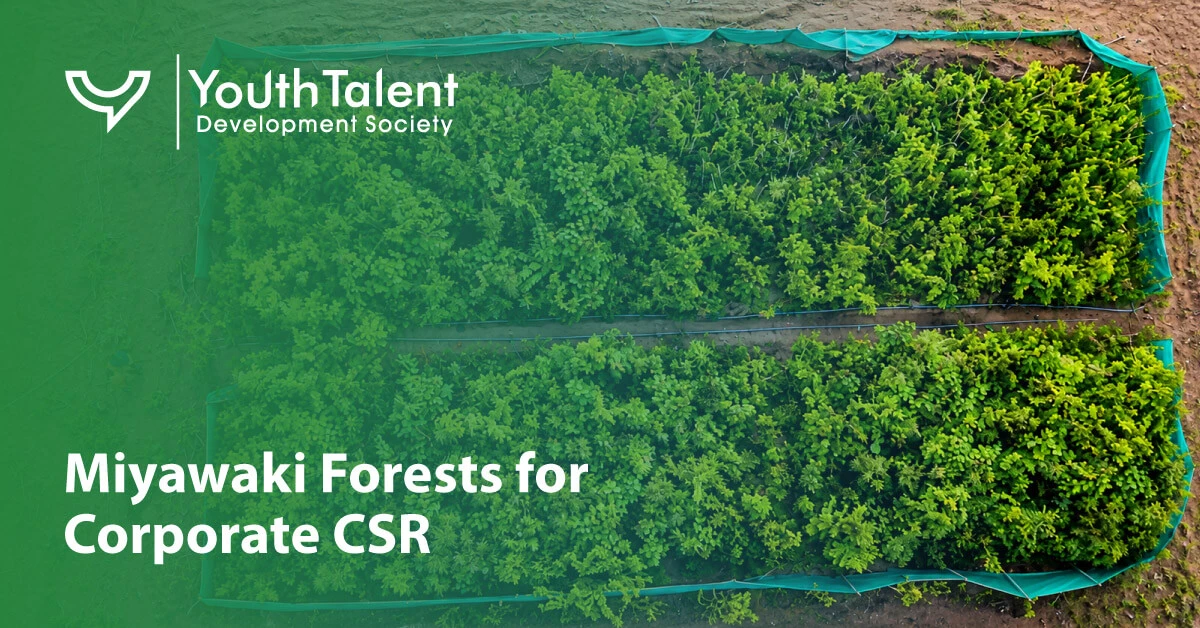
Developed by Japanese botanist Dr. Akira Miyawaki, this specialized afforestation technique allows companies to build ultra-dense, native mini-forests in highly restricted urban patches. By transforming an unused factory corner, a tech park boundary, or an urban wasteland into a self-sustaining ecosystem, companies can achieve a century’s worth of forest growth in just ten years.
The Miyawaki Advantage: Why Indian Corporates are Choosing Density
Traditional tree plantation drives often suffer from low survival rates and require continuous, expensive maintenance for 5 to 7 years. The Miyawaki method solves these corporate execution bottlenecks through a highly scientific, multi-layered planting strategy.
When you plant native shrubs, sub-trees, trees, and canopy species in close proximity, the natural competition triggers rapid ecological development:
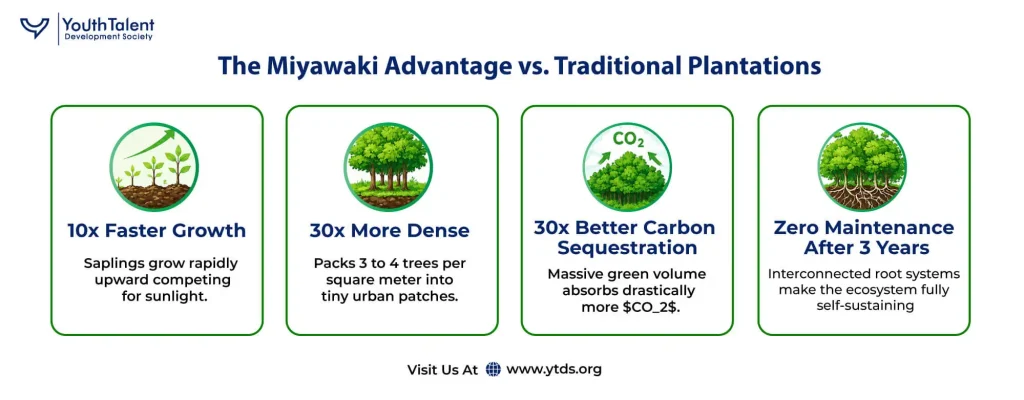
- 10x Faster Growth: Because saplings are planted closely, they compete intensely for sunlight, drastically accelerating their vertical growth rate.
- 30x More Dense: A Miyawaki pocket accommodates up to 3 trees per square meter, packing an immense amount of green cover into tiny footprints.
- 30x Better Carbon Sequestration: Higher density means a significantly larger volume of carbon dioxide is absorbed per square foot compared to conventional, sparse planting lines.
- 100% Native & Self-Sustaining: The methodology relies exclusively on indigenous species. Once the root systems interconnect underground to share nutrients, the forest requires zero maintenance after 3 years.
For an NGO implementation team, this translates into an exceptionally high survival rate—frequently exceeding 95%—giving corporate donors visible, undeniable proof of impact within just 12 to 18 months.
Technical Specifications: The 4-Layer Ecosystem Structure
A true Miyawaki forest is not just a random collection of plants; it replicates the precise structural hierarchy of a mature, ancient Indian jungle. When selecting saplings for an industrial or corporate site in regions like Maharashtra or NCR, the plantation must be balanced across four distinct layers:
Step-by-Step Corporate Implementation Framework
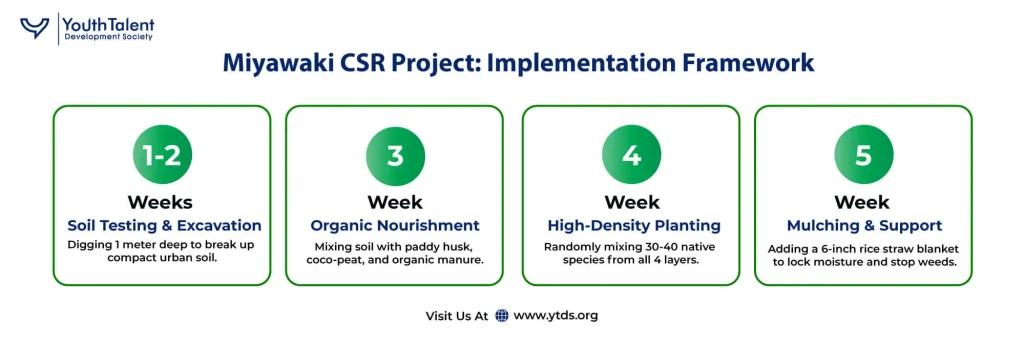
Executing a successful Miyawaki project requires a precise, engineering-driven approach rather than a standard casual planting event. To maximize survival rates on urban soil, the implementation follows a strict sequence:
1. Soil Testing and Deep Excavation: Weeks 1-2
Urban corporate land is frequently compacted or filled with construction debris. The target area must be excavated down to a depth of 1 meter. The soil is completely loosened to ensure young roots can spread rapidly without meeting dense resistance.
2. Biomass and Organic Nourishment: Week 3
To fix water retention and air perforation, the native soil is mixed heavily with local organic materials. This includes mixing agricultural by-products like paddy husk or coco-peat for water retention, and organic vermicompost or cow manure for immediate nutrition.
3. High-Density Layered Planting: Week 4
Saplings are planted at a very high density of 3 to 4 plants per square meter. Species from the 4 distinct layers are mixed randomly across the patch to prevent plants with identical root depths from competing directly with one another.
4. Thick Mulching and Support: Week 5
The entire ground surface is covered with a thick, 6-inch layer of organic mulch (such as rice straw). This acts as a protective blanket that prevents water evaporation, keeps the soil cool, and stops invasive weeds from choking the young saplings.
Boardroom Alignment: Justifying Miyawaki to Your Leadership
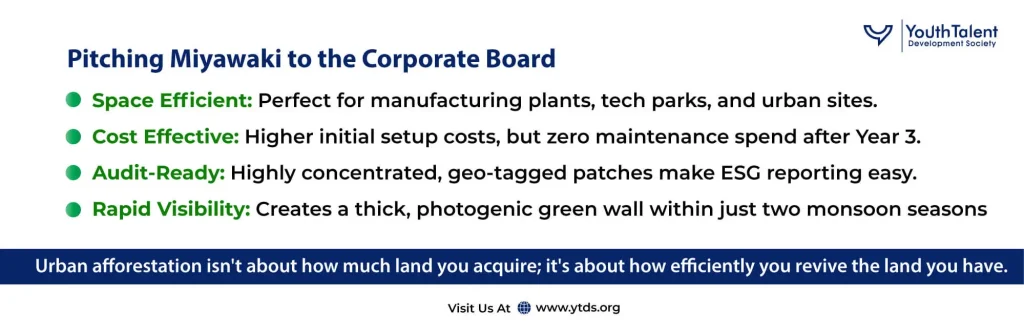
When presenting a Miyawaki afforestation proposal to your corporate board or CSR committee, the project should be framed around compliance, cost-efficiency, and brand visibility.
1. Superior Cost-per-Survival Ratio
While the initial cost per square meter for soil preparation and high-density saplings is higher than a standard open-ground plantation, the long-term maintenance costs drop to zero after year three. Because the survival rate is immensely higher, the ultimate cost per surviving tree is significantly lower. For a complete financial breakdown of initial setups vs. long-term care, review our analysis on CSR Tree Plantation Cost in India.
2. Tangible, Measurable ESG Metrics
Under Schedule VII of the Companies Act, corporate sustainability data must be easily verifiable. Miyawaki forests allow for highly concentrated, geo-tagged reporting where biomass growth, biodiversity return, and canopy density can be tracked accurately month-over-month. To build a solid tracking framework for your next compliance audit, read our guide on How to Measure the Impact of Tree Plantation CSR Projects.
3. Immediate Brand Visibility & Carbon Offsetting
Traditional forests take decades to show up on satellite imagery or corporate drone footage. A Miyawaki forest creates a thick, photogenic green wall within two monsoon seasons, making it an excellent centerpiece for employee engagement drives and environmental corporate storytelling.
To understand how these dense pockets translate directly into carbon credits, explore our briefing on Tree Plantation and Carbon Offset in India: What CSR Teams Should Know.
The Bottom Line for CSR Leaders:
Urban afforestation is no longer about how much land you can acquire; it is about how efficiently you can revive the land you already have. By implementing a Miyawaki mini-forest, your organization can create a highly visible, zero-maintenance ecological legacy right inside your local community.